Many people use reply and response as if they mean the same thing. It feels natural, so the mistake often goes unnoticed. However, these two words carry slightly different meanings, tones, and uses. That small difference can change how your message sounds, especially in emails, professional writing, or customer communication.
Writers often confuse them when answering messages, comments, or questions. Students, ESL learners, and even professionals mix them in formal writing. This confusion matters because word choice affects clarity, tone, and intent. A casual reply may sound too weak in a formal report, while a formal response may feel too heavy in a simple chat.
In this guide, you will learn the exact difference between reply vs response, when to use each word, and how to avoid common mistakes. The goal is simple: help you choose the right word every time without thinking too hard.
Reply vs Response – Quick Answer
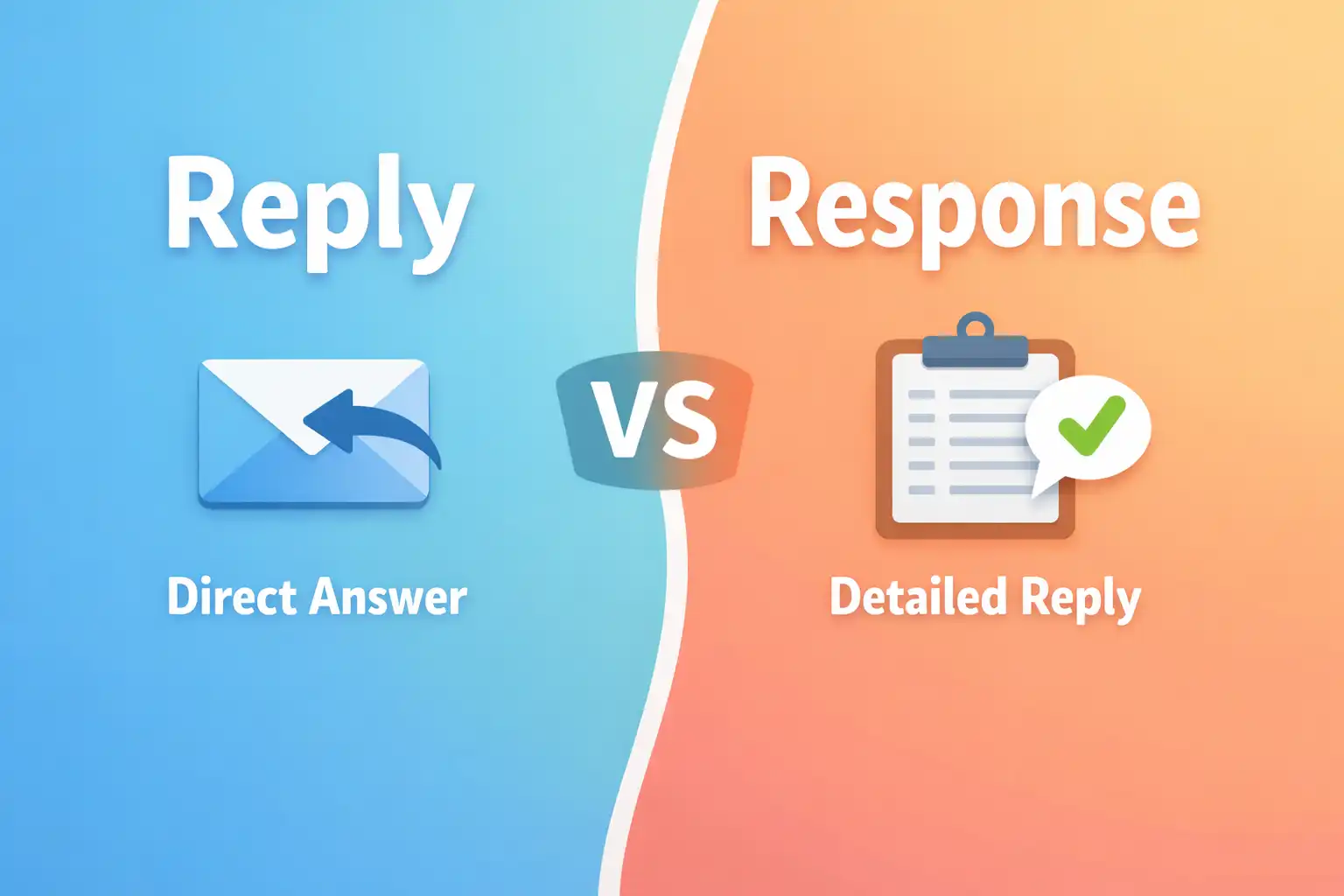
A reply is a direct answer to someone’s message or question. It is usually short and simple. A response is a broader reaction. It can include actions, feelings, or detailed answers.
- Use reply for quick communication
- Use response for formal or detailed situations
Examples:
- She replied to my email.
- The company gave a response to the issue.
Easy rule: If it is quick and direct, use reply. If it is detailed or formal, use response.
Meaning of Reply
A reply is a direct answer to a message, question, or statement.
- It is short and clear
- It is often used in daily communication
- It focuses on answering someone directly
Examples:
- I replied to his text.
- She replied with a simple “yes.”
Meaning of Response
A response is a reaction to something. It can be verbal, written, or even an action.
- It can be detailed or complex
- It is often used in formal or professional contexts
- It may include explanation or action
Examples:
- The manager gave a detailed response.
- His response showed concern.
The Origin of Reply vs Response
The word reply comes from the Latin word replicare, which means “to fold back” or “to answer.” Over time, it became a common word for direct answers in conversation.
The word response comes from the Latin respondere, meaning “to answer or react.” This word developed a broader meaning. It now includes not just answers, but also reactions, behaviors, and outcomes.
Because both words come from similar roots and both involve answering, people often confuse them. However, their usage has shifted over time. Today, reply feels more personal and direct, while response feels wider and more formal.
British vs American English Spelling
There is no spelling difference between British and American English for these words.
| Word | British English | American English |
| Reply | reply | reply |
| Response | response | response |
Both forms use the same spelling in all regions. Therefore, focus on usage, not spelling.
Examples:
- UK: Please reply soon.
- US: Please reply soon.
How to Choose the Right Word Fast
Choosing between reply and response is easy when you think about tone and purpose.
For US users:
Use reply in emails, chats, and quick answers. Use response in reports or formal writing.
For UK or Commonwealth users:
The same rule applies. The difference is not regional. It is based on context.
For global or professional writing:
Use response when writing formal documents, reports, or official statements. Use reply in casual or direct communication.
Quick tip:
- Email to a friend → reply
- Official company statement → response
Common Mistakes with Reply vs Response
Writers often mix tone and context. Here are common errors:
❌ Incorrect: I gave a quick response to his text.
✅ Correct: I gave a quick reply to his text.
Explanation: “Reply” fits better for short answers.
❌ Incorrect: The company replied to the crisis with a full plan.
✅ Correct: The company responded to the crisis with a full plan.
Explanation: “Response” fits better for actions or detailed reactions.
❌ Incorrect: Her response was just “okay.”
✅ Correct: Her reply was just “okay.”
Explanation: A short answer should use “reply.”
Editors usually see these mistakes in emails, blogs, and business writing.
Reply vs Response in Real Life Examples
Emails:
- Please reply to this email by tomorrow.
- We are waiting for your response regarding the proposal.
News:
- The minister responded to the issue.
- The spokesperson gave a response to the media.
Social Media:
- She replied to every comment.
- The brand responded to customer complaints.
Professional Writing:
- The report includes a response to feedback.
- The client replied with approval.
These examples show how tone changes based on context.
Reply vs Response – Word Usage Patterns and Search Trends
People search for reply vs response because both words appear in daily communication. Students, writers, and ESL learners want clarity. Professionals also need correct usage in emails and reports.
In general:
- “Reply” is more common in casual searches
- “Response” appears more in academic or business contexts
A common real-world issue happens in customer service. If a company says, “We will reply soon,” it sounds simple. But if it says, “We will provide a response,” it sounds more formal and serious. This small difference can affect customer trust and expectations.
Reply vs Response – Comparison Table
| Feature | Reply | Response |
| Meaning | Direct answer | Reaction or answer |
| Part of speech | Noun / Verb | Noun |
| Context of use | Informal or direct | Formal or broad |
| Tone | Simple, casual | Formal, detailed |
| Common mistake | Used in formal writing | Used for short answers |
| Correct example | She replied quickly | The company gave a response |
This table helps remove confusion quickly.
FAQs About Reply vs Response
Is reply the same as response?
No. A reply is direct and simple. A response is broader and often more formal.
Which one is correct in formal writing?
Use response in formal writing because it sounds more complete and professional.
Can they be used interchangeably?
Sometimes, but not always. Context decides the correct word.
Why do people confuse them?
Both words mean “answer,” so they seem similar at first.
Can grammar tools catch this mistake?
Not always. Many tools accept both words, even when one is better.
Is there a British vs American difference?
No. Both words are spelled and used the same in all regions.
Which is better for emails?
Use reply for simple emails and response for formal communication.
Conclusion
Understanding reply vs response is simple once you see the difference in tone and purpose. A reply is short, direct, and personal. A response is broader, more formal, and often more detailed. Both words are correct, but they fit different situations.
Writers often make one key mistake. They use “response” when a quick answer is enough, or they use “reply” in formal writing where more weight is needed. This can change how your message feels to the reader.
Overall, always think about the context before choosing the word. In short, use reply for quick answers and response for detailed or formal communication. Finally, remember this simple rule: if it is short and direct, choose reply. If it is detailed or formal, choose response.
