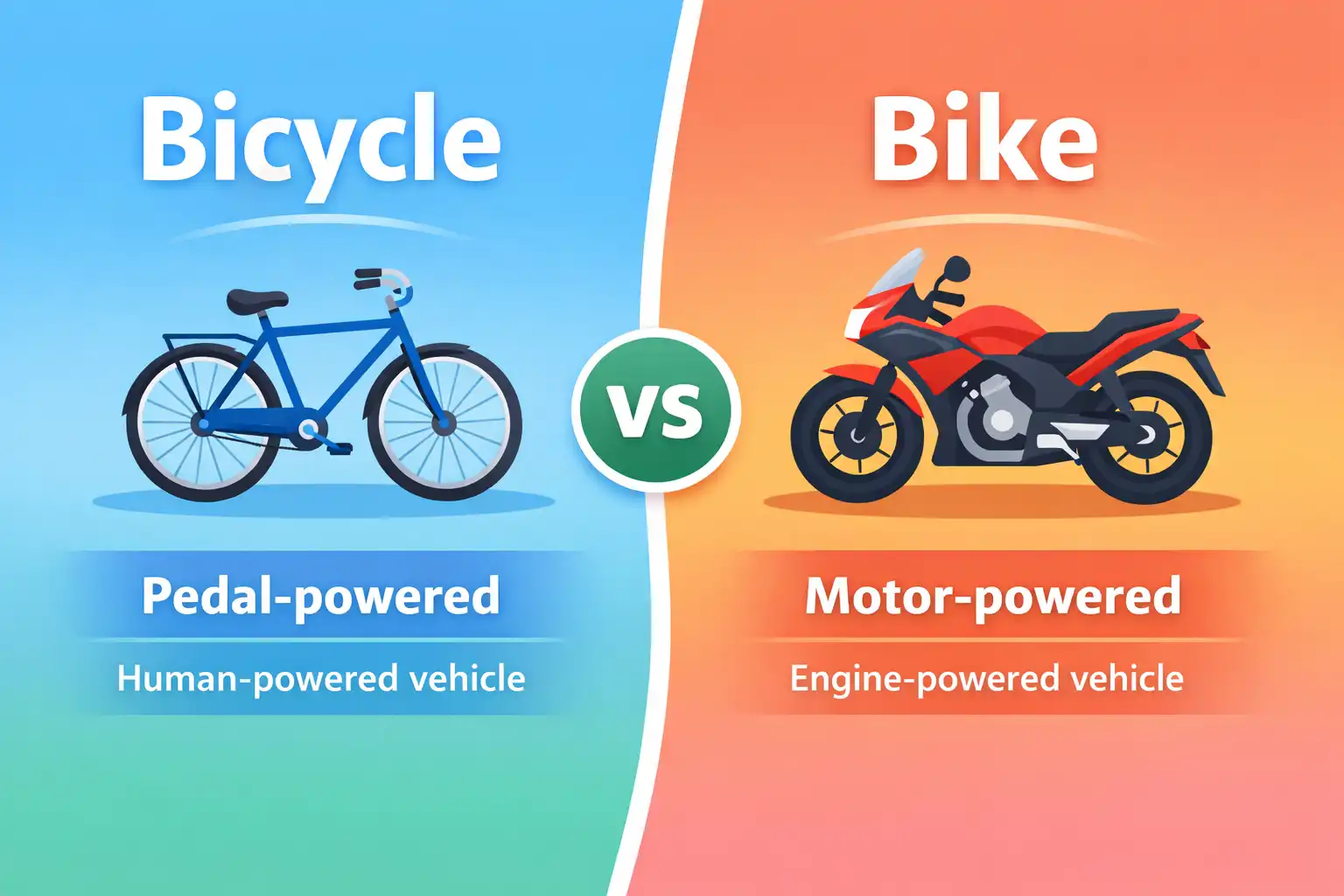
Many people search “bicycle vs bike” because both words look the same in daily use. You may hear “bike” in a casual chat, but see “bicycle” in a form or news article. So confusion happens. Some people think both always mean the same thing. Others think they are different vehicles.
This confusion matters because the wrong word can change meaning. For example, “bike” can mean a motorcycle too. That can lead to mistakes in writing, exams, or even safety instructions. Writers often mix them without thinking. Editors usually correct this based on context.
In this guide, you will learn the real difference in simple words. You will also see when to use each word, where mistakes happen, and how to avoid them in real life.
Bicycle vs Bike – Quick Answer
“Bicycle” is the full, formal word for a two-wheeled pedal vehicle.
“Bike” is a short, informal word. It can mean a bicycle or a motorcycle.
Meaning of Bicycle
- A human-powered vehicle with two wheels
- Used for transport or exercise
- Example: I ride my bicycle to school
Meaning of Bike
- Short form of bicycle
- Can also mean motorcycle
- Example: He bought a new bike
Easy rule: Use “bicycle” for clear and formal meaning. Use “bike” in casual speech, but check context.
The Origin of Bicycle vs Bike
The word bicycle comes from two parts. “Bi” means two, and “cycle” means wheel. So the word clearly describes a vehicle with two wheels. It became popular in the 1800s when early pedal machines were invented.
Later, people started using bike as a shorter form. Language often becomes shorter over time. So “bicycle” turned into “bike” in daily speech.
However, the word “bike” did not stay limited to bicycles. It also started to mean motorcycles. That is why confusion exists today.
Writers often confuse these words because spoken language is flexible. But written language needs clarity.
British vs American English Spelling
There is no spelling difference between “bicycle” and “bike” in British and American English. Both regions use the same spelling.
However, usage tone may change slightly.
| Context | UK Usage | US Usage |
| Formal writing | Bicycle | Bicycle |
| Casual speech | Bike | Bike |
| Motorcycle meaning | Bike (common) | Bike (common) |
So spelling is not the issue. The real difference is meaning and tone.
How to Choose the Right Word Fast
Choosing the right word is simple if you follow context.
For US users
- Use “bike” in casual talk
- Use “bicycle” in formal writing
For UK / Commonwealth users
- Same rule applies
- “Bike” is very common in speech
Global or professional writing
- Use “bicycle” for clarity
- Avoid confusion in documents
Quick tip: If there is any chance of confusion with a motorcycle, always use “bicycle.”
Common Mistakes with Bicycle vs Bike
Writers often make small but important mistakes.
❌ He parked his bike in the bicycle stand (unclear)
✅ He parked his bicycle in the bicycle stand
❌ The law applies to all bikes (unclear if motorcycles included)
✅ The law applies to all bicycles
These mistakes happen because “bike” has two meanings. So clarity is key.
Bicycle vs Bike in Real Life Examples
You will see these words in many real situations.
Emails
- Please store your bicycle in the parking area
- I will bring my bike today
News
- The city promotes bicycle use
- Bike sales increased this year
Social Media
- I love riding my bike at sunset
- Bicycle tours are growing fast
Professional Writing
- Bicycle safety rules are important
- Employees must not park bicycles inside
In formal writing, “bicycle” gives clear meaning. In casual content, “bike” feels natural.
Bicycle vs Bike – Word Usage Patterns and Search Trends
People often search “bicycle vs bike” because of mixed usage online. Students, ESL learners, and writers are the main users of this keyword.
“Bike” is more popular in daily searches because it is shorter. However, “bicycle” is more precise in formal content.
A real problem happens in safety rules. If a sign says “No bikes allowed,” people may not know if motorcycles are included. This can cause confusion.
So correct word choice improves clarity and avoids misunderstanding.
Comparison Table: Bicycle vs Bike
| Feature | Bicycle | Bike |
| Meaning | Two-wheeled pedal vehicle | Bicycle or motorcycle |
| Part of speech | Noun | Noun |
| Context of use | Formal and clear | Informal and flexible |
| Formal vs informal | Formal | Informal |
| Common mistakes | Rare confusion | Meaning unclear |
| Correct example | He rides a bicycle daily | He rides a bike to work |
This table helps you choose the right word quickly.
FAQs About Bicycle vs Bike
Is bicycle the same as bike?
Not always. Bicycle is specific. Bike can mean bicycle or motorcycle.
Which word is correct in formal writing?
“Bicycle” is correct because it is clear and precise.
Can they be used interchangeably?
Sometimes, but only when context is clear.
Why do people confuse them?
Because “bike” has two meanings and is widely used in speech.
Can grammar tools catch this mistake?
Most tools do not detect context confusion. You must check meaning yourself.
Is there a British vs American difference?
No. Both use the same words and spelling.
Is bike always informal?
Mostly yes, but it is accepted in casual writing.
Conclusion
Overall, the difference between bicycle vs bike is simple but important. “Bicycle” is clear, formal, and specific. It always means a two-wheeled pedal vehicle. On the other hand, “bike” is shorter and more casual. It can mean a bicycle, but it can also mean a motorcycle.
This is where confusion starts. Writers often use “bike” without thinking about context. So readers may misunderstand the meaning.
In short, use “bicycle” when you want clarity, especially in formal writing. Use “bike” in casual speech or when the meaning is obvious.
One easy rule to remember:
If confusion is possible, always choose “bicycle.”
