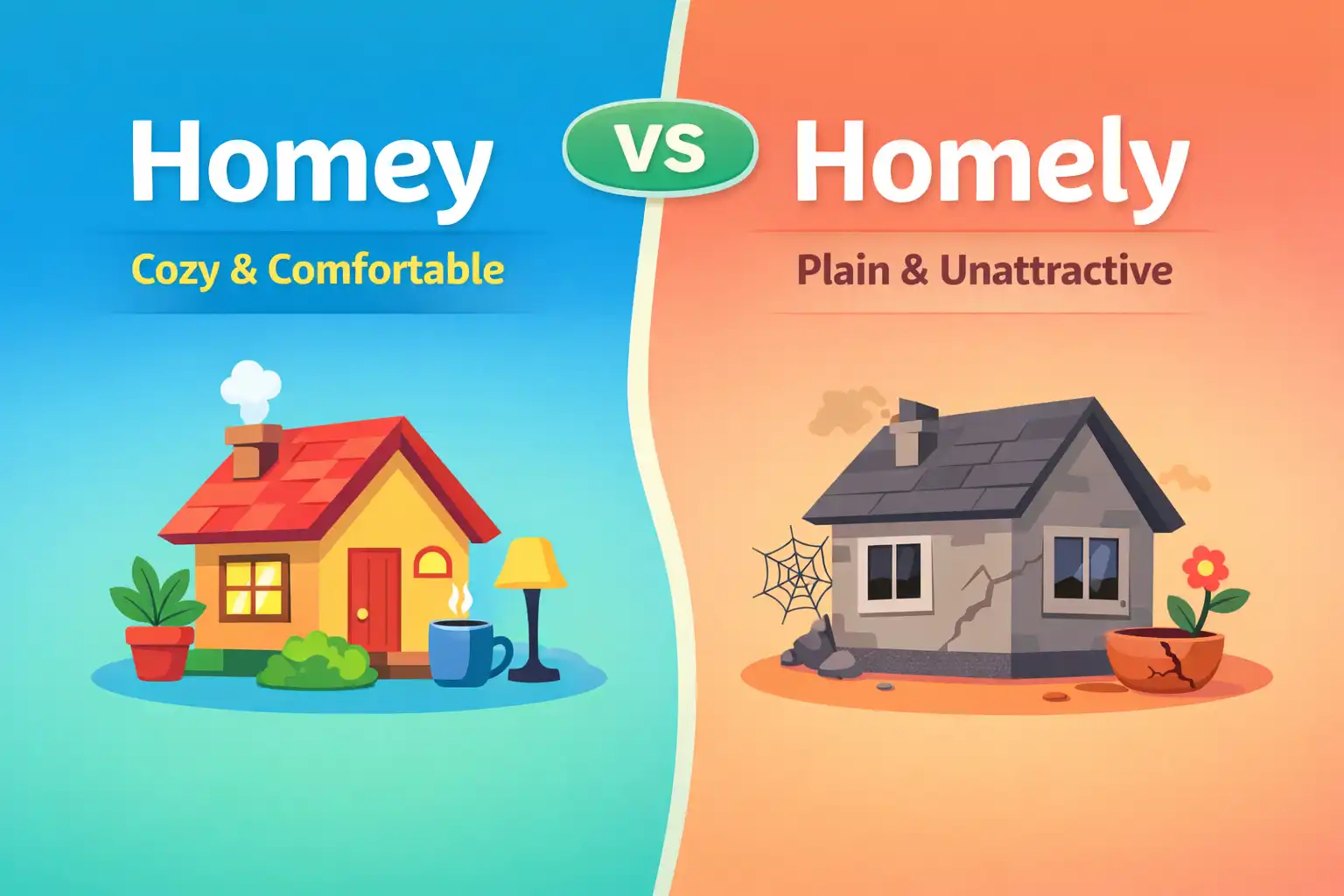
Many people get confused when they see homey and homely. At first, both words look similar. They even come from the word “home.” But their meanings are not the same. In fact, using the wrong one can completely change your sentence.
This confusion often happens in writing, emails, and even social media posts. Writers think both words describe comfort, but that is not always true. In some cases, homely can even sound negative, especially in American English. So, using the wrong word may send the wrong message.
In this guide, you will learn the real difference between homey vs homely. You will also see when to use each word, simple examples, and easy rules. By the end, you will never mix them up again.
Homey vs Homely – Quick Answer
Homey means comfortable, warm, and welcoming.
Homely means simple or plain, and in American English, it can mean unattractive.
Use homey for comfort and warmth.
Use homely for plain looks or simple style.
Meaning of Homey
- Warm and comfortable
- Feels like home
- Positive meaning
Examples:
- The room feels very homey.
- She made the place look homey with soft lights.
Meaning of Homely
- Simple or plain in style
- Not attractive (mainly US usage)
- Neutral or negative tone
Examples:
- The house looks homely but cozy.
- He described the town as small and homely.
Easy rule:
Use homey for comfort. Use homely for appearance.
The Origin of Homey vs Homely
Both words come from the base word “home.” However, their paths changed over time.
Homely is older. It started in Old English. It meant “simple” or “plain.” Later, in British English, it also gained a warm meaning like “comfortable.”
Homey came later, mostly in American English. It developed to clearly express comfort and warmth. Writers needed a word that always sounded positive, so homey became popular.
Today, the confusion exists because:
- Both words look similar
- Both relate to “home”
- Their meanings overlap in some regions
However, modern usage separates them clearly, especially in American English.
British vs American English Spelling
There is no spelling difference between homey and homely. The difference is in meaning and tone.
In American English:
- Homey = warm and cozy
- Homely = unattractive or plain
In British English:
- Homely can mean cozy and comfortable
- Homey is less common but still understood
Quick comparison:
Word | US Meaning | UK Meaning
Homey | Cozy, warm | Same meaning
Homely | Plain or unattractive | Cozy or simple
So, context matters a lot. If your audience is global, choose carefully.
How to Choose the Right Word Fast
Choosing the right word depends on your audience and purpose.
For US audience:
Use homey for comfort
Avoid homely unless you mean plain or unattractive
For UK or Commonwealth:
You can use homely for comfort
But still be careful with international readers
For global or professional writing:
Use homey when you mean cozy
Avoid homely unless clearly needed
Simple tip:
If you want a positive feeling, pick homey.
Common Mistakes with Homey vs Homely
Writers often mix these words because they sound similar. But small mistakes can change the meaning.
❌ The room looks homely and warm
✅ The room looks homey and warm
Explanation: “Homely” may sound negative in US English.
❌ She made her apartment very homely
✅ She made her apartment very homey
Explanation: “Homey” fits better for comfort.
❌ He lives in a homey but unattractive house
✅ He lives in a homely but unattractive house
Explanation: Here, “homely” works because it describes appearance.
Homey vs Homely in Real Life Examples
Understanding real usage helps you remember better.
Emails:
- We created a homey space for our guests.
- The design feels homey and inviting.
News:
- The café offers a homey atmosphere.
- The town has a homely charm.
Social media:
- Loving this homey vibe in my room
- Simple and homely design, but I like it
Professional writing:
- The hotel provides a homey environment.
- The building has a homely exterior.
Homey vs Homely – Word Usage Patterns and Search Trends
Many users search for homey vs homely because:
- ESL learners find them confusing
- Writers want clarity in tone
- Professionals avoid negative meanings
Students and content writers often make this mistake. Also, social media users use homely when they mean homey, especially in US-based content.
A real problem happens in marketing. For example, describing a hotel as “homely” in the US can make it sound unattractive. But “homey” creates a warm image.
So, choosing the right word matters for clarity and impression.
Comparison Table: Homey vs Homely
Aspect | Homey | Homely
Meaning | Warm and cozy | Plain or unattractive
Part of Speech | Adjective | Adjective
Context of Use | Comfort, interior, feeling | Appearance, simplicity
Formal vs Informal | Mostly informal | Neutral
Common Mistakes | Rare misuse | Used instead of homey
Correct Example | The room feels homey | The house looks homely
FAQs
Is homey the same as homely?
No. Homey means cozy, while homely means plain or unattractive in US English.
Which one is correct in formal writing?
Both are correct, but homey is safer when describing comfort.
Can they be used interchangeably?
No. Using them interchangeably can change the meaning.
Why do people confuse them?
They look similar and come from the same root word “home.”
Can grammar tools catch this mistake?
Sometimes. But many tools miss context, so manual checking is better.
Is there a British vs American difference?
Yes. In British English, homely can mean cozy, but in American English, it may sound negative.
Which word should I use for a positive tone?
Use homey for a positive and warm feeling.
Conclusion
Homey and homely may look alike, but they carry different meanings. This small difference can change how your message feels. So, it is important to use them correctly.
Homey always gives a warm, cozy, and welcoming feeling. It is the safer choice, especially for global or US audiences. On the other hand, homely describes something plain or simple, and in some cases, it may sound negative.
Writers often confuse these words because they share the same root. However, real usage shows a clear difference. Using the wrong word can create confusion, especially in professional or marketing content.
Overall, remember this simple rule:
Use homey for comfort. Use homely for appearance.
If you follow this rule, you will avoid mistakes and write with more clarity and confidence.
