Many people search for ether or either because these two words look similar but mean very different things. However, learners often mix them up while writing emails, exams, or articles. Moreover, spellcheck tools do not always catch this mistake. As a result, confusion stays common among students, ESL learners, and even professionals.
Either is a common word in daily English. In contrast, ether is rare and technical. Therefore, when people see both words online, they start doubting their choice. Additionally, pronunciation differences across accents make the problem worse.
This article solves that exact confusion. First, it explains what each word means. Then, it shows how and where to use them correctly. Moreover, it highlights common mistakes with clear corrections. Finally, it gives you one simple rule to remember forever. As a result, you will never confuse ether or either again.
Start from the “word comparison home page” to compare more words.
Ether or Either – Quick Answer
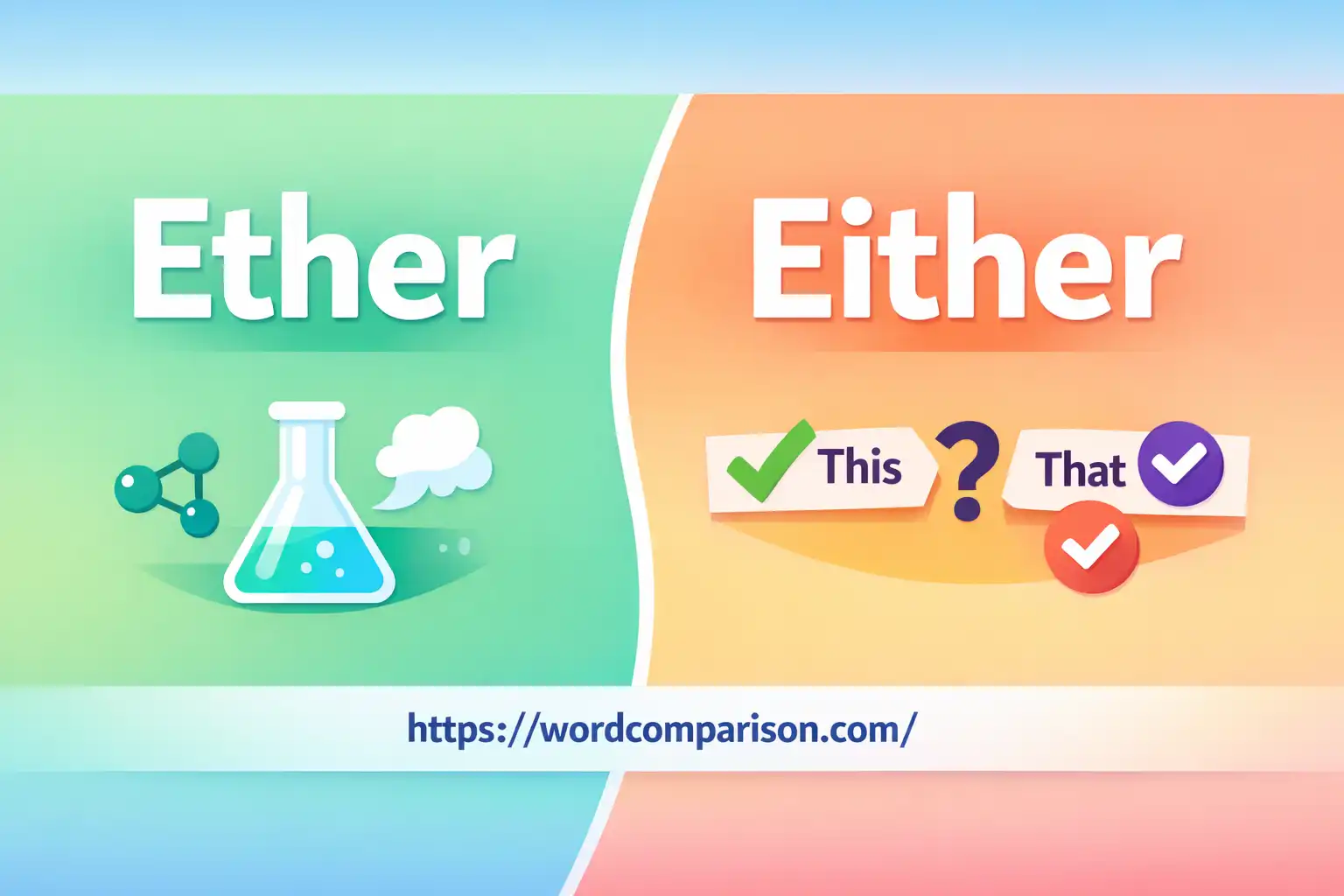
- Either means one of two choices.
Example: You can choose either tea or coffee. - Ether is a scientific word. It refers to a chemical or an old scientific idea.
Example: The lab stored ether safely.
👉 In daily English, use either, not ether.
The Origin of Ether or Either
The confusion between ether or either comes from history and sound. However, their origins differ clearly.
Either comes from Old English ǣgther, meaning “each of two.” Therefore, it always links to choice or options. Over time, its spelling stayed stable, but pronunciation changed across regions.
Ether, on the other hand, comes from Greek aithēr. It meant “upper air” or “pure sky.” Later, science adopted the word. As a result, ether became a technical term in chemistry and physics.
Because both words share similar letters and sounds, learners confuse them. Moreover, fast typing increases the error. Therefore, understanding their roots helps avoid mistakes.
Browse the “Word Confusion” category to avoid meaning swaps.
British English vs American English Spelling
Spelling does not change between regions. However, pronunciation often does. Therefore, learners think the words are interchangeable.
| Aspect | Either | Ether |
| US pronunciation | ee-ther / eye-ther | ee-ther |
| UK pronunciation | eye-ther | ee-ther |
| Spelling change | None | None |
| Meaning | Choice | Scientific term |
In contrast, spelling stays the same in both dialects. Therefore, meaning—not accent—matters most.
Which Spelling Should You Use?
The correct choice depends on context, not country.
- US audience: Use either for choices. Use ether only in science topics.
- UK / Commonwealth: Follow the same rule. Accent does not change meaning.
- Global or professional writing: Always use either unless writing chemistry or physics.
Therefore, daily writing almost never needs ether. Meanwhile, academic science writing may require it.
Common Mistakes with Ether or Either
Many writers repeat the same errors. However, these fixes are simple.
❌ You can ether call me or email me.
✅ You can either call me or email me.
❌ I don’t like ether option.
✅ I don’t like either option.
❌ She can choose ether dress.
✅ She can choose either dress.
The mistake happens because ethers looks formal. However, formality does not equal correctness.
Ether or Either in Everyday Examples
Emails
You can either reply today or tomorrow.
News
Voters may support either candidate.
Social Media
I can’t decide either way.
Formal Writing
The solution works for either method.
Scientific Context
The experiment used ethers as a solvent.
Therefore, context decides everything.
Ether or Either – Google Trends & Usage Data
Search data shows clear patterns.
- Countries: High confusion in non-native English regions.
- User types:
- Students: Very high confusion
- ESL learners: Extremely high confusion
- Writers: Medium confusion
- Professionals: Low confusion
Correct usage appears far more often than ethers misuse. However, the wrong searches still rise every year.
Therefore, this guide fills a real gap. For another quick check, read “councillor or counsellor” next.
Comparison Table: Ether vs Either
| Feature | Either | Ether |
| Meaning | One of two | Chemical / scientific term |
| Part of speech | Determiner, pronoun, adverb | Noun |
| Context of use | Daily language | Science only |
| Formal vs informal | Both | Formal, technical |
| Common mistake | Used as “ether” | Used instead of “either” |
| Correct example | Choose either path | Ether evaporates fast |
Semantic FAQs (People Also Ask)
Is ether the same as either?
No. Either means choice. Ether is scientific.
Which one is correct in formal writing?
Either, unless the topic is chemistry.
Can they be used interchangeably?
No. Their meanings differ completely.
Why do people confuse them?
Because they look and sound similar.
Can grammar tools catch this mistake?
Sometimes, but not always.
Is there a British vs American difference?
Only in pronunciation, not meaning.
Conclusion
Overall, ether or either confusion happens because of sound, not meaning. However, the difference is simple. Either always relates to choice. In contrast, ether belongs to science and history. Therefore, daily writing almost always needs either.
Moreover, remembering one rule solves the problem forever. If you talk about options, use either. If you write chemistry, use ethers. As a result, your writing stays clear and correct.
In short, never guess. Instead, check the context. Finally, trust meaning over sound. That single habit will remove this mistake permanently.
If you’re comparing similar terms, our “how to use peak or pique” article can help.

James Holloway writes detailed guides on confusing English words and grammar usage with clear side-by-side comparisons.