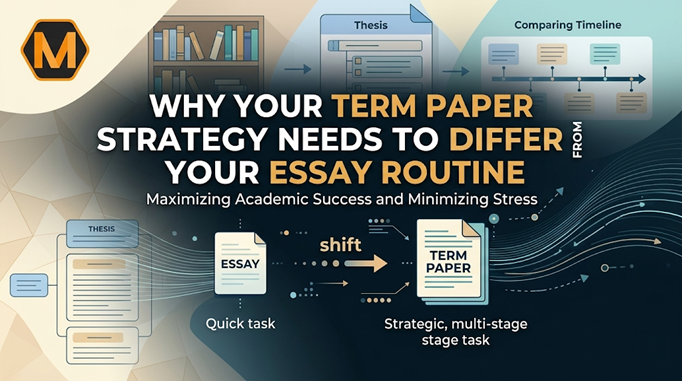
Entering university often feels like learning a new language. Just when you think you have mastered the art of the weekly essay, the mid-semester “Term Paper” arrives on the syllabus like a final boss in a video game. Many students make the mistake of treating a term paper as just a “long essay,” but that approach is a recipe for burnout and mediocre grades. The reality is that these two assignments require entirely different mental frameworks, research habits, and time management skills.
The first major hurdle is understanding the scale of the task. While a standard essay usually focuses on a single prompt or a specific reading, a term paper demands a comprehensive synthesis of an entire semester’s worth of learning. One of the most frequent questions first-year students ask when looking at their syllabus is, how long is an essay? Understanding these standard constraints is essential because it sets the baseline for your workload. If an essay is a sprint—a quick, focused burst of energy on a narrow topic—then a term paper is a marathon that requires pacing, hydration, and a very clear map of the finish line.
The Structural Shift: Depth vs. Breadth
In a standard essay, you are often proving a point using one or two primary sources. You stay close to the text, and your goal is clarity and conciseness. In contrast, a term paper requires “Information Gain.” This means you aren’t just repeating what the professor said in a lecture; you are expected to bring new perspectives to the table.
| Feature | Standard Essay | Term Paper |
| Primary Goal | Demonstrate understanding of a specific topic. | Synthesize a broad range of course themes. |
| Research Scope | 2–4 reliable sources. | 10–15 diverse academic sources. |
| Structure | Linear (Intro, Body, Conclusion). | Modular (Abstract, Lit Review, Methodology, Analysis). |
| Timeframe | 3–5 days. | 4–8 weeks. |
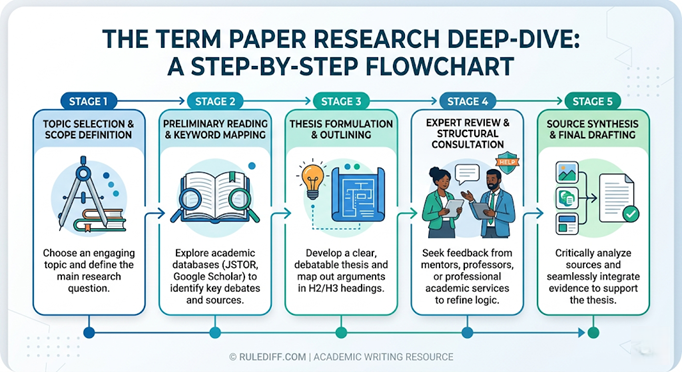
Because the structure is more complex, your “routine” must change. You cannot sit down and write a 3,000-word term paper in one sitting. You have to break it into modules. Successful students often spend the first two weeks just reading and annotating before they even write a single sentence of the introduction.
Research Strategies: Moving Beyond Google
For a short essay, a quick search through your university library database might give you enough “meat” for your paragraphs. However, for a term paper, your research needs to be layered. You need to look at the history of the debate, the current consensus, and the future implications of your topic. This is where many students feel the weight of the assignment.
When the requirements shift from a few pages to a full-scale research project, many students realize that professional help with term paper writing from experts at MyAssignmentHelp can provide the structural guidance needed to keep a complex thesis on track. Having a mentor or a professional service to review your outline ensures that you aren’t drifting off-topic—a common mistake when you are dealing with a high word count.
The “Dwell Time” Factor: Writing for the Reader
Whether you are writing for a professor or an online audience, readability is king. Long, rambling blocks of text are the fastest way to lose a reader’s interest. To make your term paper stand out, you should use “Signposting.” These are transitional phrases that tell the reader exactly where you are going.
Instead of saying “Also,” try using:
- “Furthermore, when we examine the evidence through a socio-economic lens…”
- “Contrary to the initial findings, the data suggests…”
- “This leads to a critical intersection between theory and practice…”
These phrases act as a guide, making your 1,400-word paper feel like a smooth journey rather than a chore to read.
Why the “Last Minute” Routine Fails for Term Papers
We’ve all been there—fueled by caffeine at 3:00 AM, finishing an essay due at 9:00 AM. While you can sometimes get an ‘A’ on a short essay with this method, it almost never works for a term paper. Why? Because term papers require a “Refining Phase.”
A term paper needs at least three distinct drafts:
- The “Discovery” Draft: Where you get all your messy ideas onto the page.
- The “Structural” Draft: Where you move paragraphs around to ensure the logic flows.
- The “Polish” Draft: Where you fix citations, check for tone consistency, and ensure your “Information Gain” is clear.
If you don’t allow time for these stages, your paper will feel disjointed. Your professor will notice if the tone of the first page doesn’t match the last page, which happens when a paper is written in a panicked rush.
Final Thoughts: Building a Sustainable System
The transition from essays to term papers is a rite of passage in undergraduate life. By shifting your routine from “writing” to “project management,” you reduce your stress and increase your grades. Treat your term paper as a professional report. Use tables to organize your data, use clear headings to guide your reader, and never be afraid to seek external support when the scope of the research becomes overwhelming.
Frequently Asked Questions (FAQ)
Q1: How many sources should I typically have for a term paper?
Generally, for an undergraduate term paper, aim for 1-2 credible sources per page. If your paper is 10 pages long, having 12–15 high-quality academic sources is a safe bet to show thorough research.
Q2: Can I reuse my essay research for my term paper?
Yes, but with caution. You can use an essay as a “building block,” but you must expand the scope significantly. Simply copying and pasting is often considered self-plagiarism by universities, so always check with your professor first.
Q3: What is the best way to start a term paper outline?
Start with your “Working Thesis.” This is a single sentence that summarizes your main argument. Once you have that, create your H2 headings based on the three or four main points you need to prove to support that thesis.
Q4: How do I know if my tone is too “informal”?
Read your paper out loud. If it sounds like you are chatting with a friend at a cafe, it’s too informal. If it sounds like you are presenting a case in a professional meeting, you are likely on the right track. Avoid contractions (like “don’t” or “can’t”) and stay away from slang.
Q5: Is it okay to use professional academic services for guidance?
Absolutely. Many students use services like MyAssignmentHelp to understand complex formatting styles (like APA or CMS) or to see how a professional would structure a literature review. It’s a great way to learn by example and improve your own writing skills for future assignments.
About The Author
Hello, I’m Ruby Walker, an academic consultant and senior content strategist dedicated to bridging the gap between classroom theory and professional writing excellence. With a background in academic strategy and digital communication, I focus on helping students navigate the complexities of higher education—from understanding foundational essay structures to mastering high-stakes research projects.
