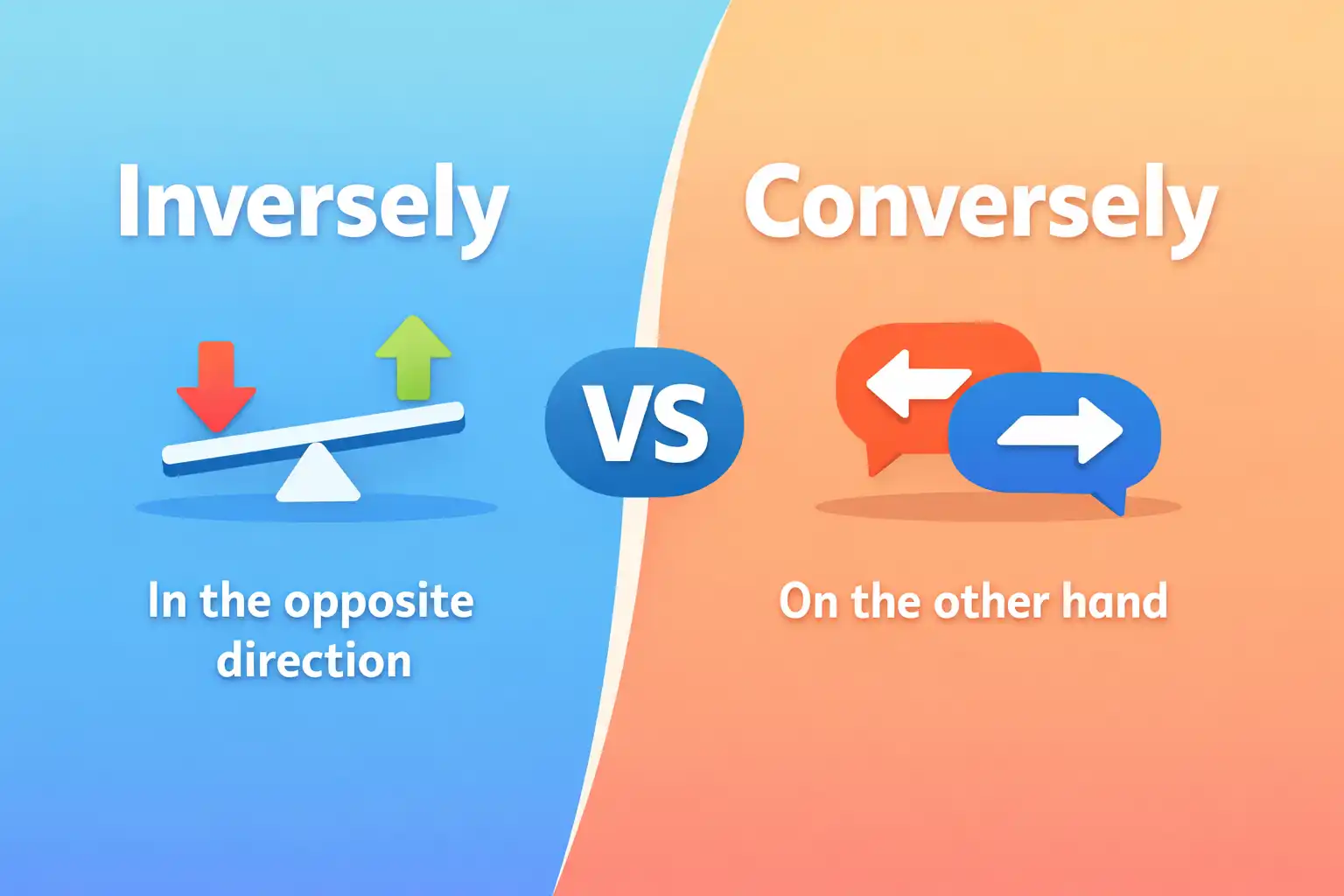
Many learners struggle with inversely vs conversely because both words suggest contrast. At first glance, they feel similar. But they are not the same. In fact, using the wrong one can change your meaning.
This confusion often happens in essays, emails, and even professional writing. Writers think both words simply mean “opposite.” However, each word has a specific role. One relates to mathematical or logical relationships, while the other connects ideas in contrast.
So, this article solves that exact problem. You will learn what each word means, when to use it, and how to avoid common mistakes. By the end, you will use both words with full confidence.
Inversely vs Conversely – Quick Answer
Inversely shows a relationship where one thing goes up while the other goes down.
Conversely introduces an opposite or contrasting idea in writing.
Use inversely for relationships or data.
Use conversely for contrasting statements or arguments.
Meaning of Inversely
- Shows an opposite relationship between two things
- Often used in science, math, and data
Examples:
- As speed increases, time decreases inversely
- Price and demand often move inversely
Meaning of Conversely
- Introduces a contrasting idea or statement
- Used in writing, speech, and arguments
Examples:
- He enjoys city life. Conversely, she prefers the countryside
- Some people save money. Conversely, others spend freely
Easy rule:
Use inversely for relationships
Use conversely for contrast in ideas
The Origin of Inversely vs Conversely
The word inversely comes from the Latin word inversus, which means “turned upside down.” Over time, it became linked to relationships where values move in opposite directions. This is why it is common in math and science.
On the other hand, conversely comes from the Latin word convertere, which means “to turn around.” It entered English through formal writing. Writers use it to show a shift in viewpoint or contrast.
Now, the confusion happens because both words suggest “opposite.” But their purpose is different. One describes how things behave, while the other explains how ideas connect.
Writers often mix them because they focus only on the idea of “opposite” and ignore context. This leads to unclear sentences.
British vs American English Spelling
There is no spelling difference between inversely and conversely in British and American English. Both forms remain the same.
However, usage style can differ slightly.
| Aspect | Inversely | Conversely |
| US usage | Common in academic and technical writing | Common in essays and formal writing |
| UK usage | Same as US | Slightly more formal tone in writing |
| Spelling | Same | Same |
So, there is no need to worry about spelling. Focus on meaning instead.
How to Choose the Right Word Fast
Choosing between inversely vs conversely becomes easy when you follow a simple logic.
For US writing
Use inversely in data, charts, or research
Use conversely in essays or arguments
For UK or Commonwealth writing
Use both words in the same way
However, conversely may sound more formal
For global or professional writing
Use inversely when describing relationships
Use conversely when shifting ideas
If your sentence talks about numbers, trends, or variables, use inversely
If your sentence compares ideas or opinions, use conversely
Common Mistakes with Inversely vs Conversely
Writers often misuse these words because they look similar. Let’s fix the most common errors.
❌ Incorrect: Sales increased. Inversely, profits dropped
✅ Correct: Sales increased. Conversely, profits dropped
Explanation: This is a contrast, not a relationship
❌ Incorrect: Temperature and pressure change conversely
✅ Correct: Temperature and pressure change inversely
Explanation: This is a relationship between variables
❌ Incorrect: He likes tea. Inversely, she prefers coffee
✅ Correct: He likes tea. Conversely, she prefers coffee
Explanation: This compares two preferences
❌ Incorrect: Demand rises conversely with price
✅ Correct: Demand rises inversely with price
Explanation: This describes a data relationship
Editors usually see these mistakes in essays and reports. The key issue is ignoring context.
Inversely vs Conversely in Real Life Examples
Let’s see how these words work in real situations.
Emails
- The workload increased. Conversely, team size remained the same
- As effort increases, errors decrease inversely
News
- Interest rates rose. Conversely, borrowing slowed
- Supply and demand often move inversely in markets
Social Media
- Some people save money. Conversely, others spend freely
- Screen time and sleep often move inversely
Formal Writing
- The variables are inversely related
- The first method is fast. Conversely, the second is more accurate
These examples show how meaning changes based on context.
Inversely vs Conversely – Word Usage Patterns and Search Trends
People search for inversely vs conversely because both words appear in academic writing. Students, ESL learners, and professionals often feel unsure.
In general, conversely appears more in essays and articles. It helps structure arguments.
Meanwhile, inversely appears in technical fields like science, economics, and statistics.
A common real-world issue happens in reports. If someone writes “conversely” instead of “inversely,” the meaning shifts from data relationship to simple contrast. This can confuse readers.
So, correct usage improves clarity and credibility.
Inversely vs Conversely Comparison Table
| Feature | Inversely | Conversely |
| Meaning | Opposite relationship between variables | Opposite or contrasting idea |
| Part of speech | Adverb | Adverb |
| Context | Data, math, science, trends | Writing, arguments, opinions |
| Formality | Technical and formal | Formal but common in writing |
| Common mistake | Used for contrast incorrectly | Used for relationships incorrectly |
| Example | Speed and time are inversely related | He prefers tea. Conversely, she likes coffee |
This table makes the difference clear at a glance.
FAQs About Inversely vs Conversely
Is inversely the same as conversely
No. Inversely shows a relationship. Conversely shows contrast between ideas.
Which one is correct in formal writing
Both are correct. Use inversely for data. Use conversely for arguments.
Can they be used interchangeably
No. They have different meanings and cannot replace each other.
Why do people confuse them
Both suggest “opposite,” so learners mix them without checking context.
Can grammar tools catch this mistake
Sometimes. However, many tools miss context-based errors.
Is there a British vs American difference
No. Both words have the same spelling and meaning in both forms of English.
Which is more common
Conversely is more common in writing. Inversely is more common in technical fields.
Conclusion
Inversely vs conversely may look similar, but they serve very different purposes. One explains how things relate, while the other connects ideas in contrast.
Use inversely when two things move in opposite directions, such as data or variables. Use conversely when you want to present an opposing idea in writing.
The most common mistake is using inversely for simple contrast. This creates confusion. So, always check your sentence type first.
In short, remember this simple rule:
If it is about relationships, use inversely
If it is about ideas, use conversely
This one rule will keep your writing clear and correct every time.
