Blooming vs blossoming often confuses learners because both words talk about growth and beauty. They sound similar, and many people use them in the same way. But small differences exist, and these differences matter in writing and daily speech. Writers often mix them in emails, essays, and social posts without knowing the subtle tone change.
This confusion usually happens when describing flowers, people, or progress. For example, is a child blooming or blossoming? Is a business blooming or blossoming? These choices can affect clarity and tone. So, understanding the difference helps you sound more natural and accurate.
In this guide, you will learn the exact meanings, real usage, and simple rules to choose the right word every time. You will also see common mistakes and clear examples from real life.
Blooming vs Blossoming – Quick Answer
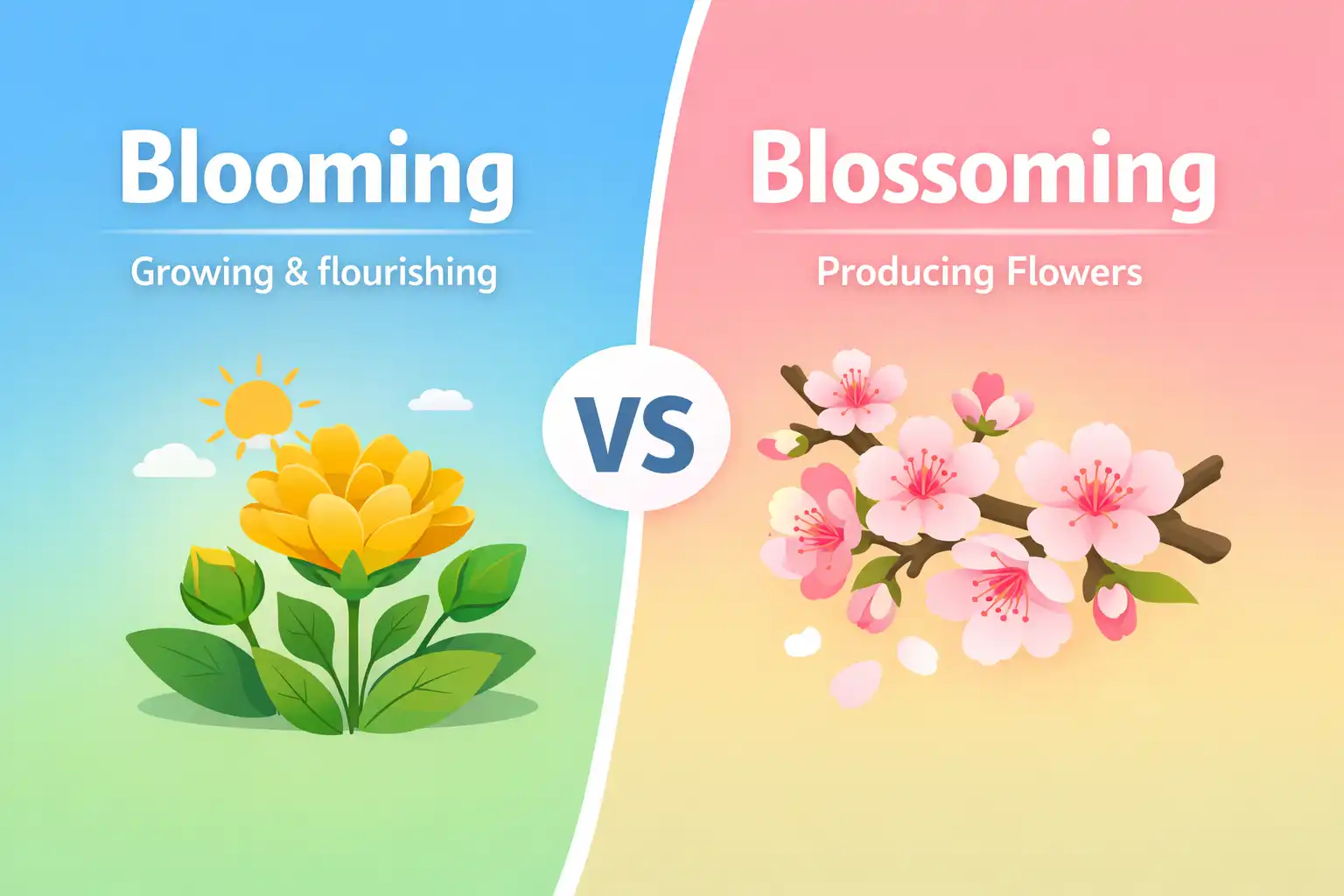
Blooming means a flower has opened or something is growing well. Blossoming means reaching a fuller, more beautiful stage of growth. Use blooming for general growth or flowers. Use blossoming for emotional, personal, or advanced development.
Meaning of Blooming
- Blooming means opening or growing actively
- Often used for flowers or general progress
- It can also describe something doing well
Examples:
- The roses are blooming in the garden
- Her confidence is blooming slowly
Meaning of Blossoming
- Blossoming means reaching a mature or full stage
- Often used for people, talent, or relationships
- It suggests deeper growth
Examples:
- He is blossoming into a great leader
- Their friendship is blossoming
Easy rule:
Use blooming for early or visible growth. Use blossoming for deeper or fuller development.
The Origin of Blooming vs Blossoming
The word blooming comes from the Old Norse word “blōm,” which means flower. It entered English many centuries ago and became common in daily speech. It mainly described flowers opening, but later people used it for general growth.
Blossoming comes from the word “blossom,” which has roots in Old English “blōstm.” It also means flower, but it developed a more poetic tone over time. Writers began to use it for personal growth and emotional change.
The confusion exists today because both words share the same root idea. They both relate to flowers and growth. However, blooming stayed simple and practical. Blossoming became more expressive and deeper in meaning.
British vs American English Spelling
There is no spelling difference between blooming and blossoming in British and American English. Both regions use the same forms.
Small examples:
- UK: The flowers are blooming
- US: The flowers are blooming
- UK: She is blossoming into a strong person
- US: She is blossoming into a strong person
So, the difference is not about spelling. It is about meaning and tone.
How to Choose the Right Word Fast
Choosing the right word depends on context and tone.
For US audience:
Use blooming for simple, everyday language. Use blossoming for expressive writing.
For UK or Commonwealth:
The same rule applies. However, blossoming may sound slightly more formal.
For global or professional writing:
Use blooming for clarity. Use blossoming when describing personal or emotional growth.
If there is no spelling difference, focus on tone. Blooming is simple. Blossoming is richer and deeper.
Common Mistakes with Blooming vs Blossoming
Many learners use both words without thinking about context. This creates awkward or unclear sentences.
❌ The child is blooming into a strong adult
✅ The child is blossoming into a strong adult
Reason: Personal growth needs “blossoming”
❌ The flowers are blossoming quickly in spring
✅ The flowers are blooming quickly in spring
Reason: Physical flowers usually take “blooming”
Editors often see these mistakes in essays and blogs. The error happens when people ignore tone and context.
Blooming vs Blossoming in Real Life Examples
Emails:
- Our business is blooming this year
- Your skills are blossoming well
News:
- The city gardens are blooming after rain
- A young artist is blossoming in the local scene
Social media:
- Spring is here and flowers are blooming
- She is blossoming into her best self
Professional writing:
- Sales are blooming in new markets
- Leadership skills are blossoming over time
These examples show how tone changes based on context.
Blooming vs Blossoming – Word Usage Patterns and Search Trends
Both words are popular among students, writers, and ESL learners. However, blooming appears more in general use because it is simple and direct.
Blossoming is more common in creative writing, motivational content, and personal development topics. It carries emotional depth, so writers prefer it when describing people or change.
A real-world confusion happens in job applications. If someone writes “my skills are blooming,” it sounds less natural. “My skills are blossoming” feels more appropriate and polished.
So, correct usage can improve clarity and impression.
Comparison Table: Blooming vs Blossoming
Aspect | Blooming | Blossoming
Meaning | Opening or growing | Full or mature growth
Part of speech | Verb, adjective | Verb, adjective
Context of use | Flowers, simple growth | People, emotions, development
Formal vs informal | Neutral, everyday | Slightly more expressive
Common mistake | Used for deep growth | Used for simple flower growth
Correct example | The flowers are blooming | She is blossoming into a leader
This table helps remove confusion quickly.
FAQs
Is blooming the same as blossoming
No. Blooming refers to simple or early growth, while blossoming refers to fuller and deeper development.
Which one is correct in formal writing
Both are correct. However, blossoming fits better for formal or expressive contexts.
Can they be used interchangeably
Sometimes, but not always. Context decides the correct word.
Why do people confuse them
They share the same root meaning and both relate to growth and flowers.
Can grammar tools catch this mistake
Most tools do not detect this nuance because both words are correct grammatically.
Is there a British vs American difference
No. Both words have the same spelling and usage in UK and US English.
Which word is more emotional
Blossoming is more emotional and expressive than blooming.
Conclusion
Blooming and blossoming both describe growth, but they are not the same. Blooming is simple and often used for flowers or general progress. Blossoming shows deeper, fuller development, especially for people, skills, and relationships.
The most common mistake is using blooming for emotional or personal growth. This makes the sentence feel less natural. Instead, blossoming should be used in such cases.
Overall, the difference is about depth. Blooming shows something starting or happening. Blossoming shows something becoming its best form.
In short, remember this easy rule:
Use blooming for visible growth. Use blossoming for meaningful growth.
