People often search simular or similar because the words look alike and sound close. However, only one works in standard English. Therefore, writers, students, and ESL learners feel unsure. Moreover, spellcheck tools sometimes fail to explain why one form is wrong. As a result, mistakes appear in emails, posts, and even reports.
This article solves that problem clearly. First, it explains what each word means. Then, it shows why confusion happens. Additionally, it gives simple rules you can follow every time. Meanwhile, you will see real examples from daily writing. Finally, you will learn one easy rule to avoid errors forever. The goal is clarity. The language stays simple. The guidance stays practical.
Need another pair? The “word comparison index” lists all comparisons in one place.
Simular or Similar – Quick Answer
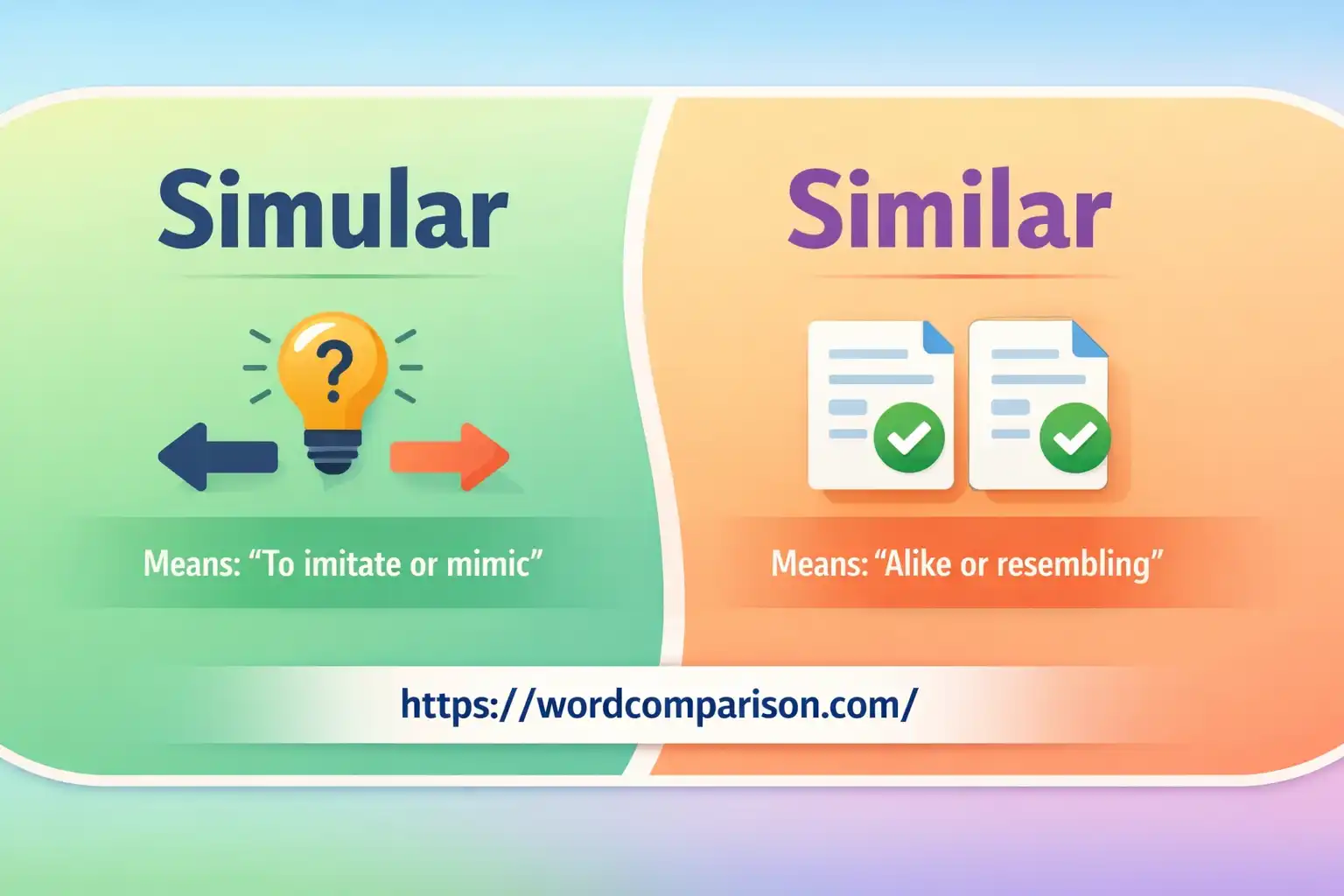
- Similar is correct English.
- Simular is almost always a spelling mistake.
- Use similar to mean “almost the same.”
- Example: These two phones are similar in design.
In short, choose similar every time in normal writing.
The Origin of Simular or Similar
The word similar comes from Latin similis, which means “like” or “alike.” Therefore, English kept the meaning clear and stable over time. Writers have used similar for centuries.
However, simular has no strong history in standard English. In contrast, it appears when people type fast or rely on sound. Moreover, some languages spell the related word closer to simular. As a result, learners copy that pattern by mistake. Overall, history supports similar only. The other form lacks authority and acceptance.
See the “Wrong Spelling collection” for more quick fixes to common misspellings.
British English vs American English Spelling
English spelling often changes by region. However, this case stays simple.
| Feature | British English | American English |
| Correct form | similar | similar |
| Accepted variant | none | none |
| Common mistake | simular | simular |
In contrast to words like colour and color, similar never changes. Therefore, the rule stays the same everywhere.
Which Spelling Should You Use?
You should always use similar. However, the context still matters.
For US audiences:
Use similar in school, work, and online writing.
For UK or Commonwealth audiences:
Use similar the same way. No change applies.
For global or professional writing:
Use similar only. Editors expect it. Clients trust it.
As a result, choosing similar keeps your writing safe and clear worldwide.
Common Mistakes with Simular or Similar
Many errors follow clear patterns. Therefore, spotting them becomes easy.
- ❌ These results are simular.
✅ These results are similar. - ❌ I found a simular product online.
✅ I found a similar product online. - ❌ The two cases are simular to each other.
✅ The two cases are similar to each other.
The mistake often starts with sound. However, English spelling follows rules, not sound alone.
Simular or Similar in Everyday Examples
People use similar in many places. Therefore, seeing examples helps.
Emails:
Your idea is similar to mine.
News:
The storms caused similar damage across the region.
Social media:
This phone looks similar to the older model.
Professional writing:
The study shows similar results across groups.
In every case, similar fits clearly. Meanwhile, simular would look wrong and unprofessional.
Related reading: see “wisp or whisp” for another commonly mixed-up pair.
Simular or Similar – Google Trends & Usage Data
Search data shows strong patterns. Therefore, the insight matters.
- Countries:
High confusion appears in non-native English regions. However, native regions still show errors. - User types:
Students and ESL learners search this term most. Writers and professionals also double-check. - Correct usage vs mistakes:
Searches for “simular” usually lead to corrections. As a result, “similar” dominates real usage.
Overall, data confirms one truth. Similar wins every time.
Comparison Table: Simular vs Similar
| Feature | Simular | Similar |
| Meaning | No standard meaning | Almost the same |
| Part of speech | Not standard | Adjective |
| Context of use | Typing error | Daily English |
| Formal vs informal | Incorrect | Works in both |
| Common mistake | Used instead of similar | Rare |
| Correct example | ❌ Not valid | ✅ Their plans are similar. |
This table removes confusion fast. Therefore, keep it in mind when writing.
Semantic FAQs (People Also Ask)
Is simular the same as similar?
No. Similar is correct. Simular is a mistake.
Which one is correct in formal writing?
Use similar in all formal cases.
Can they be used interchangeably?
No. Only similar works.
Why do people confuse them?
Sound and typing habits cause confusion.
Can grammar tools catch this mistake?
Often yes. However, manual knowledge helps more.
Is there a British vs American difference?
No. Both use similar only.
Conclusion
Overall, the confusion between simular or similar comes from sound, not meaning. However, English rules stay clear. Only similar works in standard writing. Therefore, you should trust the correct form every time.
You might also like our “foward or forward explanation” for a similar issue.
In short, similar means “almost the same.” It fits emails, essays, posts, and reports. Meanwhile, simular lacks authority and acceptance. As a result, using it can harm clarity and trust.
Finally, remember one easy rule:
If you mean “alike,” write “similar.”
That single habit removes doubt. It also improves your writing instantly.

James Holloway writes detailed guides on confusing English words and grammar usage with clear side-by-side comparisons.