If you’ve ever wondered whether to use “councillor” or “counsellor,” you’re not alone. These two words often cause confusion due to their similar spellings and meanings. In fact, many people mistakenly use them interchangeably, even though they refer to different roles.
This article will clear up the confusion once and for all by explaining the correct usage of both terms. You’ll also learn about their origins, the spelling differences between British and American English, and some common mistakes people make when using these words.
By the end, you’ll know exactly when and how to use each one, ensuring that you communicate clearly and correctly.
Start from the “word comparison home page” to compare more words.
Councillor or Counsellor – Quick Answer
People often search councillor spelling because it looks similar to counsellor. Councillor usually relates to government or a local council role while counsellor relates to advice or therapy. Some searches also include councillor vs counselor which is a US spelling variant of counsellor.
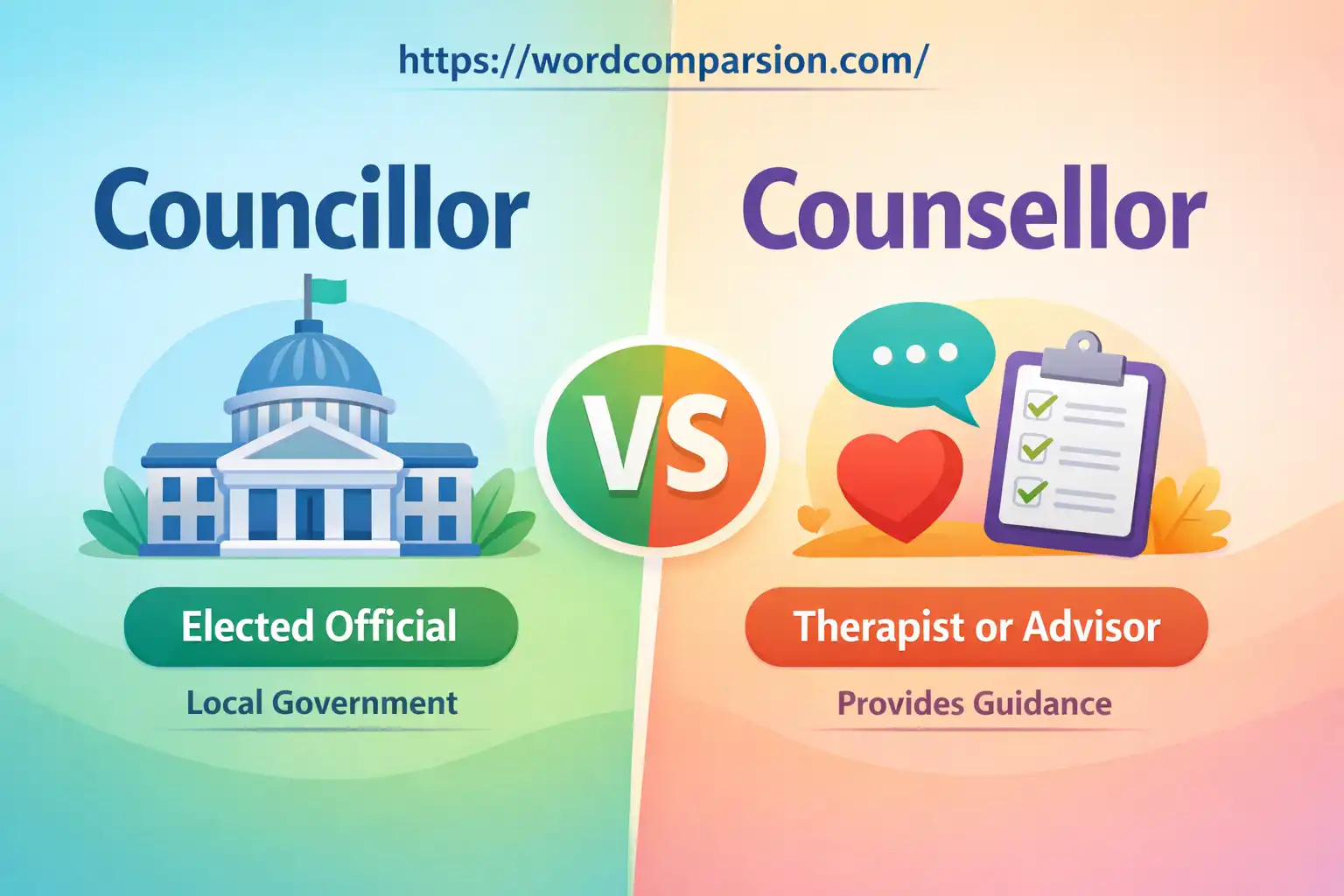
- Councillor: A person elected to a local government position.
- Counsellor: A professional who offers guidance or advice, typically in a psychological or personal context.
The Origin of Councillor and Counsellor
Word Origin and History
The words “councillor” and “counsellor” have different historical roots.
- Councillor comes from the word “council,” which means a group of people coming together for a common purpose. The suffix “-or” denotes a person who participates in the activity of the council. Historically, a councillor is someone who serves in an advisory role in local government or in a similar position of governance.
- Counsellor, on the other hand, is derived from the word “counsel,” meaning advice or guidance. The suffix “-or” in “counsellor” is similar in function, indicating someone who provides advice, especially in an emotional, psychological, or personal capacity.
Reason for Confusion
The confusion arises because both “councillor” and “counsellor” share a similar suffix and a similar meaning relating to giving advice. However, the key difference lies in their application.
A councillor advises on political or governmental matters, while a counsellor helps people with personal issues, such as mental health or life challenges.
It’s easy to mix them up, especially for those learning English or when the spelling isn’t clear. But once you understand the difference, it’s much easier to avoid mistakes.
This topic also appears in our “Word Confusion hub” of commonly mixed-up terms.
British English vs American English Spelling
Clear Spelling Rules
The primary difference between “councillor” and “counsellor” is that “councillor” is always spelled with a double “l,” and “counsellor” is also spelled with a double “l” in British English. However, in American English, the term “counsellor” becomes “counselor”, removing the second “l.”
- British English: Councillor, Counsellor
- American English: Councillor, Counselor
Examples
- In the UK, a local government representative would be called a “councillor”.
- In the US, a person who gives professional advice, especially in mental health, would be called a “counselor”.
Which Spelling Should You Use?
Audience-Based Guidance
- US: Use “counselor” (without the second “l”).
- UK / Commonwealth: Use “counsellor” and “councillor” (with double “l”).
- Global or Professional Writing: If you’re writing for a global audience, it’s best to stick to the “councillor” spelling for political positions and “counsellor” for therapeutic roles. However, if you’re using American English, you’ll write “counselor” instead.
Common Mistakes with Councillor or Counsellor
Frequent Errors
Many people confuse these two words due to their similar sound and appearance. Below are a few common mistakes:
- Incorrect: The counsellor helped the local community with its issues.
- Correct: The councillor helped the local community with its issues.
- Incorrect: I need to see a councillor about my mental health.
- Correct: I need to see a counsellor about my mental health.
Short Explanations
- Councillor refers to someone in a political or government advisory position.
- Counsellor refers to someone offering personal guidance or therapy.
Councillor or Counsellor in Everyday Examples
Let’s explore how these words are used in everyday writing:
Emails
- Councillor: “Dear Councillor, I would like to raise a concern about the local park.”
- Counsellor: “Dear Counsellor, I’ve been feeling a bit overwhelmed lately, and I’d appreciate some advice.”
News
- Councillor: “The councillor discussed new policies to improve city infrastructure.”
- Counsellor: “The counsellor provided support to families affected by the crisis.”
Social Media
- Councillor: “Exciting news from the local councillor today!”
- Counsellor: “Just had a great session with my counsellor, feeling much better.”
Formal or Professional Writing
- Councillor: “The councillor will be meeting with the town’s residents to discuss the upcoming elections.”
- Counsellor: “The counsellor specializes in helping clients with anxiety and depression.”
Councillor or Counsellor – Google Trends & Usage Data
Popularity by Country
- Councillor is more commonly used in the UK, Canada, and other Commonwealth countries.
- Counsellor is more popular in the UK for mental health professionals.
- Counselor (American spelling) is widely used in the US for both political and therapeutic roles.
User Type
- Students and writers: Often confuse the two terms, especially if they are unfamiliar with the specific roles.
- ESL learners: Struggle with spelling variations between British and American English.
- Professionals: Need to be clear about the distinction to avoid communication errors.
For another quick check, read “peak or pique” next.
Comparison Table
| Aspect | Councillor | Counsellor |
| Meaning | Elected political representative | Professional advisor or therapist |
| Part of Speech | Noun | Noun |
| Context of Use | Politics and local government | Mental health, personal advice |
| Formal vs Informal Usage | Mostly formal (political contexts) | Mostly formal (therapy or guidance contexts) |
| Common Mistakes | Confusing with “counsellor” | Confusing with “councillor” |
| Correct Example | The councillor proposed new policies. | The counsellor helped me with stress management. |
Semantic FAQs (People Also Ask)
Is Councillor the Same as Counsellor?
No, a councillor is a local government official, while a counsellor is a professional who offers advice, often in mental health contexts.
Which One is Correct in Formal Writing?
It depends on the context. Use “councillor” for government roles and “counsellor” for therapeutic roles.
Why Do People Confuse Them?
Both words sound similar and refer to roles that involve advising others, but they apply in very different contexts.
Councillor or counsellor which is correct
Both are correct but they mean different roles councillor is a government role and counsellor gives guidance or therapy.
Councillor meaning what does it mean
A councillor is an elected or appointed member of a council.
Counsellor meaning in government is it correct
Counsellor usually refers to an adviser and is not the same as councillor in local government.
Councillor vs counselor what is the difference
Councillor is a council member while counselor is the American spelling of counsellor meaning adviser or therapist.
Counsellor vs councillor which one should I use
Use councillor for council roles and counsellor for guidance or therapy.
Counsellor or counselor which spelling is correct
Counsellor is UK and Australian spelling and counselor is US spelling.
Is There a British vs American Difference?
Yes, in American English, “counsellor” becomes “counselor” without the extra “l.”
Conclusion
Overall, understanding the difference between “councillor” and “counsellor” is important for clear and accurate communication. Use “councillor” for someone in local government and “counsellor” for a professional providing advice or therapy.
The key mistake to avoid is mixing up the roles, especially in formal or professional settings. In short, when in doubt, remember: councillors work in government, and counsellors help with personal guidance.
If you’re comparing similar terms, our “how to use piqued or peaked” article can help.

James Holloway writes detailed guides on confusing English words and grammar usage with clear side-by-side comparisons.