Many people search for “cancell or cancel” because both spellings appear online, in emails, and even in official-looking text. This creates real confusion. You may pause while writing an email, filling a form, or posting on social media, unsure which spelling is correct. A small spelling mistake can make your writing look unprofessional, especially in formal or work settings.
The confusion exists because English spelling changes between regions, mainly British English and American English. Some verbs double the final “L” in one version of English but not in the other. When people see words like cancelled or cancellation, they assume “cancell” might also be correct. That assumption is wrong, but it is very common.
This article clears that confusion completely. You will get a quick answer, a simple explanation, real-world examples, and clear advice on which spelling to use based on your audience. By the end, you will never hesitate again when choosing between cancell or cancel.
Need another pair? The “word comparison index” lists all comparisons in one place.
Cancell or Cancel – Quick Answer
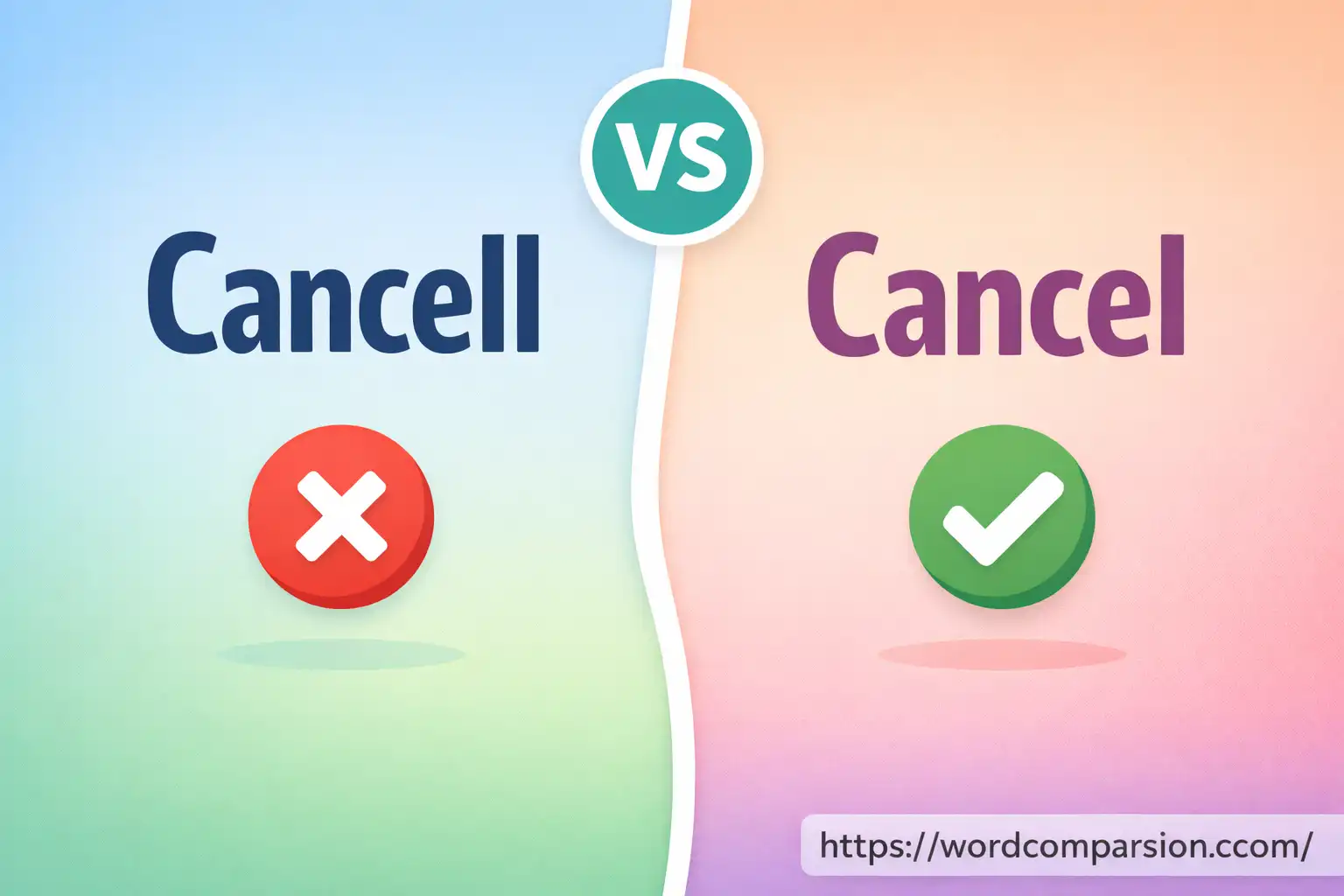
“Cancel” is correct. “Cancell” is always wrong.
- ✅ Correct: Please cancel my subscription.
- ❌ Incorrect: Please cancell my subscription.
There is no version of English where “cancell” is accepted as a correct spelling.
The Origin of Cancel
The word cancel comes from the Latin word cancellare, which meant “to cross out” or “to make invalid.” Over time, it entered English through French and kept a single L in its base form.
The confusion happens after the base word:
- cancel → cancelled / canceled
- cancel → cancelling / canceling
Different English systems handle the double L differently, but the base verb cancel never changes.
Explore the “Wrong Spelling” category for more look-alike typos.
British English vs American English Spelling
The key difference appears only in verb endings, not in the base word.
| Form | British English | American English |
| Base verb | cancel | cancel |
| Past tense | cancelled | canceled |
| Present participle | cancelling | canceling |
| Noun | cancellation | cancellation |
Important:
Both systems agree that “cancell” is incorrect.
Which Spelling Should You Use?
Choose based on your audience:
- US audience:
Use cancel, canceled, canceling - UK / Australia / Canada audience:
Use cancel, cancelled, cancelling - Global or mixed audience:
Use cancel (safe everywhere)
If you are unsure, “cancel” alone is always safe.
Common Mistakes with Cancell or Cancel
Here are frequent errors people make:
- ❌ I need to cancell my order
✅ I need to cancel my order - ❌ The event was cancell yesterday
✅ The event was canceled / cancelled - ❌ Request for cancellation
✅ Request for cancellation
Rule to remember:
There is never a double L in cancel itself.
Cancell or Cancel in Everyday Examples
Emails
- Please cancel my appointment scheduled for Monday.
News
- The airline had to cancel several flights due to weather.
Social Media
- Thinking of canceling my gym membership.
Formal Writing
- The company reserves the right to cancel the agreement.
Related reading: see “agast or aghast” for another commonly mixed-up pair.
Cancell or Cancel – Google Trends & Usage Data
Search data shows:
- “cancel” is searched worldwide.
- “cancell” spikes due to spelling confusion, not correctness.
- High confusion comes from users seeing cancelled and guessing the base form.
Most searches for “cancell or cancel” come from:
- Students
- Non-native English speakers
- Professional writers double-checking accuracy
Spelling Comparison Table
| Variation | Correct? | Usage Region |
| cancel | ✅ Yes | Global |
| cancell | ❌ No | None |
| cancelled | ✅ Yes | UK/Commonwealth |
| canceled | ✅ Yes | USA |
| cancelling | ✅ Yes | UK/Commonwealth |
| canceling | ✅ Yes | USA |
FAQs
1. Is “cancell” ever correct?
No. It is always wrong.
2. Why do people write “cancell”?
They confuse it with cancelled or cancellation.
3. Is “cancel” British or American?
It is correct in both.
4. Which spelling does Google prefer?
Google recognizes cancel as the correct base word.
5. Can I use “cancelled” in American English?
It is understood, but canceled is preferred.
6. What is the safest spelling for global writing?
Use cancel.
7. Does pronunciation change?
No. Both spellings sound the same.
Conclusion
The confusion between cancell or cancel is common, but the rule is simple. “Cancel” is the only correct base spelling. The word “cancell” does not exist in any standard form of English. The misunderstanding comes from regional spelling differences that appear only when adding endings like -ed or -ing.
British English doubles the final L in forms like cancelled and cancelling, while American English keeps one L, as in canceled and canceling. Despite this difference, both systems fully agree on the base word cancel.
If you write for an international audience, using cancel alone is always safe and professional. Remember this one rule, and you will never hesitate again. Clear spelling builds trust, improves communication, and avoids unnecessary mistakes.
You might also like our “enflamed or inflamed explanation” for a similar issue.

James Holloway writes detailed guides on confusing English words and grammar usage with clear side-by-side comparisons.