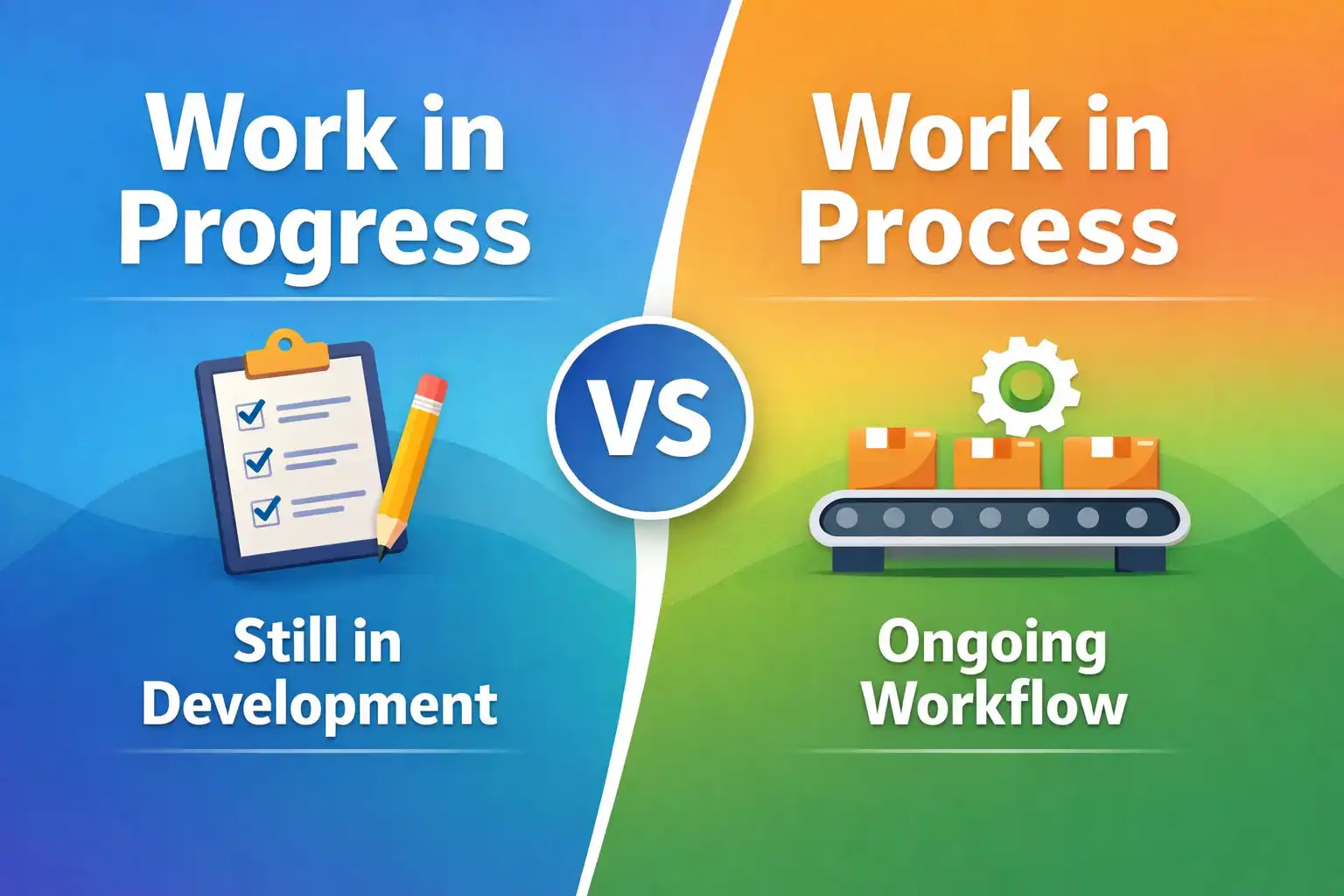
Many people search for work in progress vs work in process because both phrases look very similar. They even share the same first three words. So the confusion feels natural. Students, writers, and even professionals often mix them up.
The problem appears when people use them in the wrong place. For example, someone may write “This project is still a work in process.” In many contexts, that sentence sounds incorrect. Editors see this mistake often in articles, emails, and business reports.
The two phrases actually belong to different fields and different meanings. One is common in everyday language and creative work. The other mostly appears in manufacturing, accounting, and production systems.
This guide will explain the difference in very simple terms. You will learn what each phrase means, where it is used, and how to choose the right one quickly. By the end, the confusion between work in progress vs work in process will disappear.
Work in Progress vs Work in Process – Quick Answer
Work in progress (WIP) means something is not finished yet. People use it in everyday language.
Work in process (WIP) means items currently being manufactured or processed in production.
Examples
• “The article is still a work in progress.”
• “The factory tracks work in process inventory.”
Easy rule:
Use work in progress for general tasks. Use work in process for manufacturing or accounting.
Meaning of Work in Progress
Work in progress describes something that is still being developed or improved.
It often appears in creative, educational, and daily contexts.
Common situations include:
• writing an article
• building a website
• painting artwork
• preparing a project
Examples
• The report is a work in progress.
• Her novel is still a work in progress.
• The road construction is a work in progress.
People also use the short form WIP in design, writing, and social media.
Meaning of Work in Process
Work in process refers to items that are currently in production.
The phrase appears mainly in:
• manufacturing
• supply chain systems
• accounting
• inventory tracking
It describes products that are not finished yet but are already inside the production cycle.
Examples
• The factory monitors work in process inventory.
• Several machines are handling work in process materials.
• The report tracks work in process costs.
Outside manufacturing or accounting, this phrase sounds unusual.
The Origin of Work in Progress vs Work in Process
Both expressions came from industrial and project language, but they developed in different ways.
Work in progress appeared first in general English during the 19th century. Builders and engineers used it to describe projects that were not finished. Over time, the phrase moved into everyday language. Today people use it for writing, art, software, and personal development.
Work in process, however, came from manufacturing and accounting terminology. Factories needed a term to describe products that were still moving through the production line. Accountants then used the phrase when tracking inventory and production costs.
Because both phrases share the same words, people often assume they mean the same thing. However, their usage fields became very different, which causes confusion today.
Editors usually see mistakes when writers use work in process in normal conversation.
British vs American English Spelling
There is no spelling difference between British and American English for these phrases.
Both regions use the same wording.
However, the usage context still matters.
| Phrase | British English | American English | Typical Use |
| Work in progress | Same spelling | Same spelling | Everyday language |
| Work in process | Same spelling | Same spelling | Manufacturing and accounting |
Example:
UK news article
• “The new railway is still a work in progress.”
US manufacturing report
• “The company increased work in process inventory.”
So the difference is not spelling, but context and industry usage.
How to Choose the Right Word Fast
Choosing between work in progress vs work in process becomes easy when you focus on the situation.
US usage
Most Americans use work in progress in everyday writing.
Factories and accountants use work in process.
UK and Commonwealth usage
The pattern stays the same.
Daily communication uses work in progress.
Professional or global writing
Use work in progress unless you are discussing manufacturing or inventory systems.
Quick memory tip:
General tasks → work in progress
Factory production → work in process
Common Mistakes with Work in Progress vs Work in Process
Writers often mix these phrases because they look almost identical.
Here are common mistakes.
❌ Incorrect: The article is still a work in process.
✅ Correct: The article is still a work in progress.
Explanation: Writing belongs to general work, not manufacturing.
❌ Incorrect: The factory tracks work in progress inventory.
✅ Correct: The factory tracks work in process inventory.
Explanation: Inventory tracking belongs to production systems.
❌ Incorrect: My painting is a work in process.
✅ Correct: My painting is a work in progress.
Explanation: Creative projects use work in progress.
Editors usually notice these errors quickly because the context feels wrong.
Work in Progress vs Work in Process in Real Life Examples
Understanding real usage makes the difference much clearer.
Email example
• “The marketing plan is still a work in progress, so changes may happen.”
News example
• “The bridge remains a work in progress after several months of construction.”
Social media example
• “My website redesign is a work in progress.”
Business report example
• “The company increased work in process inventory this quarter.”
Manufacturing document
• “Managers track work in process materials through each production stage.”
These examples show how context controls the phrase choice.
Work in Progress vs Work in Process – Word Usage Patterns and Search Trends
Online searches show that many people look up work in progress vs work in process when writing or editing.
Students often search the phrase while writing essays. ESL learners also check the difference because both phrases look similar.
Writers and bloggers search it when grammar tools highlight unusual wording.
Meanwhile, professionals in manufacturing or accounting already know the term work in process because it appears in inventory reports and financial statements.
Confusion happens when someone writes about unfinished tasks but accidentally chooses the industrial phrase.
For example, a blog post might say:
“This guide is still a work in process.”
Readers may feel the sentence sounds strange. The correct phrase should be work in progress.
Understanding the context solves the confusion immediately.
Comparison Table
| Feature | Work in Progress | Work in Process |
| Meaning | Something unfinished or still developing | Items currently being manufactured |
| Part of speech | Noun phrase | Noun phrase |
| Context | General tasks, creative work, projects | Manufacturing, accounting, production |
| Formal vs informal | Used in both casual and formal writing | Mostly technical or professional |
| Common mistake | Rarely misused | Often wrongly used in everyday writing |
| Correct example | “The report is a work in progress.” | “The factory tracks work in process inventory.” |
This table shows that the key difference is context, not grammar.
FAQs
Is work in progress the same as work in process?
No. Work in progress means unfinished work. Work in process refers to items currently in production.
Which phrase is correct in normal writing?
Most everyday writing uses work in progress.
Can the two phrases be used interchangeably?
No. They belong to different contexts. Mixing them can sound incorrect.
Why do people confuse these phrases?
They share the same words and abbreviation WIP, which makes them look identical.
Can grammar tools detect the mistake?
Some tools detect it based on context, but many do not.
Is there a British vs American difference?
No. Both regions use the same spelling. The difference depends on context.
What does WIP mean?
WIP usually stands for work in progress, but in manufacturing it may also mean work in process.
Conclusion
The confusion between work in progress vs work in process happens because the phrases look almost identical. However, their meanings are very different.
Work in progress describes something unfinished that is still being developed. People use it for writing, projects, design, learning, and many everyday activities.
Work in process, however, belongs mainly to manufacturing and accounting. It describes items moving through a production system but not yet completed.
Writers often make the mistake of using work in process when they mean work in progress. This error usually appears in articles, emails, and creative writing.
Overall, the best way to remember the difference is simple.
If you talk about general work that is not finished, use work in progress.
If you talk about products moving through a factory or production system, use work in process.
Finally, keep one easy rule in mind:
Projects and creative work use work in progress, while manufacturing uses work in process.

James Holloway writes detailed guides on confusing English words and grammar usage with clear side-by-side comparisons.