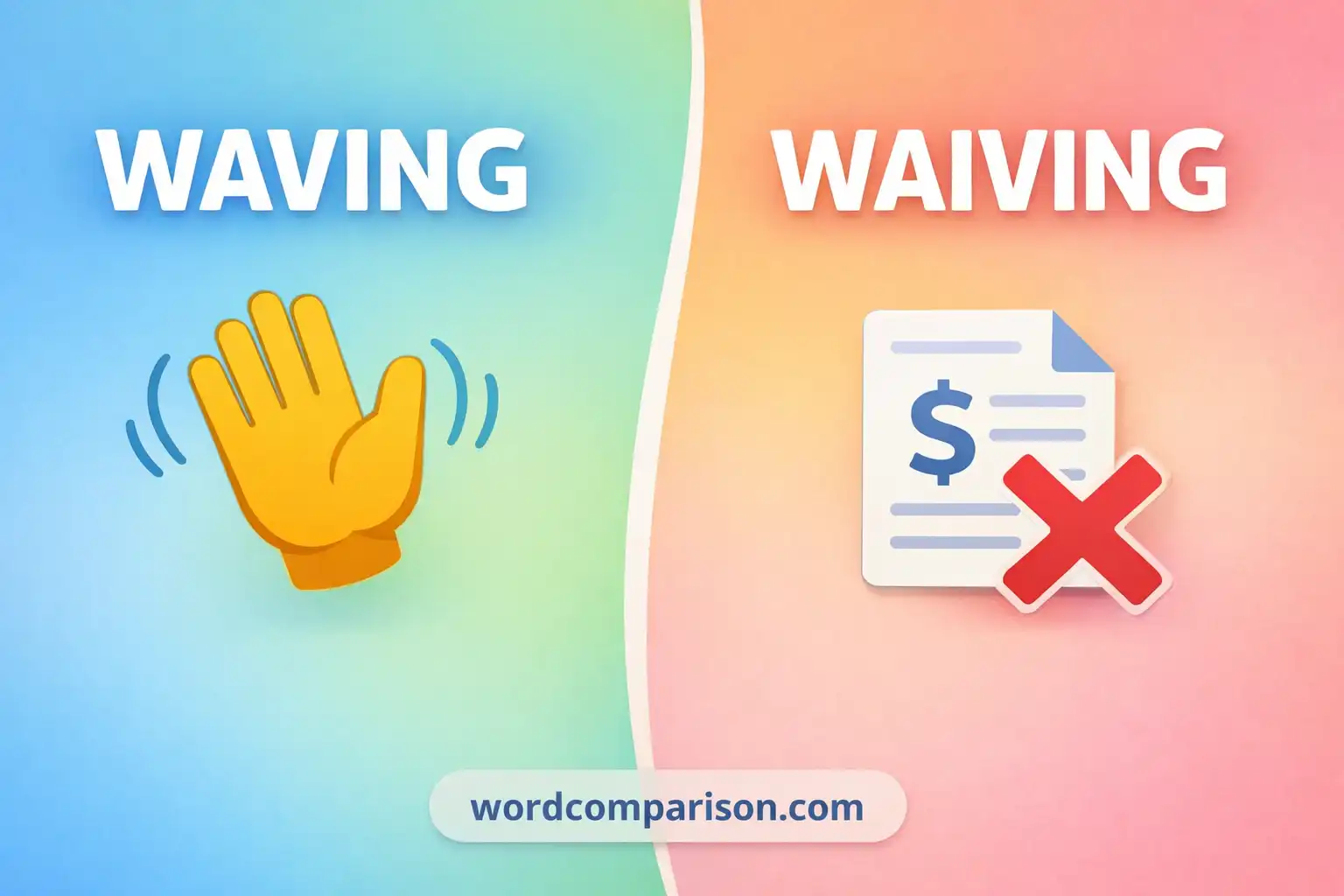
Many English learners, students, and even professionals confuse waving or waiving. At first glance, both words look similar. However, their meanings differ completely. As a result, writers often make errors in emails, contracts, and exams. This confusion usually happens because both words share the same root spelling. Moreover, spellcheck tools do not always catch the mistake. Therefore, users search this keyword to avoid embarrassment and miscommunication.
In simple terms, one word relates to movement, while the other relates to giving up a right. However, people often mix them in formal writing. For example, legal or academic texts suffer most from this error. Consequently, the wrong word can change the entire meaning of a sentence.
In this guide, you will learn the clear difference between waving or waiving. Additionally, you will see easy examples, common mistakes, and usage rules. As a result, you will write with confidence. Overall, this article solves the exact problem users face when choosing the correct word. For more quick side-by-side checks, browse the “word comparison hub“.
Waving or Waiving – Quick Answer
Waving means moving your hand or an object back and forth.
Waiving means giving up a right, rule, or fee.
- You wave to say hello.
- You waive a fee or rule.
Therefore, they are never interchangeable.
The Origin of Waving or Waiving
The word waving comes from Old English wagian, meaning “to move to and fro.” Over time, the word kept its physical meaning. As a result, it still refers to motion today.
On the other hand, waiving comes from Old French waiver, meaning “to abandon.” Therefore, it developed a legal and formal sense. This difference explains the confusion.
However, both words evolved separately despite similar spelling. Meanwhile, pronunciation stayed close, which increased errors. Consequently, writers confuse them in fast typing. Overall, history shows they were never meant to mean the same thing.
For similar mix-ups, visit the “commonly confused words” pillar page.
British English vs American English Spelling
Both waving and waiving use the same spelling in British and American English. However, their usage context stays different.
| Aspect | Waving | Waiving |
| Meaning | Physical movement | Giving up a right |
| US English | Same usage | Same usage |
| UK English | Same usage | Same usage |
| Confusion level | Low | High |
In contrast to some spelling pairs, geography does not affect this choice. Therefore, meaning matters more than location.
Which Spelling Should You Use?
Choosing between waving or waiving depends on context.
For US readers, use waving when describing movement. Meanwhile, use waiving in legal or formal settings.
For UK and Commonwealth users, the same rule applies. However, legal writing demands extra care.
For global or professional writing, clarity matters most. Therefore, always check the sentence meaning first.
As a result, your audience will understand you clearly.
Common Mistakes with Waving or Waiving
Many writers repeat the same errors. However, these mistakes are easy to fix.
❌ The company is waving the late fee.
✅ The company is waiving the late fee.
❌ She was waiving at her friends.
✅ She was waving at her friends.
❌ The judge waved the requirement.
✅ The judge waived the requirement.
These errors happen because sound misleads writers. Therefore, focus on meaning, not pronunciation. If you’re comparing similar terms, our “how to use nevertheless or nonetheless” article can help.
Waving or Waiving in Everyday Examples
In emails, mistakes appear often. For example, a manager may write about waiving charges. However, the wrong word changes intent.
In news writing, journalists use waving flags, not waiving flags. Meanwhile, legal news uses waiving rights.
On social media, casual users mostly use waving. However, professionals still misuse waiving.
In formal writing, accuracy matters most. Therefore, editors watch this pair closely.
Waving or Waiving – Google Trends & Usage Data
Search trends show steady interest in waving or waiving. Students search it before exams. Meanwhile, ESL learners search it during writing practice.
Professionals search this term when drafting contracts. However, casual users search it after seeing corrections online.
Correct usage appears less often than mistakes. Therefore, content that explains this clearly performs well. Overall, this keyword serves a real learning need.
Waving or Waiving Comparison Table
| Feature | Waving | Waiving |
| Meaning | Moving hand or object | Giving up a right |
| Part of speech | Verb | Verb |
| Context of use | Physical action | Legal or formal |
| Formal vs informal | Mostly informal | Mostly formal |
| Common mistakes | Used for fees | Used for gestures |
| Correct example | He is waving goodbye. | The fee is waived. |
This table removes confusion instantly.
Semantic FAQs (People Also Ask)
Is waving the same as waiving?
No. They have completely different meanings.
Which one is correct in formal writing?
Waiving fits formal and legal writing.
Can they be used interchangeably?
Never. Meaning changes completely.
Why do people confuse them?
Similar spelling and pronunciation cause confusion.
Can grammar tools catch this mistake?
Sometimes, but context errors often slip through.
Is there a British vs American difference?
No. Meaning stays the same in both.
Conclusion
Overall, understanding waving or waiving is easier than it seems. One word describes motion. The other describes giving something up. However, confusion happens because sound tricks the brain. Therefore, writers must slow down and check meaning.
In short, use waving for physical movement. Meanwhile, use waiving for rules, rights, or fees. This simple rule solves most problems. Moreover, clear usage improves trust in professional writing. Finally, remember one easy tip: If nothing moves, choose waiving. As a result, you will avoid this mistake forever.
Related reading: see “ether or either” for another commonly mixed-up pair.

James Holloway writes detailed guides on confusing English words and grammar usage with clear side-by-side comparisons.