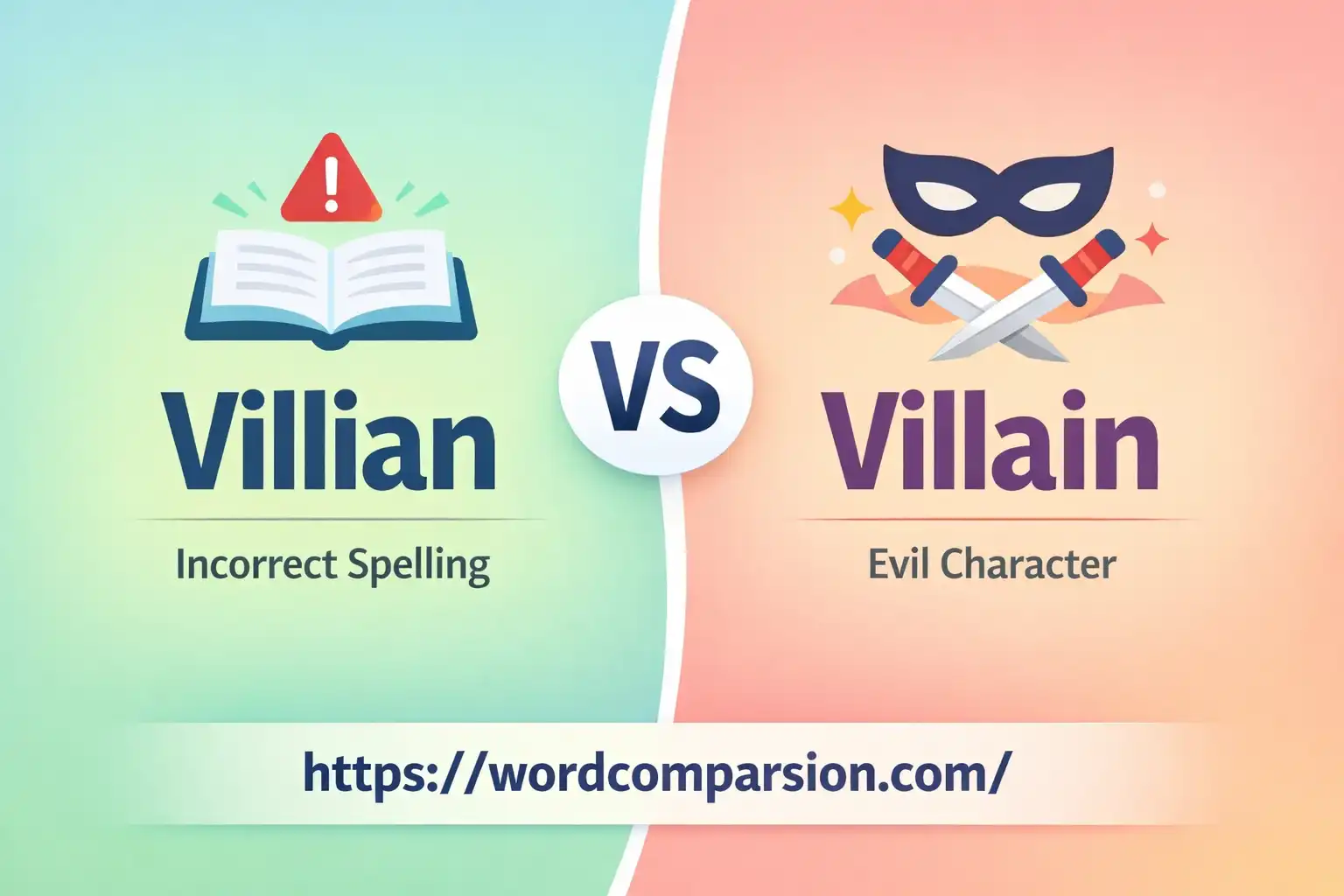
Many people stop and think when they write villain or villian. The confusion feels small. However, it happens very often. Students, writers, and even professionals make this mistake. As a result, simple writing errors appear in emails, posts, and documents.
This problem exists because English spelling is not always logical. Moreover, double letters often confuse learners. In addition, spellcheck tools do not always explain why something is wrong. Therefore, people repeat the same error again and again.
This article solves that exact problem. First, it explains which spelling is correct. Then, it shows why the confusion exists. After that, it gives clear rules, real examples, and common mistakes. Finally, it offers one simple rule you can always remember. By the end, you will never hesitate again when choosing between villain and villian.
Explore the “full word comparison library” to spot similar mix-ups.
Villain or Villian – Quick Answer
Villain is the correct spelling.
Villian is incorrect and should not be used.
- Villain means a bad or evil person.
- Villian is a common spelling mistake.
For example:
✅ The villain lost in the final scene.
❌ The villian lost in the final scene.
The Origin of Villain
The word villain has a long history. It comes from the Old French word vilain. That word described a farm worker or common person. Over time, the meaning changed. As a result, the word started to describe rude or immoral people.
Later, English adopted the term. However, the spelling stayed close to French roots. Therefore, the double L remained in place. Meanwhile, pronunciation shifted slightly, which added confusion.
The spelling villian appeared because people hear the sound vil-yan. As a result, they assume the letters should follow that sound. English, however, does not always follow sound-based spelling. Consequently, this error continues today.
See the “Wrong Spelling collection” for more quick fixes to common misspellings.
British English vs American English Spelling
Some words change spelling between regions. For example, colour and color differ. However, villain does not change. Both British and American English use the same spelling.
| Feature | Villain | Villian |
| British English | ✅ Correct | ❌ Wrong |
| American English | ✅ Correct | ❌ Wrong |
| Formal writing | ✅ Accepted | ❌ Rejected |
| Informal writing | ✅ Accepted | ❌ Still wrong |
In contrast to other words, no regional rule applies here. Therefore, one spelling works everywhere.
Which Spelling Should You Use?
The answer depends on correctness, not audience. Still, guidance helps.
For the United States
Always use villain. Schools, media, and books accept only this form.
For the UK and Commonwealth
Again, villain remains correct. Style guides support this spelling.
For global or professional writing
Use villain without hesitation. Editors and readers expect it. Moreover, search engines recognize only this spelling. In short, villain works for every audience.
You might also like our “fead or feed explanation” for a similar issue.
Common Mistakes with Villain
People repeat the same errors often. Below are the most frequent ones.
❌ The villian escaped from prison.
✅ The villain escaped from prison.
❌ He acted like a villian in the movie.
✅ He acted like a villain in the movie.
❌ The villian’s plan failed.
✅ The villain’s plan failed.
These mistakes happen because writers swap the A and I. Therefore, remembering letter order is key.
Villain in Everyday Examples
Seeing real usage helps fix memory.
Emails
The villain in the story represents fear.
News
The film presents the villain as complex and emotional.
Social media
Every hero needs a strong villain.
Formal writing
The villain symbolizes moral conflict in literature.
Across all contexts, spelling stays the same. Therefore, consistency matters. For another quick check, read “saucey or saucy” next.
Villain – Google Trends & Usage Data
Search behavior shows strong patterns. Globally, users search villain far more than villian. However, mistakes still appear.
By country
English-speaking countries search the correct spelling more often. Meanwhile, ESL regions show higher error rates.
By user type
Students and ESL learners confuse spelling most. Writers and professionals make fewer errors.
Correct vs incorrect usage
Correct usage dominates. Still, thousands search the wrong spelling each month. As a result, confusion continues.
Comparison Table: Villain vs Villian
| Feature | Villain | Villian |
| Meaning | Evil or bad person | No meaning |
| Part of speech | Noun | Not a word |
| Context of use | Stories, news, speech | None |
| Formal or informal | Both | Neither |
| Common mistakes | Letter order | Misspelling |
| Correct example | The villain was defeated. | ❌ Not usable |
This table removes confusion instantly.
Semantic FAQs (People Also Ask)
Is villain the same as villian?
No. Villain is correct. Villian is a spelling error.
Which one is correct in formal writing?
Only villain works in formal writing.
Can they be used interchangeably?
No. One is real. The other is wrong.
Why do people confuse them?
Because pronunciation suggests the wrong letter order.
Can grammar tools catch this mistake?
Yes. Most tools flag villian as incorrect.
Is there a British vs American difference?
No difference exists for this word.
Conclusion
Overall, the difference between villain and villian is simple. Only one spelling is correct. However, the confusion feels natural because English spelling often breaks logic. As a result, many people guess instead of checking.
Throughout this article, you learned the origin of the word. Moreover, you saw how pronunciation causes mistakes. In addition, examples showed correct usage in real life. Therefore, you now have clarity instead of doubt.
In short, always choose villain. Never use villian. Finally, remember this easy rule:
If you mean an evil person, use double L and no extra A.
Related reading: see “discard or disgard” for another commonly mixed-up pair.

James Holloway writes detailed guides on confusing English words and grammar usage with clear side-by-side comparisons.