Many people search “unauthorised or unauthorized” because they see both spellings online and get confused about which one is correct. You might notice unauthorised in UK news websites, but unauthorized in American emails, software messages, and official warnings. This creates doubt, especially for students, writers, bloggers, and anyone who writes for an international audience.
The good news is that the confusion is not about meaning. Both spellings mean the same thing. The difference is mainly about British English vs American English spelling rules. English has several words that change spelling depending on the country, and this is one of the most common examples.
If you are writing a blog post, a legal notice, a business email, a website, or even a security message like “unauthorized access,” using the wrong spelling for your audience can look unprofessional or reduce clarity. That is why people search this keyword—they want a clear answer and simple guidance.
In this 2026 guide, you will get a quick answer, the spelling rule, British vs American differences, real-life examples, common mistakes, and FAQs. By the end, you will know exactly which spelling to use and when. You can explore more spelling differences in the word comparison hub.
Unauthorised or Unauthorized – Quick Answer
Searchers often ask unauthorised or unauthorized when they want US vs UK spelling. Unauthorized is American English and unauthorised is British and Australian English. Queries like unauthorised spelling and spell unauthorized are common because users want the correct regional form.
✅ Both spellings are correct.
They are correct in different types of English:
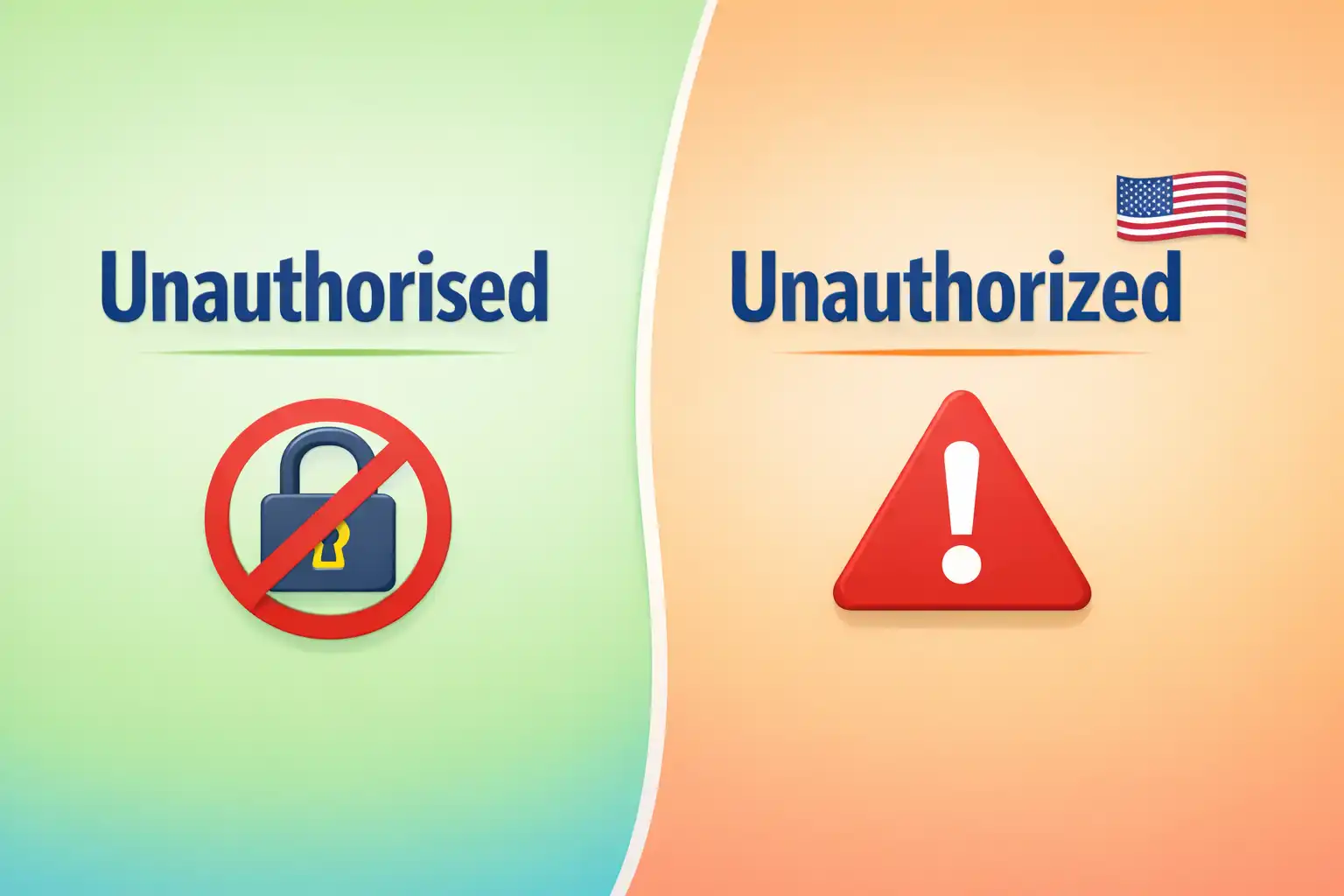
- Unauthorised → ✅ British English (UK, Australia, New Zealand, many Commonwealth countries)
- Unauthorized → ✅ American English (United States)
Examples:
✅ This access is unauthorised. (UK spelling)
✅ This access is unauthorized. (US spelling)📌 Meaning in both cases: “Not allowed” / “Without permission” / “Not approved”
What Do Unauthorised and Unauthorized Mean?
Both words mean the same thing:
Unauthorised / Unauthorized = something done without permission or approval.
You can use these words for many situations, such as:
- unauthorised access to a system
- unauthorized transaction in banking
- unauthorised entry into a building
- unauthorized use of content or software
So, if you are asking: “Is unauthorised or unauthorized correct?”
The answer is: Both are correct—choose based on your audience.
Why Do People Confuse “Unauthorised” and “Unauthorized”?
This confusion happens because English spelling changes across regions. Many people learn English from:
- movies and YouTube (often American English)
- school books (sometimes British English)
- online articles (mixed spelling)
So they end up seeing both spellings and think:
- “Maybe one is wrong?”
- “Maybe one is older?”
- “Which one should I use in writing?”
But in reality, this is a normal spelling difference, just like:
- colour vs color
- centre vs center
- organise vs organize
British vs American Spelling Rule (Simple Explanation)
The difference comes from the spelling patterns:
✅ British English usually prefers -ise
- authorise
- organise
- realise
✅ American English usually prefers -ize
- authorize
- organize
- realize
So the negative form also changes:
- Unauthorised (British spelling)
- Unauthorized (American spelling)
📌 Important: This is not a grammar rule. It is only a spelling convention.
The Origin of Unauthorised / Unauthorized
The word comes from “authorise / authorize”, which is based on the Latin word auctor, meaning one who gives permission or authority.
- British English kept the “-ise” ending
- American English standardized the “-ize” ending
Over time, these spelling differences became fixed in style guides, dictionaries, and education systems. That is why both spellings exist today.
This is part of our “UK vs US spelling guide” with more British and American variants.
Which Spelling Should You Use in 2026?
The best spelling depends on your audience.
If your audience is in the United States
Use: ✅ Unauthorized
Examples:
- unauthorized access
- unauthorized transaction
- unauthorized use
This spelling is extremely common in:
- software security messages
- banking and payment systems
- American news and legal writing
If your audience is in the UK or Commonwealth countries
Use: ✅ Unauthorised
Examples:
- unauthorised entry
- unauthorised activity
- unauthorised use
This spelling is common in:
- UK government documents
- British newspapers
- Australian and New Zealand writing
If your audience is global
Pick one spelling and stay consistent.
For example:
- If your website targets US traffic → use unauthorized
- If your website targets UK traffic → use unauthorised
📌 The biggest mistake is not choosing the spelling—
the biggest mistake is mixing both in the same article.
Consistency matters more than the spelling itself. A similar regional spelling difference appears in socialise vs socialize.
Common Mistakes (and Correct Versions)
Many people make small mistakes with these spellings. Here are the most common ones:
❌ Mistake 1: Mixing spellings in one document
Wrong:
❌ This access is unauthorised, but the system blocked unauthorized entry.
Correct:
✅ This access is unauthorised, and the system blocked unauthorised entry. (UK style)
OR
✅ This access is unauthorized, and the system blocked unauthorized entry. (US style)
❌ Mistake 2: Thinking one spelling is “more correct”
Wrong thinking:
❌ “Unauthorized is correct and unauthorised is wrong.”
Correct understanding:
✅ Both are correct, but they belong to different English variants.
❌ Mistake 3: Using autocorrect without checking
Some keyboards change spelling automatically.
Correct tip:
✅ Always check your final draft and keep the spelling consistent.
❌ Mistake 4: Choosing spelling only for SEO
SEO is important, but audience clarity matters more.
Correct approach:
✅ If you target US readers, use unauthorized
✅ If you target UK readers, use unauthorised
You can still mention the other spelling once in the article to capture global searches, but keep one as the main version.
Unauthorised or Unauthorized in Real-Life Examples
Here are natural examples you can use in writing:
Emails
✅ Your account was flagged for unauthorized activity.
✅ This action is unauthorised under company policy.
Security & Technology
✅ The system blocked unauthorized access.
✅ An unauthorised login attempt was detected.
News
✅ Police reported an unauthorised entry into the building.
✅ The bank stopped an unauthorized transaction.
Social Media
✅ Why was my account marked as unauthorized?
✅ I didn’t approve this—this is unauthorised!
Formal Writing
✅ Any unauthorised distribution of this document is prohibited.
✅ Unauthorized copying may result in legal action.
Unauthorised or Unauthorized – Google Trends & Usage Data
Search data shows clear regional patterns:
- Unauthorized → Most searched in the United States
- Unauthorised → Common in UK, Australia, India
- Global platforms show both spellings depending on region
Websites often optimize content using both versions to capture global traffic, but they keep one spelling as primary.
Unauthorised vs Unauthorized: Comparison Table
Here is a quick comparison:
| British English | American English | Meaning |
| unauthorised | unauthorized | without permission |
| authorised | authorized | officially allowed |
| authorise | authorize | give permission |
| organisation | organization | group/company |
| realise | realize | understand/notice |
FAQs (Unauthorised or Unauthorized – 2026)
Is “unauthorised” wrong?
No. Unauthorised is correct in British English.
Is “unauthorized” more correct?
No. Unauthorized is correct in American English, not “more correct.”
Can I use both spellings in one article?
It’s better not to. Choose one spelling and stay consistent to look professional.
Unauthorised or unauthorized which is correct
Both are correct depending on region unauthorized is US spelling and unauthorised is UK and Australian spelling.
Difference between unauthorised and unauthorized
The meaning is the same and the difference is spelling style.
Unauthorised UK spelling is it correct
Yes unauthorised is correct in UK and Australian English.
Is it unauthorised or unauthorized
Choose based on your audience UK and Australia prefer unauthorised and US prefers unauthorized.
Unauthorised spelling what is correct
Unauthorised is spelled with s in UK and Australian English.
Spell unauthorized ?
Unauthorized is spelled u n a u t h o r i z e d.
Conclusion
The confusion between unauthorised or unauthorized comes from British vs American spelling, not from meaning or correctness. Both spellings are valid and widely used in professional, legal, and everyday writing.
The simple rule is this:
- Use unauthorised for British English audiences
- Use unauthorized for American English audiences
If you write for a global audience, choose one spelling and stay consistent throughout your content. Once you understand this difference, you can write confidently and avoid unnecessary corrections.
Understanding this difference helps you write withconfidence, look professional, and avoid unnecessary corrections. Once you know the rule, this keyword becomes easy to handle in any type of writing. This spelling difference is explained in the UK vs US category.

James Holloway writes detailed guides on confusing English words and grammar usage with clear side-by-side comparisons.