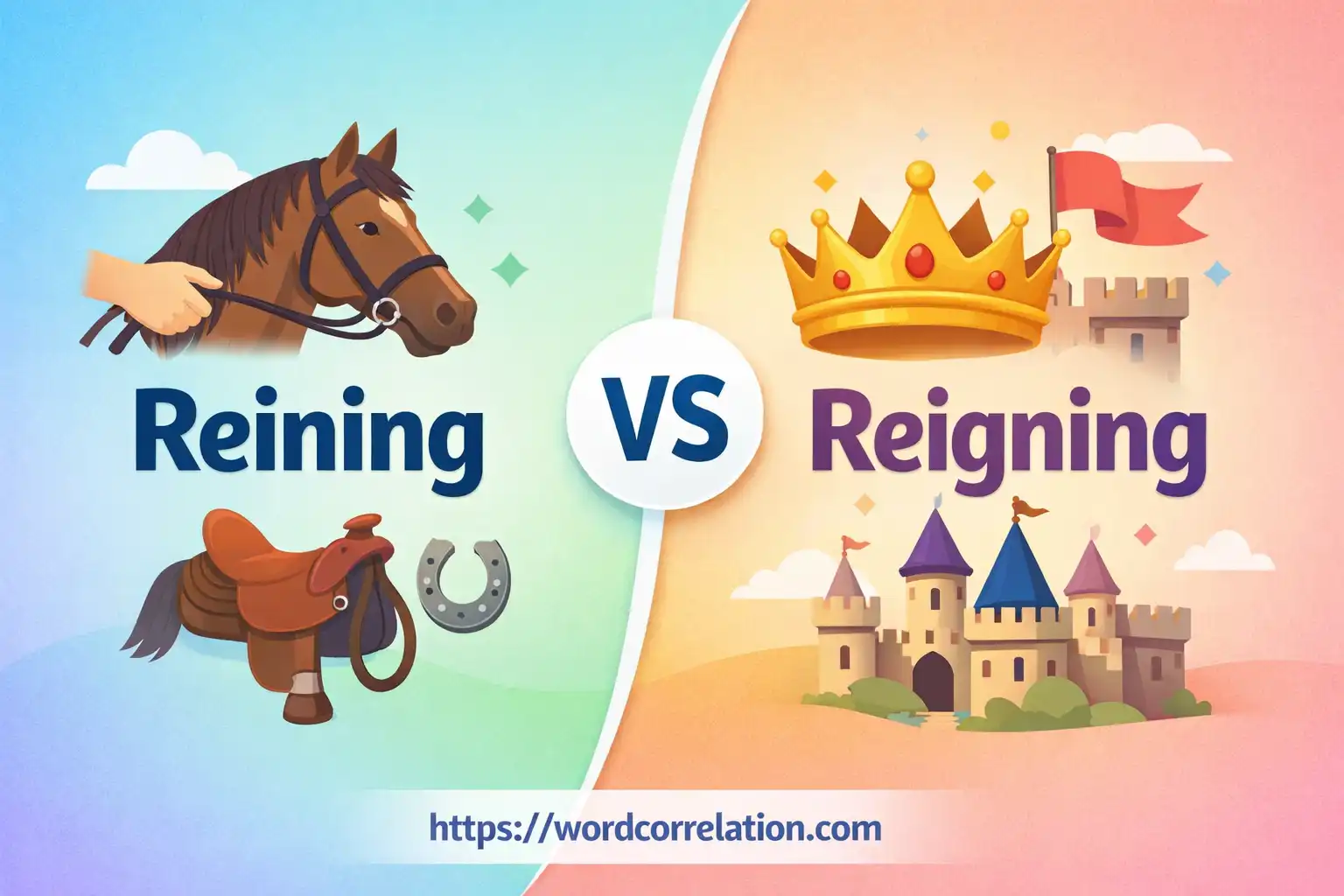
Many people search for reining or reigning because these two words look similar. However, their meanings are very different. As a result, writers, students, and ESL learners often feel confused. Moreover, grammar tools do not always explain the reason clearly. Therefore, mistakes keep happening in emails, exams, blogs, and even news writing.
In most cases, the confusion starts with sound. Both words sound almost the same when spoken. Additionally, both words exist in correct English, which makes the problem harder. In contrast, only one word fits a specific context. Because of this, readers often guess instead of choosing correctly.
This article solves that problem completely. First, you will learn the real meaning of each word. Then, you will see where people make mistakes and why. Moreover, you will understand British and American spelling differences. Finally, you will get simple rules, examples, and tables that remove all doubt. Overall, by the end, you will never confuse reining or reigning again.
Explore the “full word comparison library” to spot similar mix-ups.
Reining or Reigning – Quick Answer
Reining relates to control, especially with horses.
Reigning relates to ruling or being in power.
- ✅ She is the reigning champion.
- ✅ He pulled the reins, so the horse was reining in.
Rule:
If it means control, use reining.
If it means rule or power, use reigning.
The Origin of Reining or Reigning
The history of these words explains the confusion clearly. Reining comes from the word rein. A rein is a strap used to guide a horse. Therefore, the meaning connects to control or restraint. Over time, people started using reining in to mean controlling ideas, money, or actions.
On the other hand, reigning comes from the word reign. This word relates to kings, queens, and rulers. As a result, reigning means ruling, leading, or being dominant. Moreover, the word often appears in sports, politics, and leadership contexts.
The confusion happens because both words sound the same when spoken. However, their roots are completely different. Therefore, spelling matters a lot in writing. For similar mix-ups, visit the “commonly confused words” pillar page.
British English vs American English Spelling
Many learners think this issue is about British and American spelling. However, that idea is incorrect. Both reining and reigning exist in British and American English. The difference is meaning, not region.
| Aspect | Reining | Reigning |
|---|---|---|
| English type | US & UK | US & UK |
| Meaning | Control or restraint | Rule or dominance |
| Common phrase | Reining in | Reigning champion |
In contrast to spelling differences like color and colour, this pair works the same everywhere. Therefore, location does not change the correct choice.
Which Spelling Should You Use?
The correct spelling depends on your message. Therefore, always focus on meaning first.
For US audiences, use reigning when talking about winners, leaders, or power. Meanwhile, use reining when control or limits are involved.
For UK or Commonwealth audiences, the same rule applies. However, readers often expect precise usage in formal writing.
For global or professional writing, accuracy matters even more. As a result, editors and teachers notice this error quickly. Therefore, choosing the right word improves credibility instantly. In short, spelling choice follows meaning, not audience location.
You might also like our “bases or basis explanation” for a similar issue.
Common Mistakes with Reining or Reigning
Many errors happen because writers rely on sound, not sense. Below are the most common mistakes with clear fixes.
❌ She is the reining champion of the world.
✅ She is the reigning champion of the world.
Explanation: A champion rules the title.
❌ The government is reigning in spending.
✅ The government is reining in spending.
Explanation: Spending needs control, not rule.
❌ He is reining king of the region.
✅ He is the reigning king of the region.
Explanation: Kings reign, not rein.
These small errors change meaning. Therefore, careful checking is necessary.
Reining or Reigning in Everyday Examples
In emails, people often write fast. For example, “We are reining leaders in this field” is wrong. Instead, “We are reigning leaders” sounds professional.
In news, journalists use reigning for titles. Meanwhile, they use reining in for policies or actions.
On social media, mistakes spread quickly. However, correct usage builds trust and authority.
In formal writing, teachers and editors expect accuracy. As a result, one wrong letter can reduce credibility. Therefore, using the right word always helps your image.
Reining or Reigning – Google Trends & Usage Data
Search data shows that many users type reining or reigning together. This pattern proves confusion. Students search it for exams. Writers search it for clarity. ESL learners search it for confidence. Professionals search it to avoid embarrassment.
Correct usage appears more in edited content like books and news. However, mistakes appear often in blogs and social posts. Therefore, learning this difference gives an advantage in writing quality.
Overall, the trend shows a clear need for simple explanations like this one.
Comparison Table: Reining vs Reigning
| Feature | Reining | Reigning |
|---|---|---|
| Meaning | Controlling or restraining | Ruling or holding power |
| Part of speech | Verb | Verb / adjective |
| Context of use | Horses, control, limits | Kings, leaders, champions |
| Formal or informal | Both | Mostly formal |
| Common mistake | Used for leaders | Used for control |
| Correct example | Reining in costs | Reigning world champion |
This table removes confusion instantly by separating meaning and use.
Semantic FAQs (People Also Ask)
Is reining the same as reigning?
No. They sound alike but mean different things.
Which one is correct in formal writing?
Both are correct when used in the right context.
Can they be used interchangeably?
No. Interchanging them changes meaning.
Why do people confuse them?
Because they sound the same when spoken.
Can grammar tools catch this mistake?
Sometimes. However, tools miss context often.
Is there a British vs American difference?
No. Meaning stays the same in both.
Conclusion
Overall, reining or reigning is confusing because sound hides meaning. However, once you understand the difference, the problem disappears. Reining always links to control, limits, or restraint. In contrast, reigning always links to rule, leadership, or dominance.
Many people make this mistake because they write fast. Moreover, they rely on sound instead of sense. Therefore, slowing down helps. Additionally, checking meaning before spelling prevents errors.
In short, remember one easy rule. If you can replace the word with control, choose reining. If you can replace it with ruling, choose reigning. Finally, use this rule every time you write, and confusion will never return. For another quick check, read “performing or preforming” next.

James Holloway writes detailed guides on confusing English words and grammar usage with clear side-by-side comparisons.