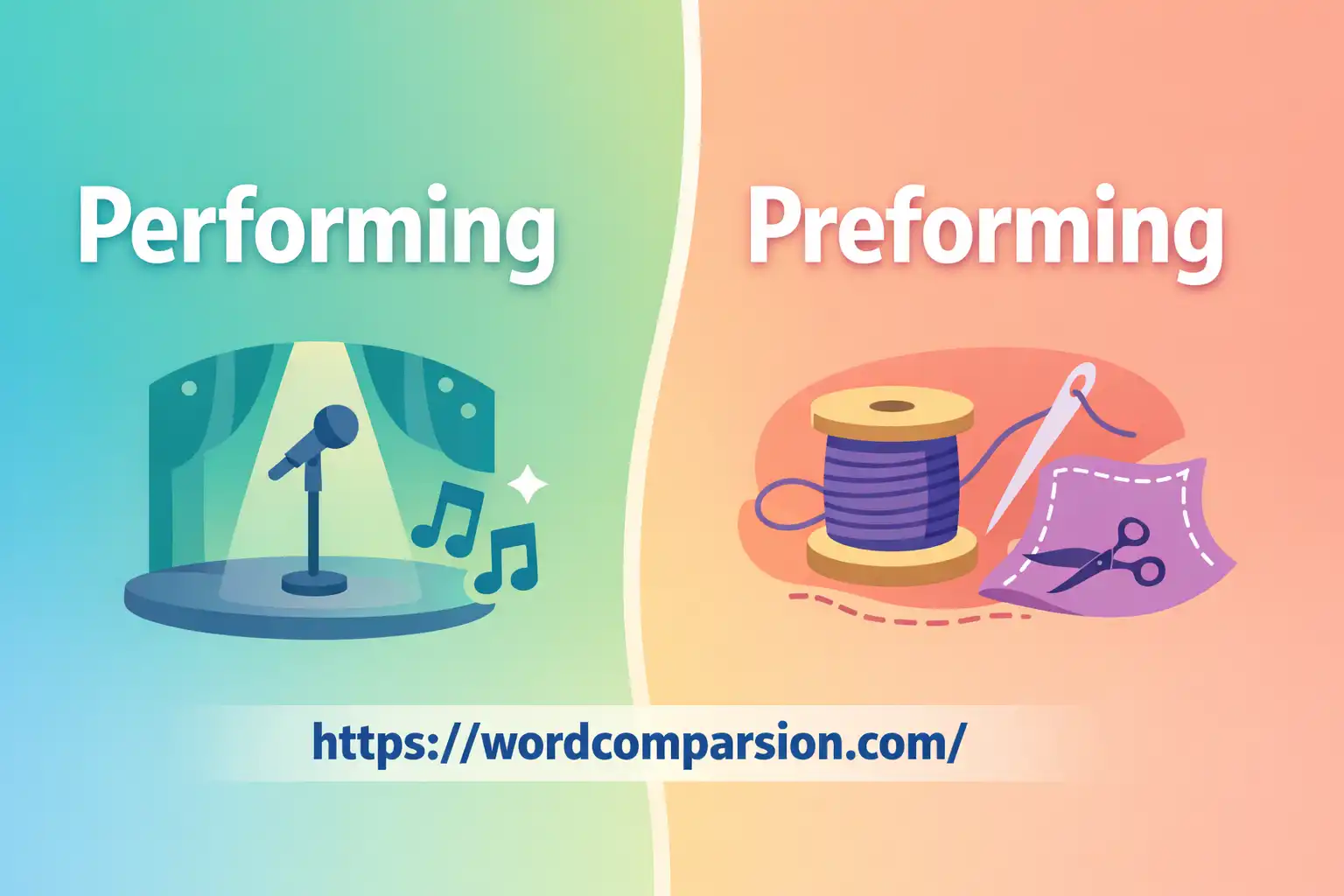
Many people stop while writing and ask one question: performing or preforming?
This confusion is very common. Students face it in exams. Writers face it in emails. ESL learners face it in daily practice. However, the problem feels bigger than it is.
The confusion happens because both words look similar. Moreover, both come from related ideas. As a result, spellcheck often misses the error. Additionally, grammar tools may not warn you. Therefore, people keep repeating the same mistake.
This article solves that exact problem. It explains the real meaning of performing and preforming. It also shows where each word fits. In contrast to short dictionary notes, this guide uses real examples. Furthermore, it explains why people confuse these words. Meanwhile, you will learn how to choose the right word every time.
Overall, this guide is simple. It uses clear English. It avoids complex grammar. Finally, it gives you one easy rule to remember forever. Start from the “word comparison home page” to compare more words.
Performing or Preforming – Quick Answer
Performing means doing an action, task, or job.
Preforming means shaping or forming something in advance.
- Use performing for actions or activities.
- Use preforming for physical shaping before final use.
For example:
- She is performing well at work.
- The factory is preforming metal parts.
The Origin of Performing or Preforming
The word performing comes from Old French parfournir. It meant “to complete” or “to carry out.” Over time, English kept that idea. Therefore, today it means doing an action or task.
The word preforming has a different path. It comes from the prefix pre-, meaning “before,” and forming, meaning “to shape.” As a result, it describes shaping something before the final step.
The confusion happens because both words share the root form. However, their prefixes change everything. In contrast, one focuses on action, while the other focuses on shape.
Browse the “Word Confusion” category to avoid meaning swaps.
British English vs American English Spelling
There is no spelling difference between British and American English for these words. However, confusion still appears in both regions.
| Aspect | Performing | Preforming |
| UK usage | Very common | Very rare |
| US usage | Very common | Very rare |
| Meaning change | No | No |
In contrast to words like “colour” and “color,” these spellings stay the same everywhere. Therefore, region does not change correctness.
Which Spelling Should You Use?
Choosing the right word depends on meaning, not location.
For US writers, performing fits most cases.
For UK and Commonwealth writers, performing also fits most cases.
For global or professional writing, preforming only fits technical or industrial topics.
Moreover, if you talk about people, skills, or actions, choose performing.
However, if you talk about materials or manufacturing steps, choose preforming.
As a result, context decides everything.
Common Mistakes with Performing or Preforming
Many errors repeat again and again. Understanding them saves time.
❌ He is preforming well in exams.
✅ He is performing well in exams.
Explanation: Exams involve action, not shaping.
❌ The actor is preforming on stage.
✅ The actor is performing on stage.
Explanation: Acting is an action.
❌ The company is performing plastic sheets before molding.
✅ The company is preforming plastic sheets before molding.
Explanation: This involves shaping before final use.
Therefore, always ask what is happening: action or shape.
Performing or Preforming in Everyday Examples
In emails, performing appears often.
Example: “Our team is performing better this quarter.”
In news writing, performing dominates.
Example: “The market is performing strongly today.”
On social media, people often misspell the word.
Example: “You are preforming great” ❌
Corrected: “You are performing great” ✅
In professional or technical writing, preforming appears rarely.
Example: “The engineer is preforming steel rods.”
Meanwhile, everyday life almost never needs preforming.
Performing or Preforming – Google Trends & Usage Data
Search data shows clear patterns. Performing appears in millions of searches. Preforming appears mostly in niche fields.
By country, students in the US and UK search this topic often. ESL learners also search it frequently. Moreover, writers and editors search it to avoid mistakes.
Correct usage dominates professional writing. However, common mistakes still appear in casual content. As a result, this confusion keeps spreading online.
Overall, performing wins in frequency by a huge margin. For another quick check, read “apprised or appraised” next.
Performing vs Preforming: Clear Comparison Table
| Feature | Performing | Preforming |
| Meaning | Doing an action | Shaping in advance |
| Part of speech | Verb | Verb |
| Context of use | Work, skills, actions | Manufacturing, materials |
| Formal vs informal | Both | Mostly formal |
| Common mistakes | Misspelled as preforming | Used instead of performing |
| Correct example | She is performing well | The factory is preforming parts |
This table removes confusion instantly.
Semantic FAQs (People Also Ask)
Is performing the same as preforming?
No. Performing means doing. Preforming means shaping before use.
Which one is correct in formal writing?
Both can be correct. However, context decides.
Can they be used interchangeably?
No. Their meanings are different.
Why do people confuse them?
They look similar and share the word “form.”
Can grammar tools catch this mistake?
Sometimes no, because both are real words.
Is there a British vs American difference?
No. Both regions use the same spelling.
Conclusion
Overall, the confusion between performing or preforming comes from similarity, not meaning. However, the difference is clear once you understand it. Performing always relates to action, behavior, or results. In contrast, preforming relates to shaping materials before final processing. If you’re comparing similar terms, our “how to use jibe or jive” article can help.
Students should remember this rule for exams. Writers should apply it in emails and articles. ESL learners should practice it with real examples. Meanwhile, professionals should reserve preforming for technical contexts only.
In short, ask one simple question before choosing the word:
Is this about doing something or shaping something?
Finally, if it involves people, skills, or tasks, choose performing every time.

James Holloway writes detailed guides on confusing English words and grammar usage with clear side-by-side comparisons.