Many people search “manor or manner” because the words look and sound similar. However, their meanings are very different. This mistake is common for students, writers, and English learners. It often appears in emails, exams, and professional writing. Even a small spelling error can change the meaning of a sentence.
At first, both words may seem related to something formal or “proper.” But they are not the same. Manner is about behavior or the way someone does something. Manor refers to a large house or estate. Because English spelling can be tricky, people often mix them up when writing quickly.
This 2026 guide makes the difference simple. You will learn the meanings, the easiest rule to remember, and clear examples. You will also see common mistakes, a comparison table, and FAQs based on real searches like “manner or manor,” “manner or mannar,” and “manner or mannor.” For more quick side-by-side checks, browse the “word comparison hub“.
Manor or Manner – Quick Answer
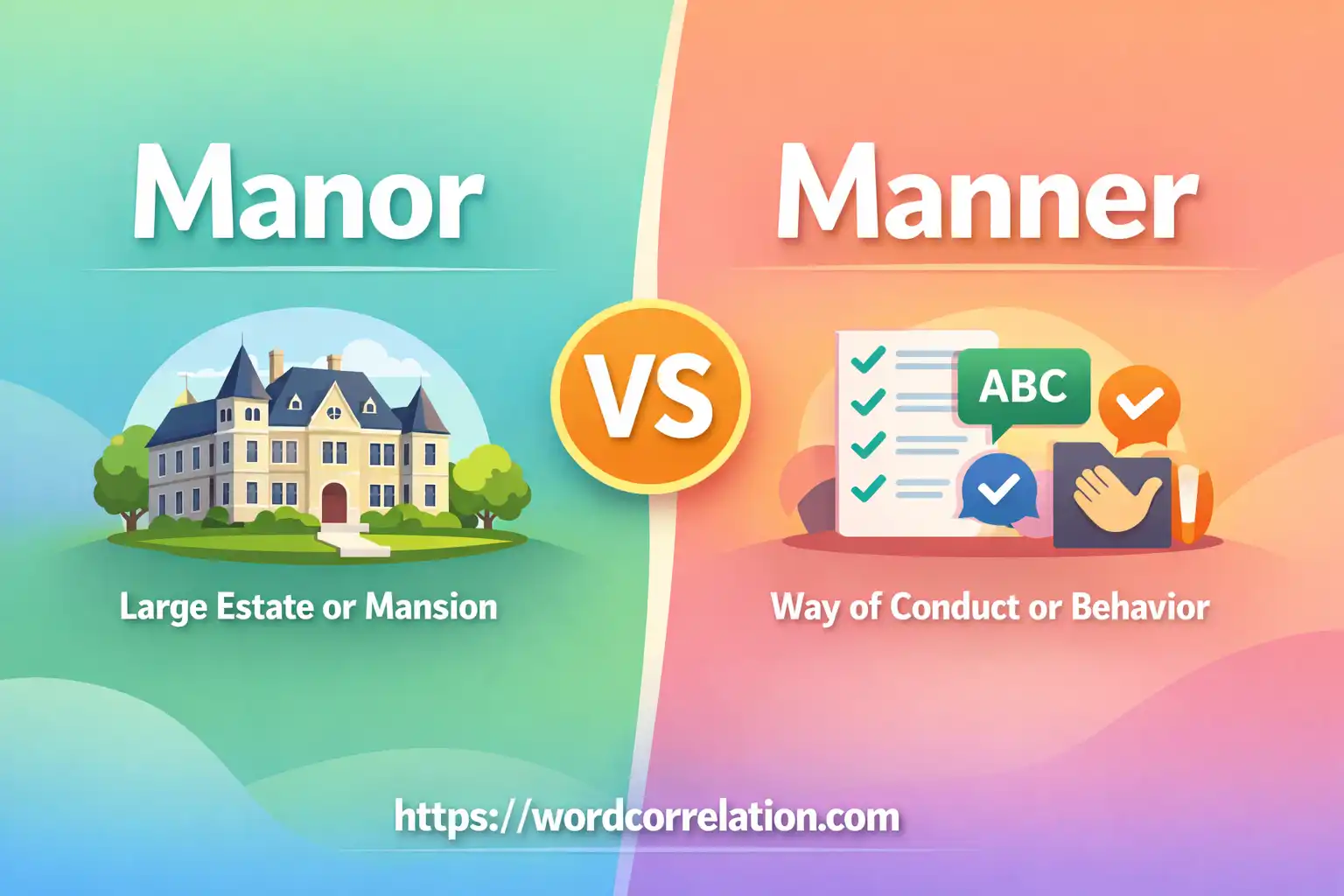
✅ Correct: Manor = a large house or estate
✅ Correct: Manner = behavior or the way something is done
❌ Incorrect: Using manor for behavior
❌ Incorrect: Using manner for a house or property
Examples:
- ✅ A rich family owns a manor.
- ✅ She speaks in a polite manner.
- ❌ She speaks in a polite manor.
- ❌ They visited a beautiful manner.
📌 Simple rule: Behavior = manner | House/estate = manor
Why People Get Confused (Manor vs Manner)
People confuse manor and manner because:
- They look very similar in spelling
- They sound similar when spoken quickly
- Both words feel “formal,” so writers guess
- Spellcheck does not always catch the mistake
- Some people type the wrong word from memory
That’s why many people search variations like:
- manner or manor
- manner or mannar (misspelling)
- manner or mannor (misspelling)
- mannor or manor (misspelling)
Even if the spelling is wrong in the search query, the meaning question is the same: Which word is correct? Browse the “Word Confusion” category to avoid meaning swaps.
The Simple Rule (Easy Trick to Remember)
If you want to choose correctly every time, use this trick:
✅ Use manner when talking about behavior or method
Ask yourself: How is someone doing something?
- politely
- angrily
- calmly
- professionally
➡️ That’s manner.
✅ Use manor when talking about a building, land, or estate
Ask yourself: Is it a place or property?
- a large house
- an estate
- land around a big home
- historical property
➡️ That’s manor.
One-line memory tip:
Manner = manners (behavior)
Manor = mansion (big house)
Meaning of Manor
Manor is a noun that usually means:
✅ A large country house or estate
A manor is often a big house with land around it. Historically, it was connected to wealthy families, lords, or landowners.
Examples of “manor” meaning:
- a historic manor
- a manor house
- the old manor on the hill
- the family manor
In simple words:
Manor = big house + estate/property
Meaning of Manner
Manner is also a noun, but it means:
✅ The way someone behaves or does something
It can describe behavior, style, or method.
Examples of “manner” meaning:
- polite manner
- rude manner
- calm manner
- professional manner
In simple words:
Manner = behavior / way / style
Manor or Manner in Everyday Examples
Here are real-life examples to help you see the difference clearly.
Emails
✅ He replied in a professional manner.
✅ Please communicate in a respectful manner.
News
✅ The old manor was sold to the city council.
✅ A fire damaged a historic manor in the countryside.
Social Media
✅ Don’t talk to people in that rude manner.
✅ That manor looks like it belongs in a movie!
Formal Writing
✅ The historic manor reflects local heritage.
✅ The manager addressed the issue in a calm manner.
Common Mistakes (and Correct Versions)
These mistakes are very common and can change the meaning of the sentence.
❌ Mistake 1: Using manor when you mean behavior
Wrong: She spoke in a polite manor.
Correct: She spoke in a polite manner.
❌ Mistake 2: Using manner when you mean a house or estate
Wrong: They visited a beautiful manner in the countryside.
Correct: They visited a beautiful manor in the countryside.
❌ Mistake 3: Confusing the spellings (mannor / mannar)
Wrong: The mannor was very old.
Correct: The manor was very old.
Wrong: His mannar was rude.
Correct: His manner was rude.
❌ Mistake 4: Guessing instead of checking meaning
Tip: If it’s about behavior, choose manner.
If it’s about a property, choose manor.
People also write:
- mannor (wrong spelling)
- mannar (wrong spelling)
✅ Correct spellings are only:
manner
manor
Manor vs Manner – Comparison Table (Fast Difference)
| Feature | Manor | Manner |
| Meaning | Large house / estate | Behavior / way of doing |
| Part of speech | Noun | Noun |
| Used for | Property, buildings, land | Attitude, style, method |
| Common phrases | manor house, old manor | polite manner, rude manner |
| Correct example | They live in a manor. | He spoke in a calm manner. |
| Common mistake | Used for behavior ❌ | Used for buildings ❌ |
British English vs American English (Any Difference?)
Good news: There is no UK vs US spelling difference here.
Both British and American English use:
- manor = estate/house
- manner = behavior/method
So the correct choice depends only on meaning, not location. If you’re comparing similar terms, our “how to use reining or reigning” article can help.
More Examples in Sentences (Practice)
Here are extra examples (very useful for students and ESL learners):
- She answered the question in a confident manner.
- The guests arrived at the manor in the evening.
- He apologized in a sincere manner.
- The old manor has a beautiful garden.
- Her friendly manner made everyone comfortable.
- The manor was built over 200 years ago.
- The teacher spoke in a strict manner.
- They restored the historic manor to its original design.
- His rude manner upset the customers.
- The family inherited the manor from their ancestors.
Manor or Manner – Google Trends & Usage (Why It’s Popular)
Search data shows strong interest in manor or manner, especially in countries where English is a second language. Students, writers, and professionals often search it because:
- the words are confusing in spelling
- they sound similar in pronunciation
- the mistake is common in exams and writing
- people want a quick answer before publishing
That’s why users type different versions like:
- manner or manor
- manner or mannar
- manner or mannor
- mannor or manor
Even when the spelling is wrong, the goal is the same: choose the correct word.
FAQs (Based on Real GSC Queries)
1) Manner or manor — which is correct?
Both are correct, but they have different meanings:
- manner = behavior
- manor = estate/house
2) Is “manner or mannar” correct spelling?
❌ No. “mannar” is incorrect.
✅ The correct word is manner (with “e”).
3) Is “manner or mannor” correct spelling?
❌ No. “mannor” is incorrect.
✅ The correct spelling is manor (one “n”) or manner (two “n”), depending on meaning.
4) Mannor or manor — which one is correct?
✅ Manor is correct.
❌ Mannor is a spelling mistake.
5) Can manor and manner be used interchangeably?
No. They are not interchangeable because they mean different things.
Using the wrong one can change your sentence completely.
6) How can I remember the difference easily?
Use this memory trick:
- manner = manners (behavior)
- manor = mansion (big house)
7) Which one is correct in formal writing?
Both are correct in formal writing, as long as you use them correctly:
- formal behavior → manner
- formal estate/property → manor
Conclusion
The confusion between manor or manner happens because the words look and sound similar, but the meanings are very different. Manor refers to a large house or estate, while manner refers to behavior or the way something is done. There is no British vs American spelling difference, so the only thing that matters is context. Related reading: see “bases or basis” for another commonly mixed-up pair.
Before you write, pause and ask one simple question:
Is this about behavior or property?
If it is behavior, use manner. If it is a large house or estate, use manor. This small habit will instantly improve your writing and help you avoid common mistakes. In short, never guess. Instead, connect meaning with purpose. Finally, remember one easy rule:
Behavior = manner, Property = manor.

James Holloway writes detailed guides on confusing English words and grammar usage with clear side-by-side comparisons.