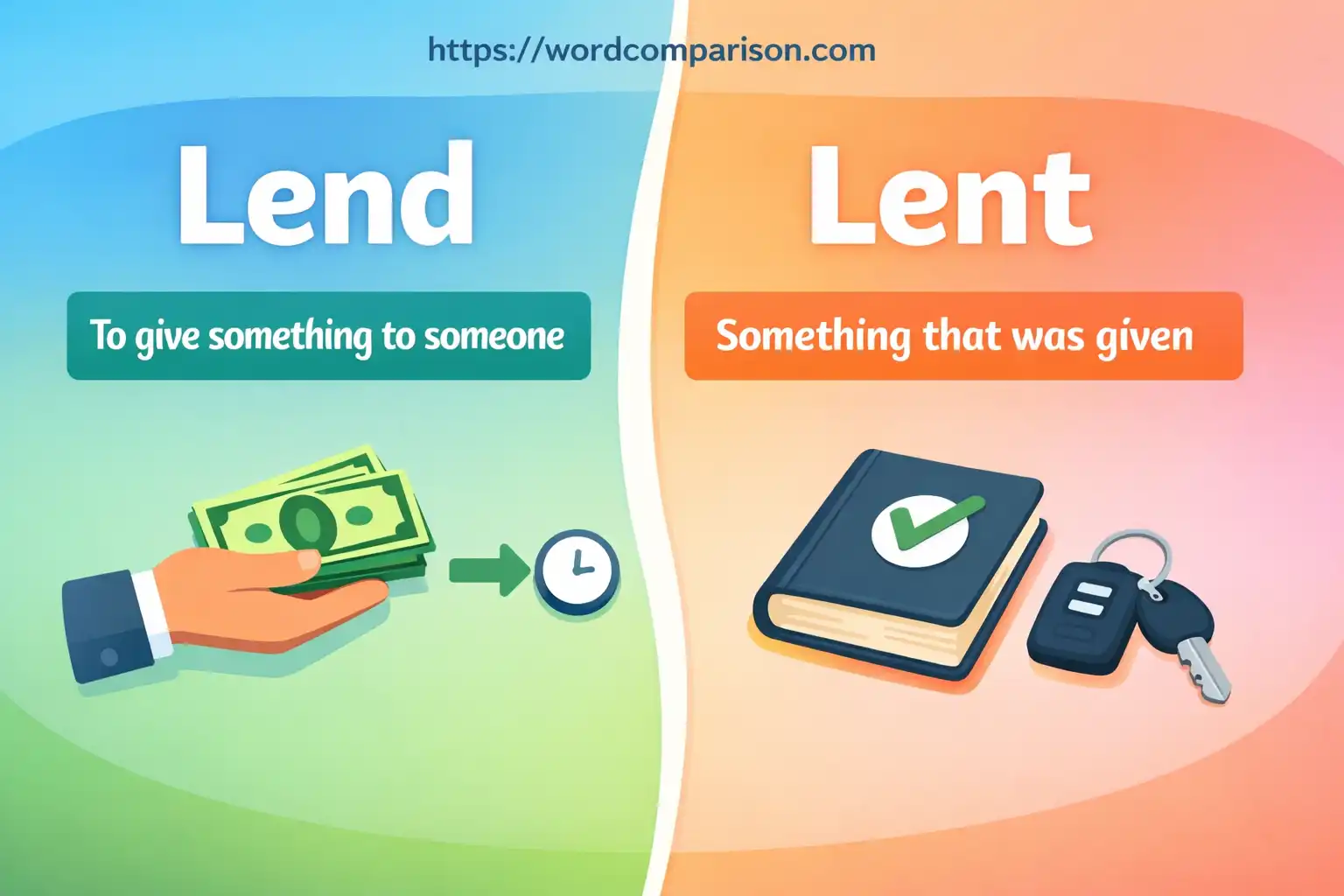
The English language can be tricky for both beginners and native speakers. One area where people often get confused is the difference between lend and lent. These two words are commonly used, but many learners and writers struggle to use them correctly. Understanding when to use lend and lent will help you improve your writing and communication skills.
This article will clear up the confusion surrounding lend vs lent, explain their correct usage, and provide simple examples to guide you. By the end of this article, you will be able to confidently use both words in the right context.
Lend vs Lent – Quick Answer
- Lend is the base form of the verb, meaning to give something temporarily to someone with the expectation of getting it back.
- Example: I will lend you my book.
- Lent is the past tense and past participle of lend.
- Example: I lent her my book yesterday.
Decision rule: Use lend when referring to the present or future, and use lent when talking about the past.
The Origin of Lend vs Lent
The difference between lend and lent comes from their roots in Old English. The verb lend comes from the Old English word lendan, which means “to give or grant temporarily.” Over time, it has evolved into the modern verb we use today.
Lent is simply the past tense and past participle form of lend. It follows a typical pattern in English, where verbs change their form when referring to actions that have already occurred. In the case of lend, lent serves as its past form, just as send becomes sent in the past.
Understanding the origin of these words will help you remember that lend refers to the present and future, while lent refers to something that has already happened.
Reason for Confusion Today
Many English learners struggle with lend vs lent because they are both related to giving something temporarily, but they are used in different contexts. The confusion often arises because the two words sound similar and are used in similar situations. The key difference lies in their tense.
The verb lend is used when referring to an action that is happening now or will happen in the future. For example:
- I lend you my pen.
- She will lend him the money tomorrow.
On the other hand, lent is used to describe actions that have already taken place. For example:
- I lent her my pen yesterday.
- He lent me the money last week.
Writers and learners often confuse lend with lent because they think both words can be used interchangeably in all situations, but this is not the case.
British English vs American English Spelling
Interestingly, the spelling of lend and lent does not change between British and American English. Both lend and lent are used in the same way, regardless of which variety of English you are using.
However, there are other words in English where spelling differences between British and American English matter. For example, colour (British) vs color (American) or travelling (British) vs traveling (American). But when it comes to lend and lent, there is no difference between British and American English usage.
Which Spelling Should You Use?
Since there is no difference in spelling for lend and lent between British and American English, the choice depends on the tense and context.
- Lend: Use when referring to the present or future.
- Lent: Use when referring to the past.
Common Mistakes with Lend vs Lent
One of the most common mistakes learners make is using lend when they should use lent. This mistake happens because both words are related, but they belong in different tenses. Let’s look at a few examples of mistakes:
❌ Incorrect: I lend her my phone last week.
✅ Correct: I lent her my phone last week.
❌ Incorrect: She lent me her book tomorrow.
✅ Correct: She will lend me her book tomorrow.
Here are some more examples:
- Incorrect: I lent him my coat tomorrow.
- Correct: I will lend him my coat tomorrow.
- Incorrect: They lend us their car last month.
- Correct: They lent us their car last month.
As you can see, the confusion mostly comes from using lend when the action is in the past, or using lent when referring to the future.
Lend vs Lent in Everyday Examples
Let’s look at how lend and lent appear in everyday examples:
In Emails:
- Lend: “Can you lend me your notes for the class tomorrow?”
- Lent: “I lent you my notes yesterday. Did you get a chance to review them?”
In News:
- Lend: “The bank will lend money to those who qualify.”
- Lent: “The organization lent a helping hand to the flood victims last year.”
On Social Media:
- Lend: “Who can lend me a phone charger?”
- Lent: “I lent my phone to a friend, and now I can’t find it.”
In Formal Writing:
- Lend: “We are happy to lend our support to this important cause.”
- Lent: “The company lent a significant amount to the startup last year.”
Lend vs Lent – Usage Patterns & Search Interest
Searches for lend vs lent typically come from students, ESL learners, and anyone looking to improve their grammar skills. Writers and editors also search for clarification to avoid making errors in their professional work.
People often search for this keyword when they want to ensure that they are using the right word in the right context. For example, someone might wonder if they should say, “I lend you money last year” or “I lent you money last year.” They are likely unsure of the correct past tense and when to use each.
Comparison Table: Lend vs Lent
| Aspect | Lend | Lent |
| Meaning | To give something temporarily. | The past tense of “lend.” |
| Part of Speech | Verb | Verb (past tense / past participle) |
| Context of Use | Present or future action. | Past action. |
| Formal vs Informal | Can be used in both formal and informal contexts. | Generally used in both contexts, but primarily past tense. |
| Common Mistakes | Incorrectly used in the past tense. | Incorrectly used in the present/future tense. |
| Correct Example | “I lend her my pen.” | “I lent her my pen yesterday.” |
Semantic FAQs
- Is “lend” the same as “lent”?
- No. Lend is the present or future tense, and lent is the past tense.
- Which one is correct in formal writing?
- Both can be correct, depending on the tense. Use lend for present or future actions and lent for past actions.
- Can they be used interchangeably?
- No, because they represent different tenses. Lend is used for present or future, and lent is used for the past.
- Why do people confuse them?
- People confuse lend and lent because they are both related to giving something temporarily, but they are used in different tenses.
- Can grammar tools catch this mistake?
- Yes, most grammar tools can spot the difference and suggest the correct verb tense.
- Is there a British vs American difference?
- No, there is no difference in spelling or usage between British and American English for lend and lent.
Conclusion
To sum up, lend and lent are both essential verbs, but they serve different purposes in the English language. Lend refers to an action happening now or in the future, while lent refers to an action that has already taken place. The most common mistake is using lend in the past tense.
Remember this simple rule: Use lend for present and future actions, and use lent for actions in the past. Once you keep this in mind, you’ll be able to use both words correctly every time!

James Holloway writes detailed guides on confusing English words and grammar usage with clear side-by-side comparisons.