Many people pause when they write it or it’s. The confusion feels small. However, the mistake appears everywhere. Students make it. Professionals make it. Even native speakers get stuck. Therefore, this tiny apostrophe causes big problems.
The issue starts because both words sound the same. Moreover, autocorrect does not always help. As a result, writers guess instead of thinking. That guess often turns wrong. In contrast, the rule itself is very simple.
This article fixes that problem. First, it explains why people search for it or it’s. Next, it shows the exact rule in clear steps. Additionally, it gives real examples from daily writing. Finally, it shares one easy trick you can remember forever.
By the end, you will stop guessing. You will write with confidence. You will also avoid a mistake that hurts clarity and trust. Overall, this guide makes the rule simple, clear, and easy to use. Start from the “word comparison home page” to compare more words.
It or It’s – Quick Answer
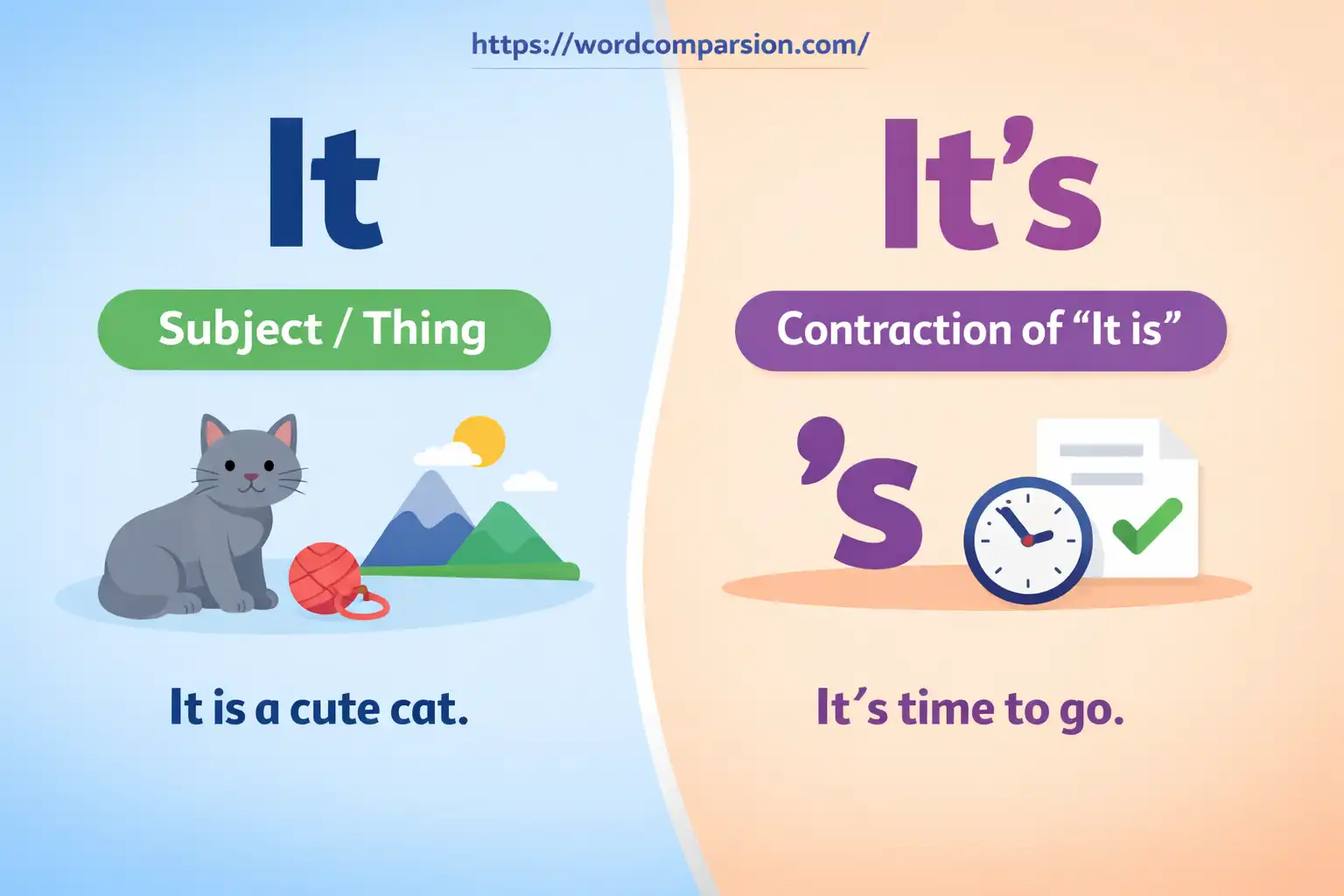
It shows ownership.
It’s means it is or it has.
- It’s raining outside.
- The dog hurt its paw.
If you can replace the word with it is, use it’s. Otherwise, use it.
The Origin of It or It’s
The word it comes from Old English. At first, English did not use apostrophes often. Later, writers added apostrophes to show missing letters. Therefore, it’s became short for it is.
However, possessive words like his and hers never used apostrophes. As a result, its followed the same rule. This history explains the confusion. People expect ownership to need an apostrophe. In contrast, English breaks that pattern here.
Because both forms sound the same, the error stayed common. Meanwhile, writing rules became stricter. Today, correct use matters more in school, work, and online content. Explore our “Grammar Mistakes” category for related writing errors.
British English vs American English Spelling
Both British and American English follow the same rule. However, usage mistakes appear in both regions.
Key rule stays the same everywhere:
- It’s = it is or it has
- Its = shows ownership
| Aspect | British English | American English |
| Rule difference | None | None |
| Common mistakes | Same | Same |
| Formal writing | Strict | Strict |
In contrast to spelling differences like colour and color, this rule never changes. Therefore, one rule works worldwide.
Which Spelling Should You Use?
Your audience does not change the rule. However, context helps you decide faster.
For US writing:
Use the standard rule. Editors expect accuracy.
For UK or Commonwealth writing:
Follow the same rule. Exams check this error closely.
For global or professional writing:
Always double-check. This mistake reduces trust quickly.
Overall, correct use shows attention to detail. Therefore, it improves credibility everywhere.
Common Mistakes with It or It’s
Many errors follow the same pattern. Below are the most frequent ones.
❌ The company changed it’s policy.
✅ The company changed its policy.
Explanation: Ownership never uses an apostrophe.
❌ Its going to be a long day.
✅ It’s going to be a long day.
Explanation: The sentence means it is.
❌ The phone lost it’s charge.
✅ The phone lost its charge.
Explanation: The phone owns the charge.
These mistakes look small. However, they change meaning. As a result, readers lose clarity.
It or It’s in Everyday Examples
Real-life writing uses these words often. Therefore, practice helps.
Emails:
- It’s great to meet you.
- Please check its attachment.
News:
- It’s expected to rain today.
- The city updated its rules.
Social media:
- It’s finally Friday!
- The app changed its design.
Professional writing:
- It’s important to review the report.
- The system improved its performance.
In each case, the rule stays simple. Therefore, checking meaning first avoids mistakes.
It or It’s – Google Trends & Usage Data
Search data shows this confusion stays popular. Many users search the rule every day.
Popularity by country:
- High in the US
- High in the UK
- Growing in non-native English regions
User types:
- Students learning grammar
- ESL learners
- Writers and editors
- Professionals writing emails
Correct usage appears less often than mistakes online. As a result, clear content about this topic ranks well. Moreover, Google favors pages that solve common language problems. For another quick check, read “13rd or 13th” next.
Comparison Table: It vs It’s
| Feature | It | It’s |
| Meaning | Ownership | It is / It has |
| Part of speech | Possessive pronoun | Contraction |
| Context of use | Shows belonging | Shows action or state |
| Formal or informal | Both | Both |
| Common mistakes | Adding apostrophe | Using for ownership |
| Correct example | The cat licked its paw. | It’s getting late. |
This table removes confusion fast. Therefore, bookmark it for quick checks.
Semantic FAQs (People Also Ask)
Is it the same as it’s?
No. One shows ownership. The other shortens it is.
Which one is correct in formal writing?
Both are correct when used properly.
Can they be used interchangeably?
Never. Each has a different meaning.
Why do people confuse them?
They sound the same when spoken.
Can grammar tools catch this mistake?
Sometimes. However, manual checks work best.
Is there a British vs American difference?
No. The rule stays identical.
Conclusion
Overall, it and it’s follow one clear rule. The apostrophe does not show ownership here. Instead, it replaces missing letters. Therefore, it’s always means it is or it has. In contrast, its always shows possession.
Many writers guess because the words sound the same. However, guessing causes errors. As a result, meaning becomes unclear. Therefore, pause for one second before choosing. Try the it is test. If the sentence works, use it’s. Otherwise, choose its. If you’re comparing similar terms, our “how to use ccd or cc’d” article can help.
In short, never add an apostrophe for ownership with it. Finally, remember this simple rule:
If you can say “it is,” use it’s. If not, use its.
That single check will fix the mistake forever.

James Holloway writes detailed guides on confusing English words and grammar usage with clear side-by-side comparisons.