Many English learners, students, and even fluent speakers often pause at one small question: flew or flown? The confusion feels simple. However, the mistake happens again and again. People see both words. They sound related. Therefore, many assume they work the same way. Unfortunately, that assumption causes errors in writing and speech.
This problem appears in school essays, emails, job applications, and social posts. Moreover, grammar tools do not always explain why one form is wrong. As a result, learners stay unsure. They guess. Sometimes they guess right. Other times, they do not.
This article solves that exact problem. First, it explains what flew and flown really mean. Then, it shows where each word belongs. Additionally, it gives clear examples from daily life. You will also learn common mistakes and how to avoid them forever. Finally, you will get one simple rule that works every time. Overall, by the end, you will feel confident using flew or flown without fear. Need another pair? The “word comparison index” lists all comparisons in one place.
Flew or Flown – Quick Answer
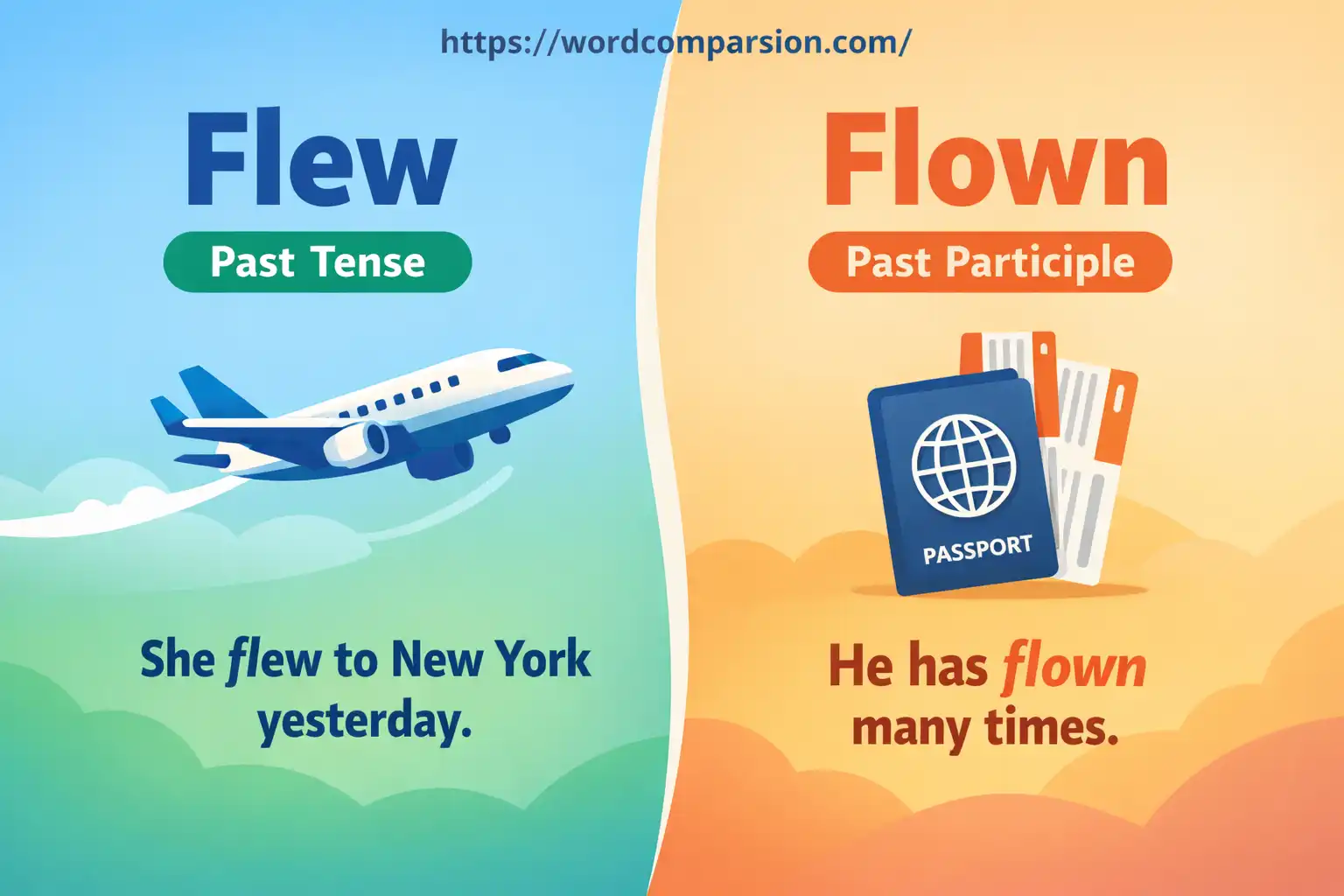
- Flew is the simple past tense of fly.
Example: She flew to Paris yesterday. - Flown is the past participle of fly.
It needs a helper verb like has or have.
Example: She has flown to Paris many times.
The Origin of Flew or Flown
The verb fly comes from Old English fleogan. At that time, verbs changed form to show time. Over centuries, English kept this pattern. Therefore, fly became flew in the past and flown as a participle.
However, modern English hides these patterns. Many verbs now add -ed. In contrast, fly stayed irregular. As a result, learners expect a simpler rule. That expectation creates confusion.
Additionally, both words relate to the same action. They describe movement through air. Because of that shared meaning, people mix them up. Meanwhile, grammar requires different forms for different sentence structures. Understanding that difference removes the confusion. Browse “common grammar slip-ups” for more punctuation and form fixes.
British English vs American English Spelling
Many learners expect spelling changes between British and American English. However, flew and flown stay the same everywhere.
- Both dialects use flew as simple past
- Both dialects use flown as past participle
| Aspect | British English | American English |
| Spelling | flew / flown | flew / flown |
| Usage | Same rules | Same rules |
| Meaning | No difference | No difference |
However, style differences appear in sentence tone. British writing often sounds formal. American writing often sounds direct. Nevertheless, the verb choice never changes. Therefore, you can use the same rule worldwide.
Which Spelling Should You Use?
The answer depends on sentence structure, not location.
- For US writers:
Use flew for past actions. Use flown with has or have. - For UK and Commonwealth writers:
Follow the exact same rule. - For global or professional writing:
Always check for a helper verb. If one exists, choose flown. Otherwise, use flew.
In short, grammar decides. Geography does not.
Common Mistakes with Flew or Flown
Many mistakes follow clear patterns. Recognizing them helps you avoid errors quickly.
❌ Incorrect: She has flew to London.
✅ Correct: She has flown to London.
Explanation: The helper verb has requires a participle.
❌ Incorrect: He flown yesterday.
✅ Correct: He flew yesterday.
Explanation: Past time words need simple past tense.
❌ Incorrect: They were flew over the city.
✅ Correct: They were flown over the city.
Explanation: Passive voice needs a participle.
These errors happen because learners focus on meaning, not structure. Therefore, always check the verb helpers first. Related reading: see “time flies or time flys” for another commonly mixed-up pair.
Flew or Flown in Everyday Examples
Real-life usage makes the rule clear.
Emails
- I flew to New York last week.
- I have flown there many times.
News
- The pilot flew the plane safely.
- The aircraft has flown over the storm.
Social Media
- Just flew home today!
- I have never flown first class.
Formal or Professional Writing
- The team flew to the conference yesterday.
- The CEO has flown internationally this year.
Each example follows the same pattern. Therefore, practice becomes easier with repetition.
Flew or Flown – Google Trends & Usage Data
Search data shows high confusion around flew or flown. Students search it often. ESL learners search it daily. Even professionals check it before publishing.
- By country:
High searches in India, the US, the UK, and Canada. - By user type:
Students and ESL learners lead searches. Writers follow closely. - Common pattern:
Flown appears wrongly without helper verbs.
Overall, correct usage increases with education level. However, mistakes still appear in informal writing. Therefore, clarity matters at every level.
Flew vs Flown – Comparison Table
| Feature | Flew | Flown |
| Meaning | Past action | Completed action |
| Part of speech | Verb (past tense) | Verb (past participle) |
| Context of use | No helper verb | Needs has, have, had |
| Formal or informal | Both | Both |
| Common mistake | Used with has | Used alone |
| Correct example | She flew home | She has flown home |
This table removes doubt instantly. Keep it in mind while writing.
FAQs – Flew or Flown
Is flew the same as flown?
No. Flew is past tense. Flown is a participle.
Which one is correct in formal writing?
Both are correct when used properly.
Can they be used interchangeably?
No. Sentence structure decides.
Why do people confuse them?
Both relate to the same action.
Can grammar tools catch this mistake?
Sometimes. Manual checks work better.
Is there a British vs American difference?
No difference at all.
Conclusion
Overall, flew and flown confuse many people because they look similar and describe the same action. However, grammar makes a clear distinction. Flew works alone. Flown never works alone. That single idea solves most errors. You might also like our “tomatoes or tomato’s explanation” for a similar issue.
Moreover, checking for helper verbs gives instant clarity. If you see has, have, or had, choose flown. If not, choose flew. As a result, your writing becomes accurate and confident.
In short, meaning matters less than structure here. Finally, remember this easy rule: no helper verb means flew; helper verb means flown. Follow it every time, and the confusion disappears.

James Holloway writes detailed guides on confusing English words and grammar usage with clear side-by-side comparisons.