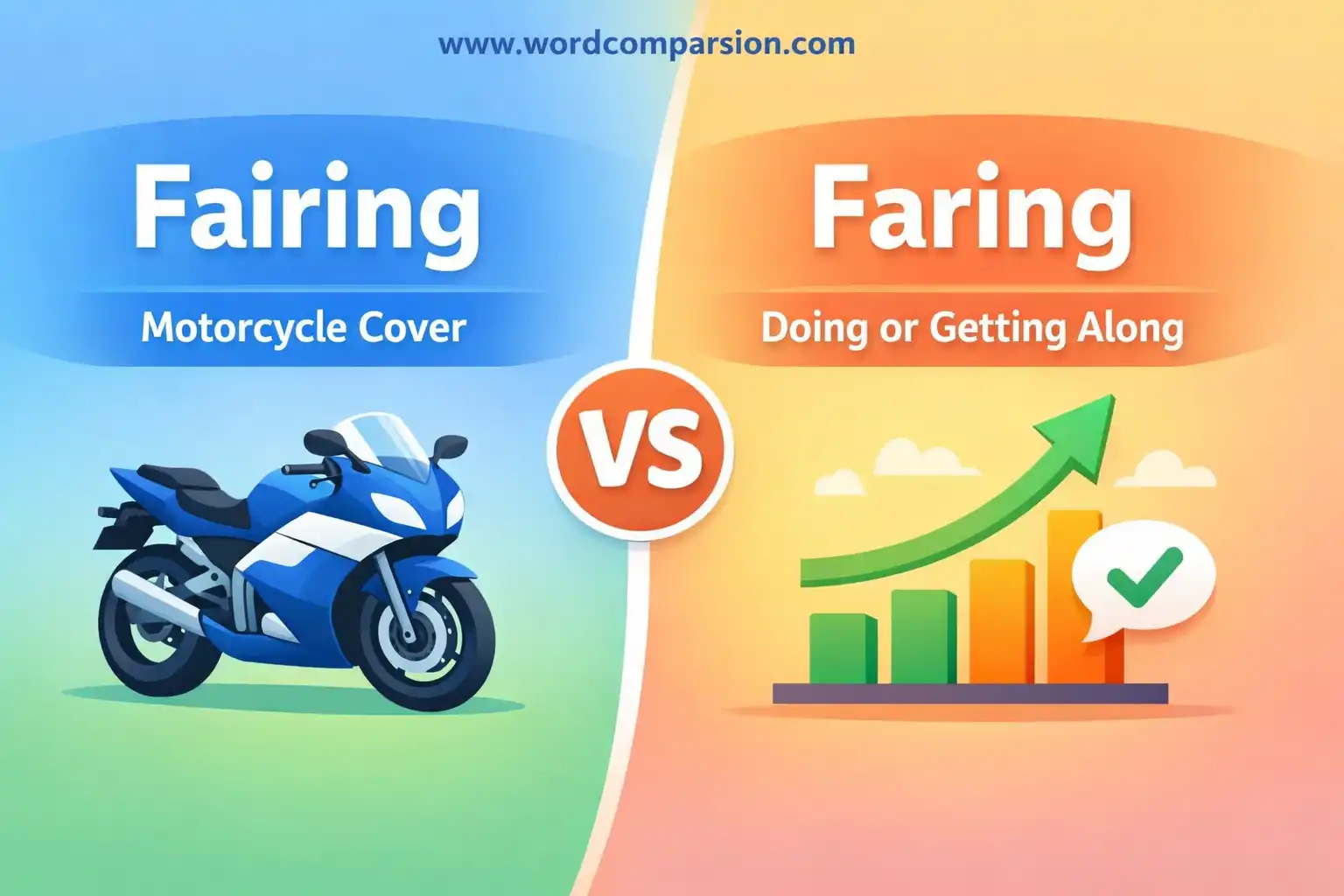
Have you ever wondered whether to use fairing or faring? Many people get confused between these two words because they sound the same. However, they have different meanings, and using the wrong one can make your writing unclear. In this article, we’ll explain the difference in simple words so you’ll never mix them up again. By the end, you’ll know exactly when to use fairing and when to use faring, helping you sound more confident in your writing!
Both fairing and faring are used in different situations. Fairing refers to a part of a vehicle, like the body of a motorcycle, that helps reduce air resistance. On the other hand, faring is all about how someone is doing, like how well someone is performing in a race or how they’re feeling in life. In this guide, we’ll show you examples and tips so you can use both words correctly in your writing.
Now, let’s dive into the simple rules and examples that will make you a pro at using fairing and faring in no time! You’ll learn where each word fits and why using the right one is important for clearer, better communication.
Fairing vs Faring – Quick Answer
- Fairing: Refers to a structure or covering on a vehicle, often for aerodynamic purposes (e.g., in motorcycles or aircraft).
- Example: The motorcycle’s fairing helped reduce wind resistance.
- Faring: Refers to the act of getting along or experiencing something, usually in terms of how well someone does.
- Example: She’s faring well in her new job.
Decision Rule:
- Use fairing for physical coverings or structures.
- Use faring when talking about progress or how someone is doing.
The Origin of Fairing and Faring
The words fairing and faring come from different roots, which is part of the reason for the confusion. Fairing is derived from the word fair, which in its old French form means “beautiful” or “clear,” referring to the smooth and structured shape of a vehicle’s covering. On the other hand, faring comes from the Old English faran, meaning “to journey or travel.”
While they share similar phonetics, their meanings and applications are distinct, which is where most confusion arises today.
Reason for Confusion Today
The confusion between fairing and faring is common, especially in writing. Their similar pronunciation leads many people to assume they can be used interchangeably. Moreover, since they have different contexts—fairing for physical objects and faring for progress—mistakes often happen when writing quickly or when learners are unsure of the precise usage.
British English vs American English Spelling
There is no significant difference between the British and American English spelling of fairing or faring. Both words are spelled the same in both forms of English. However, the contexts in which these words are used can differ slightly between regions, such as the preference for fairing in engineering and vehicle design (which is common globally) versus the use of faring more frequently in literary contexts, particularly when discussing someone’s wellbeing.
Which Spelling Should You Use?
- US and UK: Use the same spelling for both fairing and faring in both British and American English.
- Global or professional writing: Always choose based on context, as there are no spelling variations, only differences in meaning.
Common Mistakes with Fairing and Faring
Mistake 1:
❌ He is fairing well in the race.
✅ He is faring well in the race.
Explanation: Faring refers to how someone is progressing or doing, while fairing is about physical objects or coverings.
Mistake 2:
❌ The fairing of the ship was damaged during the storm.
✅ The fairing of the ship was damaged during the storm.
Explanation: Fairing is the correct term here, referring to the ship’s structure.
Mistake 3:
❌ I’m faring to get on the plane.
✅ I’m fairing to get on the plane.
Explanation: This is incorrect because fairing should not be used for actions like traveling or getting on a plane. The correct usage is faring when discussing progress or how someone is doing.
Fairing vs Faring in Everyday Examples
Let’s look at how fairing and faring are used in everyday contexts.
- Emails
- Fairing: The car’s fairing was damaged after the collision.
- Faring: I hope you are faring well after the surgery.
- News
- Fairing: The new fairing design for the aircraft improves its fuel efficiency.
- Faring: The country is faring better in economic recovery this year.
- Social Media
- Fairing: Check out this fairing for the new electric bike.
- Faring: How is everyone faring this week?
- Professional Writing
- Fairing: The fairing helps reduce wind drag in automotive engineering.
- Faring: The project is faring well ahead of schedule.
Fairing vs Faring – Usage Patterns & Search Interest
The confusion between fairing and faring is most common among ESL learners and those new to writing. Writers tend to confuse the two words because of their similar sounds and overlap in some contexts. Fairing is often misused in situations where faring should be applied, especially in informal contexts like social media or emails.
A common scenario where misuse occurs is when people discuss how someone is doing in a job or a competition. They may write “fairing well” when the correct phrase is “faring well.”
Comparison Table: Fairing vs Faring
| Feature | Fairing | Faring |
| Meaning | A structure that reduces air resistance or protects | How someone is progressing or doing |
| Part of Speech | Noun (physical object) | Verb (to go, to travel) |
| Context of Use | Engineering, vehicles, aircraft, design | Progress, well-being, personal experiences |
| Formal vs Informal | Formal (in technical contexts) | Informal (commonly used in conversational tone) |
| Common Mistakes | “Fairing well” (should be faring well) | “Fairing to do” (should be faring to do) |
| Correct Example | The fairing on the motorcycle improves speed. | She is faring much better since the surgery. |
Semantic FAQs (People Also Ask)
- Is fairing the same as faring?
- No, fairing refers to a physical structure, while faring refers to how someone is doing.
- Which one is correct in formal writing?
- Fairing is used in technical contexts, while faring is used to describe progress or how someone is doing.
- Can they be used interchangeably?
- No, they are not interchangeable as they have different meanings and uses.
- Why do people confuse them?
- People often confuse them because they sound similar, but their meanings are very different.
- Can grammar tools catch this mistake?
- Most grammar tools will flag fairing when used in the wrong context (e.g., fairing well instead of faring well).
- Is there a British vs American difference?
- There is no difference in spelling between fairing and faring in British and American English.
Conclusion
In short, the difference between fairing and faring lies in their meanings and contexts. Fairing refers to physical objects like vehicle coverings, while faring is used to describe how someone is progressing or doing.
The most important thing to remember is that faring is used when discussing progress or well-being, while fairing is used in technical contexts involving design and structure. Avoid using fairing when talking about how someone is doing, and use faring to describe that progress. This small change will make your writing clearer and more accurate.

James Holloway writes detailed guides on confusing English words and grammar usage with clear side-by-side comparisons.