Many people search engage vs ingage because they see both spellings online. One looks normal, but the other appears in comments, captions, and even business posts. So readers stop and wonder: is ingage a new spelling, or is it just a mistake?
This confusion matters more than it seems. A small spelling error can change how writing feels. It can make a message look rushed or unprofessional. Students worry about exams. Writers worry about credibility. ESL learners worry they learned the wrong word. Because of that, this article clears the problem in a simple, friendly way.
You will learn the real spelling, why the error happens, and how to avoid it forever. We will also look at everyday examples so you can feel confident using the word in emails, social media, and formal writing.
Engage vs Ingage – Quick Answer
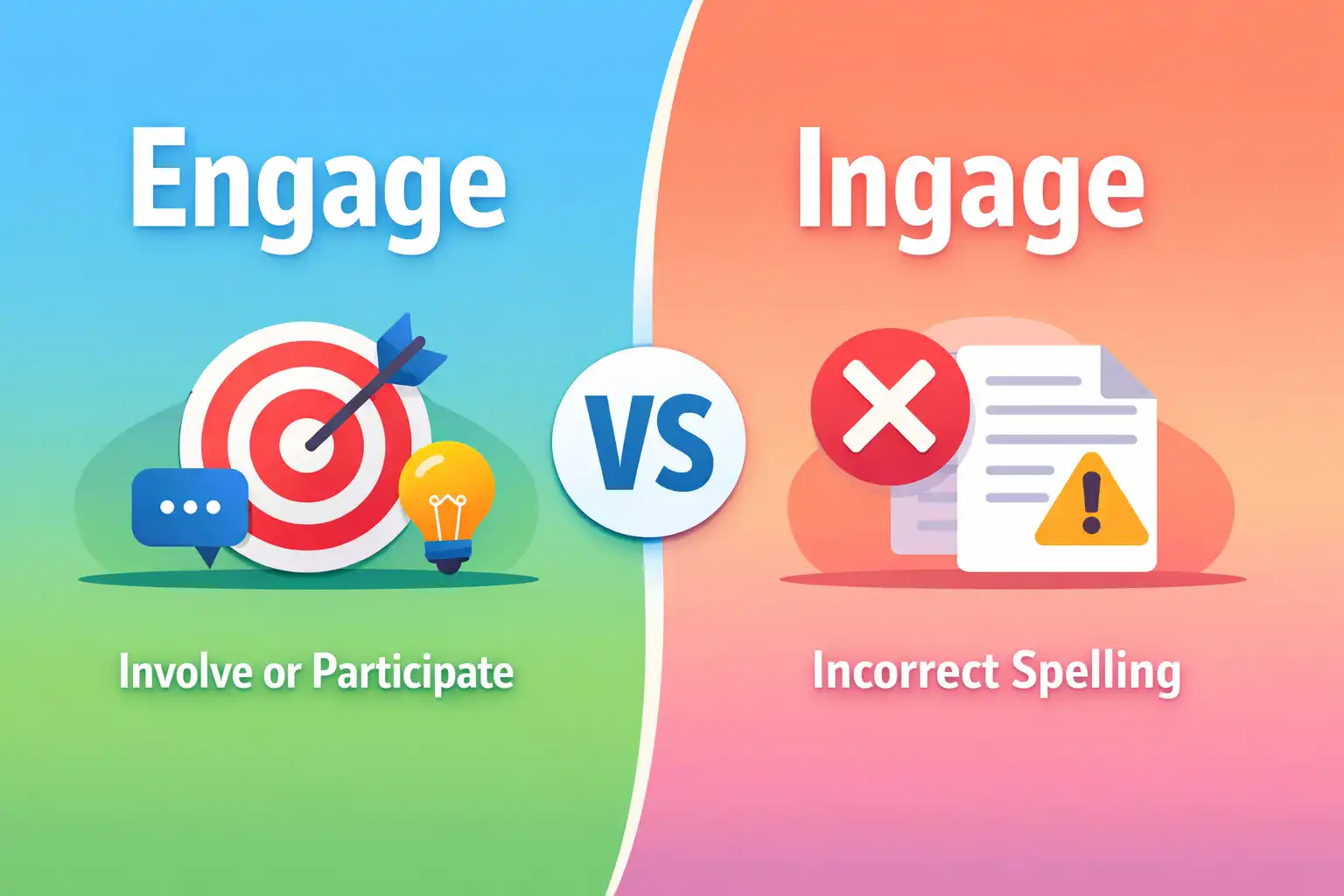
Engage is the correct word. Ingage is a spelling mistake.
- ✅ We engage with customers daily.
- ❌ We ingage with customers daily.
Easy rule:
If you write ingage, change it to engage every time.
There is no accepted version where ingage is correct.
Why People Misspell Engage as Ingage (Plus Real Word Origin)
The word engage comes from old French and Latin roots. It originally meant “to pledge” or “to bind together.” Over time, English speakers used it for action, connection, and involvement. Today it means to participate, attract attention, or become involved.
So why does ingage appear?
The confusion comes from sound. When people say engage, the first vowel sounds like a short “i” to some ears. Fast speech makes the word blur. Because of that, new writers guess the spelling based on sound instead of memory.
Writers often confuse words that start with soft vowel sounds. Editors usually see this with words like enough, energy, and encourage. The brain hears one sound, but English spelling follows history, not pure sound logic.
Because of that gap, ingage keeps showing up online, even though dictionaries never accepted it.
British English vs American English Spelling
There is no spelling difference between British and American English here. Both regions use engage.
Some English words change across regions, but this one stays the same. So the confusion does not come from dialect. It comes only from phonetic guessing.
| Region | Correct spelling |
| US English | engage |
| UK English | engage |
| Commonwealth English | engage |
In contrast, words like color/colour change by region. However, engage remains stable worldwide.
How to Remember the Correct Spelling (Fast Rule + Trick)
You do not need a complicated rule. You only need a memory shortcut.
For US writers: always use engage
For UK writers: always use engage
For global writing: always use engage
Because there is no variation, the fastest choice is simple:
👉 If the word starts with i, it is wrong.
Think of engage = energy. Both start with en, and both are correct English patterns.
Common Mistakes with Engage vs Ingage
Writers repeat a few patterns again and again. Let’s fix them clearly.
❌ We ingage the audience with stories.
✅ We engage the audience with stories.
Explanation: The base spelling must stay engage, even when the sentence changes.
❌ Our goal is to ingage customers.
✅ Our goal is to engage customers.
Explanation: Infinitive verbs keep the same root spelling.
❌ This post helps ingagement online.
✅ This post helps engagement online.
Explanation: The noun form still uses en, not in.
Most mistakes come from typing fast. Spellcheck tools often catch it, but casual platforms sometimes ignore it.
Engage vs Ingage in Everyday Examples
Seeing the word in real life makes memory stronger.
Emails
“We want to engage our readers with helpful tips.”
News writing
“The campaign aims to engage young voters.”
Social media
“Ask questions to engage your followers.”
Professional writing
“Interactive tools engage users more effectively.”
Notice that the spelling never changes. The context shifts, but the base word stays stable.
Engage vs Ingage – Usage Patterns & Search Interest
Search engines show steady interest in this spelling confusion. Students, ESL learners, and beginner writers search it often. Content creators also check before publishing posts.
The mistake appears most in fast digital writing. Social media captions, chat messages, and marketing drafts show the highest error rate. Because online text spreads quickly, the wrong spelling can copy itself.
One real scenario shows the impact clearly. A brand posts:
“We ingage with our community daily.”
Readers may still understand the meaning. However, the brand looks less polished. That single vowel changes trust perception, especially in business settings.
Because of that, people search this comparison before sending important messages.
Engage vs Ingage Comparison Table(Meaning + Correct spelling)
| Feature | Engage | Ingage |
| Meaning | To involve or attract attention | No accepted meaning |
| Part of speech | Verb / noun form: engagement | Not a real word |
| Context of use | Formal + informal English | Spelling error |
| Formal usage | Correct everywhere | Incorrect everywhere |
| Common mistakes | Rare when proofread | Phonetic typing error |
| Correct example | “We engage customers daily.” | ❌ Not valid |
This table removes all doubt instantly: only engage exists in standard English.
FAQs About Engage vs Ingage
Is ingage a real English word?
No. Dictionaries do not recognize it.
Which spelling is correct in formal writing?
Engage is correct in all formal writing.
Can they ever be interchangeable?
No. Only engage is valid.
Why do people confuse them?
They spell by sound instead of memory.
Can grammar tools catch the mistake?
Most modern spellcheck tools fix it automatically.
Is there a British vs American difference?
No. Both regions use engage.
Does ingage appear in slang?
It appears online, but it is still considered wrong.
Conclusion
The confusion between engage vs ingage comes from sound, not grammar. English spelling often breaks phonetic expectations. Because of that, new writers guess the wrong vowel. However, the rule stays simple once you know it.
Only engage exists in standard English. It works in emails, social posts, exams, and professional documents. The spelling never changes across regions. In short, ingage is always an error, no matter the context.
Overall, the safest habit is proofreading slowly. Even confident writers mistype familiar words. A quick reread protects credibility and clarity. Finally, remember one rule:
👉 If it starts with “in,” fix it to “en.”
That single check prevents the mistake forever.

Moses Jhon is a dedicated content writer known for producing high-quality, reader-focused, and SEO-optimized content. He has experience crafting blog posts, website content, articles, and marketing copy across different niches. His writing style combines creativity, clarity, and strategy to help businesses grow their online presence and engage their target audience effectively.