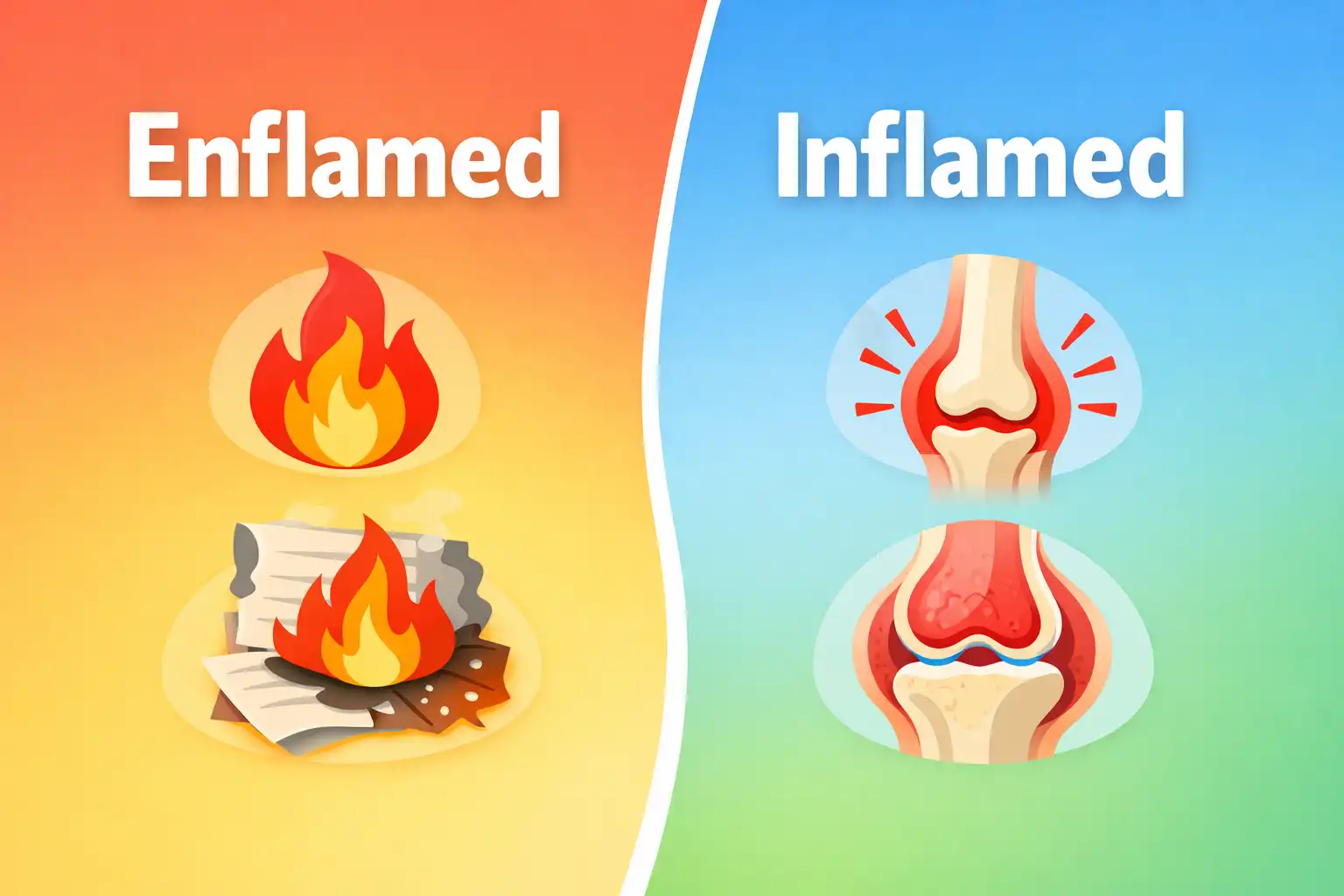
Many people search for enflamed or inflamed because both words look correct. However, only one spelling works in modern English. This confusion appears in medical reports, school essays, emails, and online articles. As a result, writers often stop and question their choice.
Moreover, spelling tools do not always help. Sometimes, they accept both words. Other times, they give no suggestion at all. Therefore, the mistake keeps spreading. Students copy it. ESL learners repeat it. Even professionals feel unsure.
However, this article solves that confusion completely. It explains why both spellings exist. It shows which one modern English accepts. Additionally, it explains how real people use the word today.
Overall, this guide gives you clarity. You will learn the correct spelling. You will also understand why the mistake happens. Finally, you will write with confidence and accuracy.
For more quick side-by-side checks, browse the “word comparison hub“.
Enflamed or Inflamed – Quick Answer
- Inflamed is the correct modern spelling
- Enflamed is outdated and rarely correct
- Use inflamed in medical, emotional, and general writing
Examples:
- The skin is inflamed.
- His words inflamed the argument.
The Origin of Enflamed or Inflamed
Both words come from the same Latin root. The Latin word inflammare means “to set on fire.” Early English borrowed this word and created two spellings. At that time, writers used enflamed often.
However, language evolved. Over time, inflamed became the preferred form. Meanwhile, enflamed slowly disappeared from everyday use. It stayed mainly in poetry and old literature.
Therefore, the confusion exists for clear reasons. Old books still show enflamed. The spelling also looks logical. As a result, modern writers assume both forms work. However, modern English chose one clear winner.
See the “Wrong Spelling collection” for more quick fixes to common misspellings.
British English vs American English Spelling
Some people believe this issue comes from British and American differences. However, that belief is incorrect.
Both British English and American English use inflamed.
In contrast, enflamed does not belong to standard spelling in either system.
Small comparison for clarity:
- American English → inflamed
- British English → inflamed
- Medical English → inflamed
- Modern media → inflamed
Therefore, geography does not change the answer.
Which Spelling Should You Use?
The rule stays simple for every audience.
For US readers
Always use inflamed. Editors expect it.
For UK or Commonwealth readers
Use inflamed. It matches standard usage.
For global or professional writing
Choose inflamed. It avoids confusion everywhere.
Overall, enflamed has no modern advantage.
Common Mistakes with Enflamed or Inflamed
Many writers repeat the same errors. These examples show the fix clearly.
❌ Her knee was enflamed after the fall.
✅ Her knee was inflamed after the fall.
❌ The speech enflamed public anger.
✅ The speech inflamed public anger.
Why do these mistakes happen?
- The spelling looks natural
- Old texts still appear online
- Writers assume both forms work
However, modern English accepts only inflamed. If you’re comparing similar terms, our “how to use nitch or niche” article can help.
Enflamed or Inflamed in Everyday Examples
Emails
- My throat feels inflamed today.
- The issue inflamed tension in the office.
News
- The decision inflamed public debate.
- The injury caused inflamed muscles.
Social media
- That post inflamed the comments.
- My skin is inflamed from the sun.
Formal or professional writing
- Inflamed tissue needs treatment.
- The statement inflamed international relations.
Every example confirms the same rule.
Enflamed or Inflamed – Google Trends & Usage Data
Search behavior shows a clear pattern.
- Inflamed appears far more often
- Enflamed shows very low interest
- Medical and academic searches favor inflamed
By user type:
- Students search both due to confusion
- Writers and editors use inflamed
- ESL learners ask about the difference
- Professionals avoid enflamed
By country:
- US, UK, Canada, Australia prefer inflamed
- Global English content confirms the trend
Therefore, real data supports correct usage.
Comparison Table: Enflamed vs Inflamed
| Aspect | Inflamed | Enflamed |
| Meaning | Swollen, irritated, or intensified | Old form meaning “set on fire” |
| Part of speech | Adjective / Verb | Adjective / Verb |
| Context of use | Medical, emotional, everyday writing | Historical or poetic writing |
| Formal usage | Fully acceptable today | Not recommended |
| Common mistake | Writers doubt correct spelling | Using it in modern writing |
| Correct example | The wound is inflamed. | Rare and outdated |
This comparison removes confusion instantly.
Semantic FAQs (People Also Ask)
Is enflamed the same as inflamed?
They share history, but only inflamed works today.
Which spelling is correct in formal writing?
Inflamed is always correct.
Can they be used interchangeably?
No. Modern English but rejects enflamed.
Why do people confuse them?
Old texts and similar spelling cause doubt.
Can grammar tools catch this mistake?
Sometimes. Not always.
Is there a British vs American difference?
No. Both prefer inflamed.
Conclusion
Overall, the confusion between enflamed or inflamed makes sense. Both words look valid. Both share a common origin. However, modern English made a clear decision.
Inflamed is the correct spelling today. It works in medical writing, emotional context , suits professional and casual use. In contrast. Enflamed belongs to older English and poetic history.
Therefore, the one mistake to avoid is using enflamed in modern content. It appears outdated. It also weakens clarity. In short, remember one simple rule:
If you are writing today, always use “inflamed.”
Finally, this rule removes doubt every time.
Related reading: see “studying or studing” for another commonly mixed-up pair.

Charlotte Brontë was an English novelist and poet, renowned for her groundbreaking contributions to literature in the 19th century. Best known for her classic works such as Jane Eyre, Shirley, and Villette, Brontë’s writing has had a lasting influence on both the literary world and modern narrative structure. A researcher at heart, she carefully crafted narratives that delved into complex emotional landscapes, examining social issues and personal resilience.
With a natural talent for exploring the nuances of human relationships, Brontë’s works are characterized by a deep understanding of language and its power to convey profound emotional truths. Her keen ability to contrast words and their meanings, often underpinned by her knowledge of human psychology, makes her an influential figure in the study of literary language. Her approach is rooted in meticulous research, focused on delivering clarity and insight that resonates with readers.
Charlotte Brontë’s enduring legacy lies not only in her masterful storytelling but also in her capacity to bridge the gap between language, emotion, and human experience.