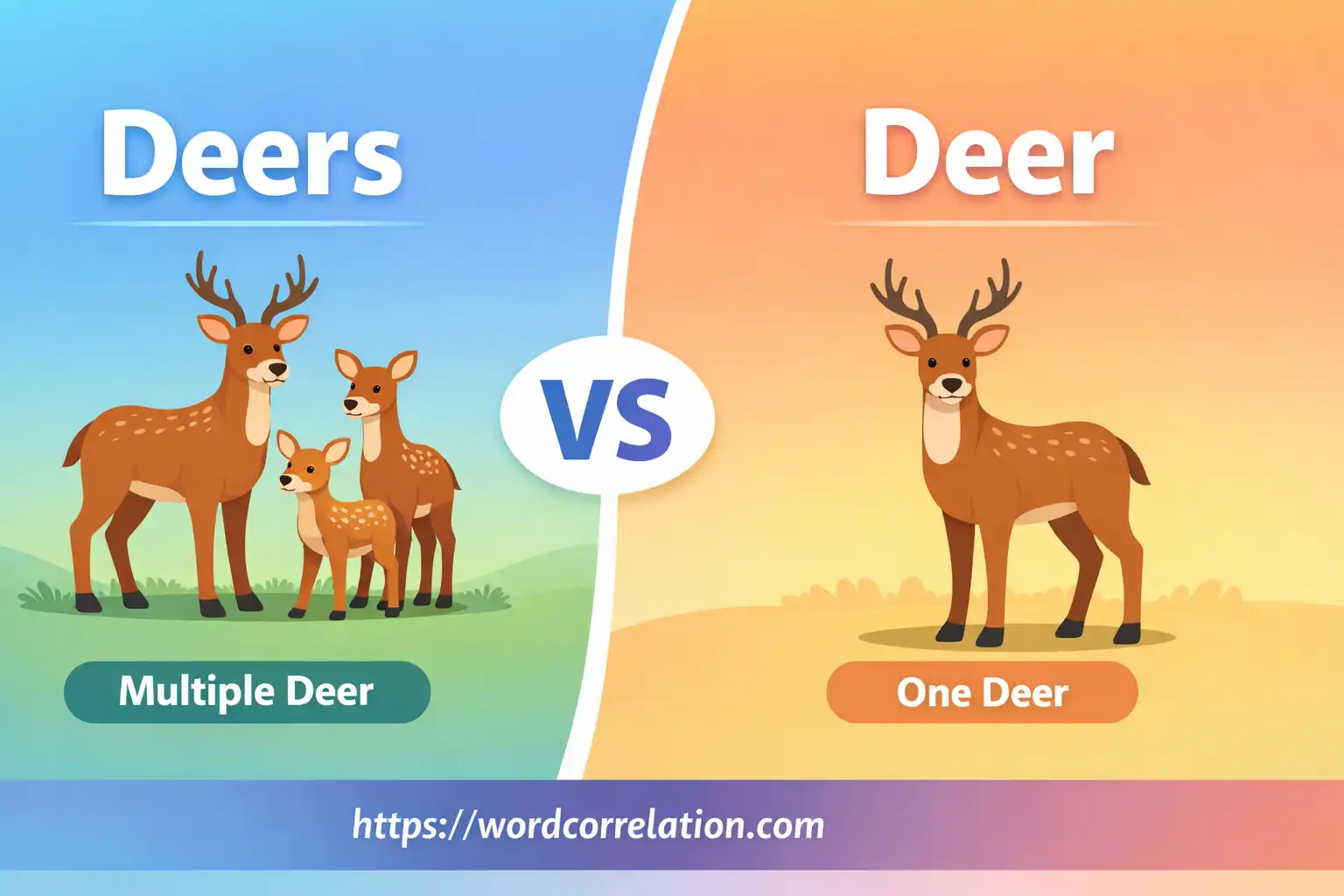
Many people pause when they write about animals in English. However, one word causes more trouble than most: deers or deer. Students, writers, and ESL learners often feel unsure here. Therefore, they search online to check which word is correct.
This confusion happens for a clear reason. Most English nouns add -s in plural form. For example, cat becomes cats, and dog becomes dogs. In contrast, deer does not follow this rule.
As a result, many people guess and write deers by mistake.
Moreover, grammar tools sometimes fail to explain why the word works this way. Because of that, users stay confused even after corrections. This article solves that exact problem. You will learn the correct form, the reason behind it, and how to avoid errors. Additionally, you will see clear examples from real life. Overall, this guide keeps everything simple and clear.
Start from the “word comparison home page” to compare more words.
Deers or Deer – Quick Answer
Deer is both singular and plural.
Deers is incorrect in standard English.
- One animal → a deer
- Many animals → three deer
For example:
✅ We saw five deer in the forest.
❌ We saw five deers in the forest.
The Origin of Deers or Deer
The word deer comes from Old English. Long ago, it meant any wild animal. However, the meaning slowly changed over time. Eventually, it came to mean only this specific animal.
In early English, many nouns did not change in plural form. Deer stayed the same in both singular and plural use. Meanwhile, other words later adopted -s endings. Because of this history, deer kept its old structure.
Today, English still follows that pattern. Therefore, the plural form remains deer, not deers.
This history explains the confusion clearly. For more pluralization questions, see the “Plural Forms guide” pillar.
British English vs American English Spelling
Both British and American English use deer the same way.
There is no spelling difference here.
However, learners often expect one.
In contrast to words like color and colour, this word stays fixed.
Therefore, rules do not change by region.
| Region | Correct Form | Notes |
|---|---|---|
| US English | deer | Same for singular and plural |
| UK English | deer | No variation |
| Global English | deer | Used in all formal writing |
As a result, location does not affect correctness.
Which Spelling Should You Use?
The answer depends on correctness, not audience.
However, context still matters.
For US writers:
Always use deer for one or many.
For UK and Commonwealth writers:
The same rule applies without exception.
For global or professional writing:
Use deer to avoid errors and confusion.
Moreover, academic, business, and news writing all follow this rule. Therefore, deers should never appear in standard text. For another quick check, read “octopus or octopi” next.
Common Mistakes with Deers or Deer
People make the same errors again and again.
These mistakes feel logical, but they remain incorrect.
❌ I saw many deers today.
✅ I saw many deer today.
❌ Those deers live near the river.
✅ Those deer live near the river.
❌ Farmers protect their crops from deers.
✅ Farmers protect their crops from deer.
The mistake happens because writers expect plural rules to match others.
However, English contains many exceptions.
As a result, memory matters more than logic here.
Deers or Deer in Everyday Examples
You will see deer used everywhere.
Context does not change the form.
Emails:
I noticed deer crossing the road near the office.
News:
Wild deer populations are increasing in rural areas.
Social media:
Just saw deer while hiking today!
Professional writing:
The study tracks deer movement patterns.
In each case, deer stays the same.
Therefore, usage stays simple once learned.
Deers or Deer – Google Trends & Usage Data
Search data shows high confusion around this term.
Students search it often.
ESL learners also ask this question repeatedly.
Writers check it during editing.
Most searches come from:
- English learners
- School students
- Blog writers
- Content editors
Correct usage appears more in professional texts.
In contrast, informal writing shows more mistakes.
As a result, education clearly improves accuracy.
Deers or Deer Comparison Table
Here is a clear table to remove all doubt:
| Feature | Deer | Deers |
|---|---|---|
| Meaning | One or many animals | Incorrect form |
| Part of speech | Noun | Not standard |
| Context of use | All writing types | None |
| Formal or informal | Both | Never |
| Common mistakes | Rare when known | Very common |
| Correct example | Ten deer ran away. | ❌ Ten deers ran away. |
This table shows the rule clearly.
Therefore, confusion should stop here.
Semantic FAQs (People Also Ask)
Is deer the same as deers?
No. Deer is correct. Deers is wrong.
Which one is correct in formal writing?
Only deer works in formal text.
Can they be used interchangeably?
No. One is correct. The other is not.
Why do people confuse them?
They expect normal plural rules.
Can grammar tools catch this mistake?
Some can. However, not all explain it well.
Is there a British vs American difference?
No. Both use deer the same way.
Conclusion
Overall, the difference between deers or deer is simple. Only deer is correct in modern English. This rule applies to one animal and many animals. Therefore, you never need deers.
The confusion exists because English has many exceptions. However, once learned, this one stays easy. Moreover, correct usage improves writing quality fast. If you’re comparing similar terms, our “how to use bicep or biceps” article can help.
Students sound more confident. Writers look more professional. Editors avoid basic errors.
In short, remember one clear rule. If you talk about this animal, use deer every time.
Finally, ignore the -s, even when the number increases. That single habit will keep your English clean and correct.

James Holloway writes detailed guides on confusing English words and grammar usage with clear side-by-side comparisons.