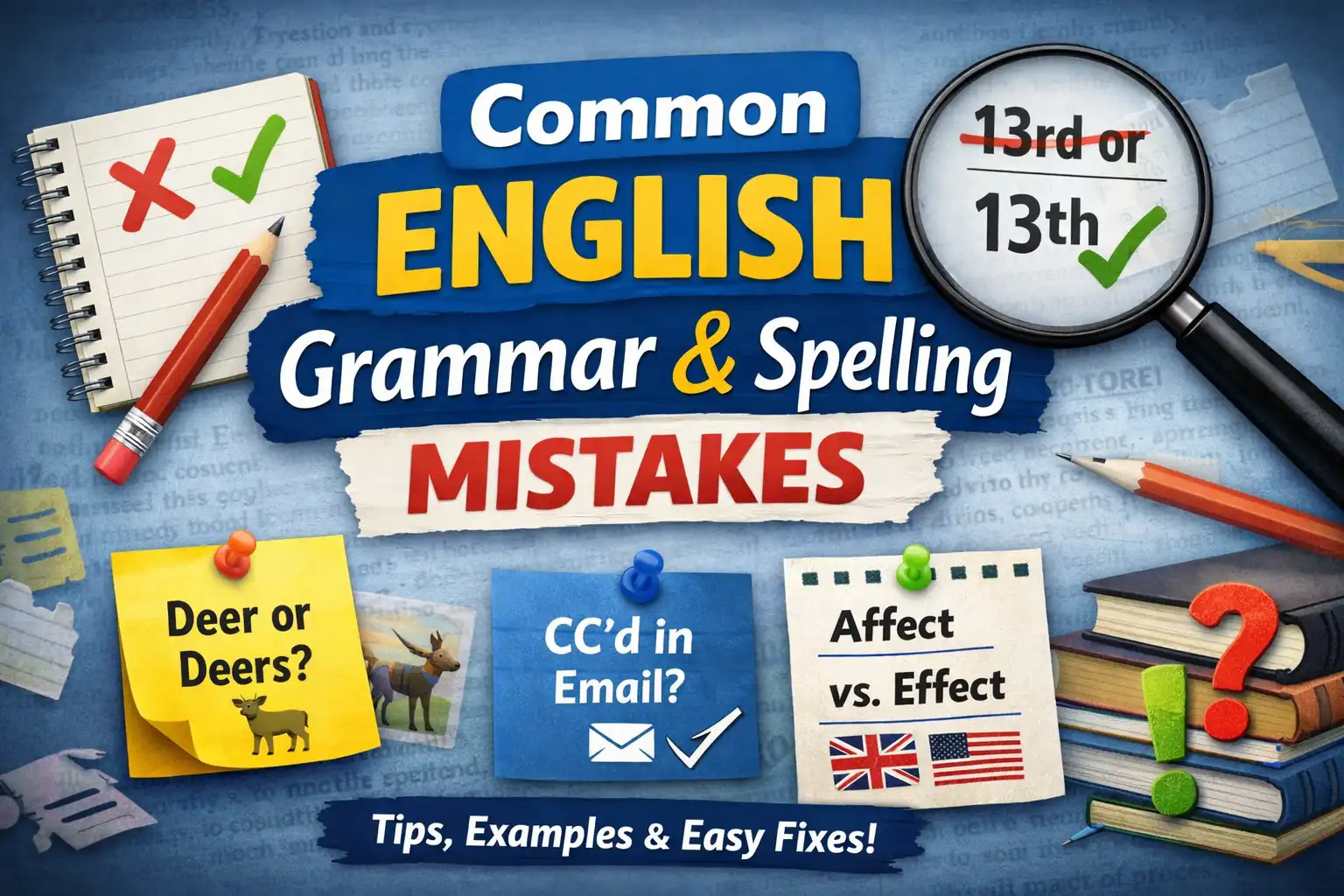
English grammar and spelling mistakes are extremely common—even among fluent and native English speakers. Every day, people search questions like:
- 13th or 13rd — which is correct?
- Is “sitted” a real word?
- Deer or deers — what’s the plural?
- What does CC’d mean in email?
This pillar guide explains 200+ real, search-based English mistakes using simple rules, correct forms, and clear examples, so you can avoid confusion and write confidently.
Ordinal Numbers and Date Mistakes (13th vs 13rd)
❌ 13rd
✅ 13th
Correct rule for ordinal numbers:
- 1 → 1st
- 2 → 2nd
- 3 → 3rd
- 4–20 → th
(11th, 12th, and 13th are exceptions)
Correct examples:
- January 13th
- December 13th
- The 13th day of the month
- 13th anniversary
❌ Incorrect forms:
- 13rd
- 13st
- 13nd
Important:
👉 13th is always correct. “13rd” is never correct.
British vs American English Spellings
English spelling often depends on whether you follow British English (UK) or American English (US).
| British English | American English |
| unauthorised | unauthorized |
| cancelled | canceled |
| cancelling | canceling |
| catalogue | catalog |
| cataloguing | cataloging |
✅ Both versions are correct
✅ Choose one style and stay consistent throughout your content
Commonly Confused Word Pairs
Inflamed vs Enflamed
- Inflamed → medical or emotional meaning
- Enflamed → rare, literary usage
✔ Example:
His ankle is inflamed.
Peaked vs Piqued
- Peaked → reached the highest point
- Piqued → interest or curiosity was aroused
✔ Correct:
My curiosity was piqued.
Reining vs Reigning
- Reining → controlling (from horse reins)
- Reigning → ruling or dominant
✔ Correct:
The reigning champion won again.
Manor vs Manner
- Manor → a large house or estate
- Manner → behavior or way of doing something
✔ Example:
He spoke in a polite manner.
Words That Are Commonly Used but Incorrect
These words appear frequently online but are not standard English.
❌ Sitted → ✅ Seated / Sat
❌ Unpure → ✅ Impure
❌ Ingenuine / Ungenuine → ✅ Not genuine / Insincere
❌ Nitch → ✅ Niche
📌 Tip:
If a word is not accepted by major dictionaries, avoid using it in professional or SEO content.
Singular and Plural Confusion
Deer
- Singular: deer
- Plural: deer
❌ deers (incorrect)
Basis
- Singular: basis
- Plural: bases
Bicep
- Singular: bicep
- Plural: biceps
Apostrophe and Punctuation Errors
Do’s and Don’ts
✔ do’s and don’ts
❌ donts
❌ dont’s
Comma vs Coma
- Comma (,) → punctuation mark
- Coma → medical condition
✔ Example:
Use a comma, not a coma.
Email and Office English Mistakes (CC Confusion)
What does CC’d mean in email?
CC stands for Carbon Copy.
✔ Correct forms:
- cc’d
- CC’d
✔ Example sentence:
I have cc’d you on this email.
❌ Avoid:
- cced
- ccd (informal and non-standard)
Common English Spelling Mistakes
| Incorrect | Correct |
| studing | studying |
| anual | annual |
| cancle | cancel |
| cancell | cancel |
| inflammed | inflamed |
| saucey | saucy |
| agast | aghast |
| copywrite | copyright |
Word Usage Confusion in Sentences
Seated vs Sitted
✔ Correct:
- Please be seated.
- She is seated near the window.
❌ sitted (incorrect)
Curiosity Peaked or Piqued?
✔ My curiosity was piqued.
❌ peaked (incorrect in interest context)
Quick Meanings of Confusing Words
- Piqued → aroused interest
- Reigning → ruling or dominant
- Aghast → shocked or horrified
- Impure → not pure
- Dryly → in a serious or unemotional way
Why Grammar and Spelling Matter for SEO
- Google understands minor grammar mistakes. For More Deatil…
- But frequent errors reduce trust and authority
- Correct language improves:
- Content quality
- User experience
- Search rankings
Final Takeaway
English mistakes are normal—but repeating them is avoidable.
✔ Use correct spellings
✔ Avoid non-standard words
✔ Stay consistent with US or UK English
✔ Learn common confusing word pairs
This guide is designed to be your go-to reference whenever you’re unsure.
✅ Conclusion
English grammar aur spelling mistakes har kisi se hoti hain, lekin unhein repeat karna zaroori nahi. Is pillar guide me aap ne 200+ common English errors ke correct forms, simple rules, aur real examples dekhe — jese 13th vs 13rd, deer or deers, CC’d meaning in email, aur British vs American spellings.
Agar aap blogging, academic writing, emails, ya professional content likhte hain, to correct language usage aap ki credibility, readability, aur SEO performance ko behtar banata hai. Chhoti chhoti mistakes door karke aap apni writing ko zyada clear, confident, aur Google-friendly bana sakte hain.
Is guide ko reference page ki tarah use karein aur jab bhi doubt ho, yahin wapas aayein.
Perfect 👍
Neeche saari FAQs ko number de kar, ek hi clean block me arrange kar diya hai — no repetition, schema-ready, Google-friendly.
👉 Is poore block ko conclusion ke baad paste karein
👉 RankMath / Yoast FAQ block me same order me daal sakte hain
Frequently Asked Questions (FAQs)
1. Is 13th or 13rd correct?
13th is correct. In English, ordinal numbers ending in 11, 12, and 13 always use “th.” The form 13rd is incorrect and should never be used.
2. Is “sitted” a real English word?
No, “sitted” is not standard English. The correct forms are “sat” (past tense of sit) or “seated.”
3. What is the plural of deer?
The plural of deer is deer. The word remains the same in both singular and plural forms. “Deers” is incorrect in standard English.
4. What does CC’d mean in an email?
CC’d means Carbon Copied. It indicates that someone has been included in an email for information purposes, not as the main recipient.
5. Is it deer or deers?
The correct form is deer for both singular and plural usage. “Deers” is grammatically incorrect.
6. What is the difference between British and American spelling?
British and American English use different spellings for some words, such as “cancelled” (UK) and “canceled” (US). Both forms are correct depending on regional style.
7. Is “unpure” a correct English word?
No, “unpure” is not standard English. The correct word is “impure.”
8. Is “nitch” a word?
No, “nitch” is a misspelling. The correct word is “niche,” which means a specialized role, position, or market.
9. Is it “peaked” or “piqued” my interest?
The correct phrase is “piqued my interest.”
“Peaked” means reached the highest point, while “piqued” means aroused curiosity.
10. What is the correct spelling: do’s and don’ts or dont’s?
The correct spelling is do’s and don’ts. The apostrophe is used to show omitted letters, not possessio

James Holloway writes detailed guides on confusing English words and grammar usage with clear side-by-side comparisons.