Many people type trouper vs trooper into Google because the two words sound the same. They also look almost identical. So writers, students, and even native speakers often mix them up.
This mistake happens a lot in emails, blog posts, and social media. Someone may want to praise a hardworking person and write trooper. Another person may talk about a soldier and accidentally write trouper. The spelling changes the meaning completely.
Editors see this confusion very often. ESL learners also struggle because pronunciation does not help much. Both words sound like “troo-per.” Because of that, spell-check tools sometimes miss the mistake.
This guide solves that problem in a simple way. You will learn the real meaning of each word. You will also see where people use them in daily writing. Clear examples will show how they appear in emails, news, and social media. By the end, you will know exactly when to use trouper and when trooper is the correct word.
Trouper vs Trooper – Quick Answer
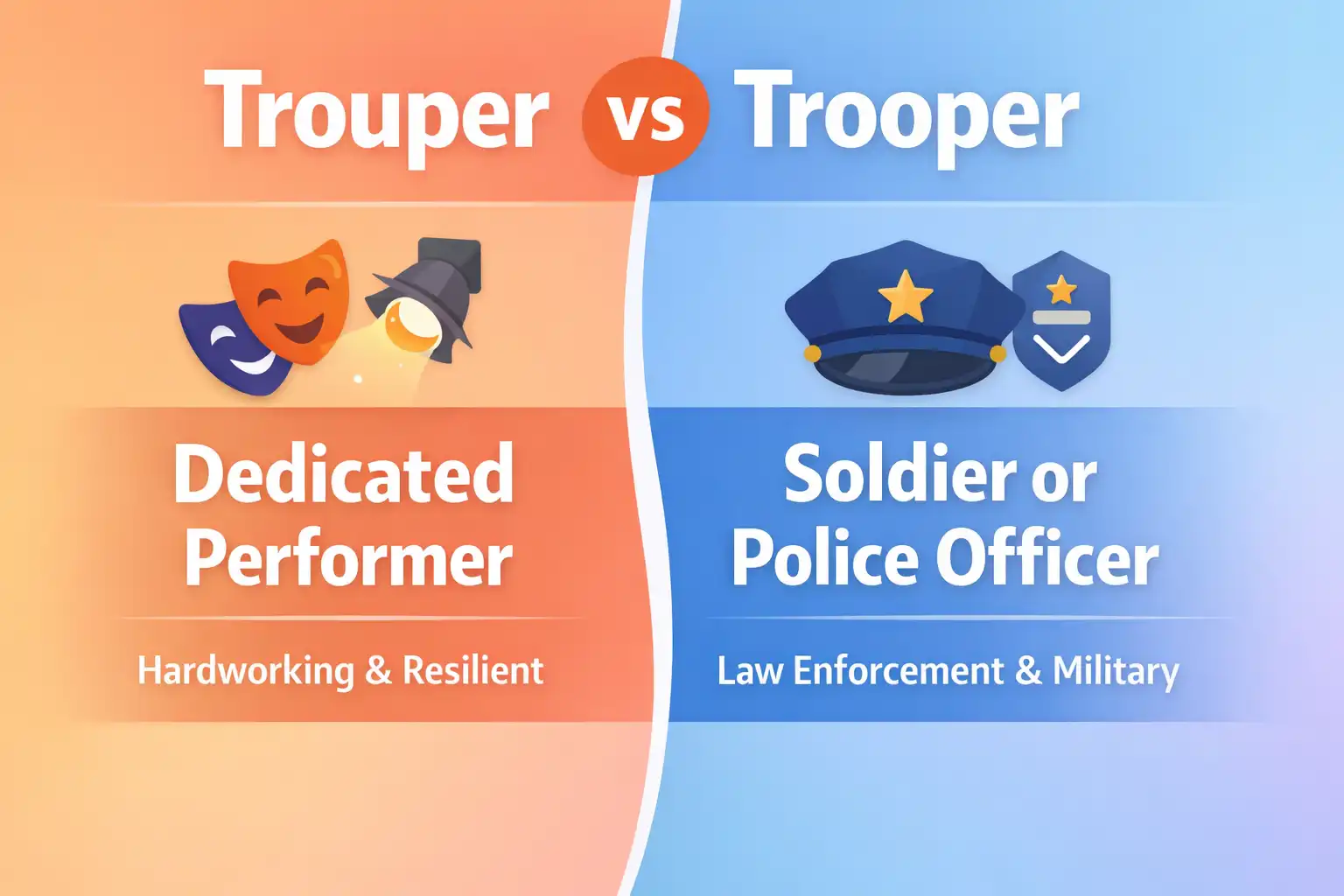
Trouper and trooper sound the same but have different meanings.
• Trouper – a reliable, hardworking performer or team member
• Trooper – a soldier, police officer, or cavalry member
Examples:
• She stayed calm during the crisis. She was a real trouper.
• The highway trooper stopped the speeding car.
Easy rule:
If the sentence is about performance or attitude, use trouper.
If the sentence is about military or police, use trooper.
The Origin of Trouper vs Trooper
Understanding the history of these words makes the difference much clearer.
Trooper appeared first in English. The word came from the word troop, which means a group of soldiers. During the 1600s, armies used cavalry units. A cavalry soldier in a troop became known as a trooper. Over time the word expanded. Now it can refer to soldiers, state police officers, and similar roles.
Trouper came later. The word grew from theater culture in the 1800s. Traveling theater groups were called troupes. A performer in that group was known as a trouper. These actors worked long hours, traveled constantly, and performed in difficult conditions. Because of that, the word slowly gained a new meaning.
Soon people used trouper to describe anyone who works hard without complaining.
So the modern meanings developed from two different worlds. One came from military groups. The other came from performing groups.
However, both words still sound the same today. That is why confusion continues.
British vs American English Spelling
In many word comparisons, spelling changes between British and American English. However, trouper vs trooper does not follow that pattern.
Both varieties of English use the same spelling rules.
| Word | US English | UK English | Meaning |
| Trouper | Trouper | Trouper | hardworking or reliable person |
| Trooper | Trooper | Trooper | soldier or police officer |
Because spelling does not change across regions, confusion usually comes from meaning, not dialect.
Examples:
• US news: A state trooper responded to the accident.
• UK writing: She was a real trouper during the long rehearsal.
In contrast to many spelling differences like color/colour, this pair stays identical across English varieties.
How to Choose the Right Word Fast
Many readers want a quick rule they can remember.
First think about what kind of person the sentence describes.
If the sentence talks about effort, attitude, or teamwork, use trouper.
Example:
You worked all night and still helped everyone today. You are a real trouper.
Now consider whether the sentence describes law enforcement or military service. In that case the correct word is trooper.
Example:
The state trooper directed traffic after the storm.
Audience context can also help.
US usage
The word trooper appears often in news about highway patrol officers. So Americans usually connect the word with police.
UK and Commonwealth usage
Writers still use trooper for soldiers. Meanwhile trouper appears in theater or general praise.
Global or professional writing
Most international writing follows the same rule. If the message praises someone’s attitude, choose trouper. If the text refers to uniformed service, choose trooper.
This quick check usually solves the problem in seconds.
Common Mistakes with Trouper vs Trooper
Because the words sound identical, mistakes appear frequently.
Here are some typical examples.
❌ She helped everyone during the stressful event. She was a real trooper.
✅ She helped everyone during the stressful event. She was a real trouper.
Explanation: The sentence praises effort, not military service.
❌ The highway trouper stopped the driver.
✅ The highway trooper stopped the driver.
Explanation: Police officers are troopers, not troupers.
❌ Thanks for staying positive during the long project. You were a great trooper.
✅ Thanks for staying positive during the long project. You were a great trouper.
Explanation: This sentence describes attitude and teamwork.
Editors often notice these errors in business emails and blog posts. Many writers choose trooper because it feels more familiar.
Trouper vs Trooper in Real Life Examples
These words appear in different kinds of writing. Real-life examples make the difference easier to remember.
Emails
Thank you for helping the team finish the report so quickly. You were a real trouper.
News
The state trooper arrived at the scene within minutes.
Social Media
My friend waited with me at the hospital all night. Absolute trouper.
Professional Writing
The trooper reported the incident and secured the area.
Workplace Messages
Everyone stayed late to solve the problem. The whole team acted like troupers.
These examples show the pattern clearly. Praise uses trouper, while authority or service roles use trooper.
Trouper vs Trooper – Word Usage Patterns and Search Trends
Search interest in trouper vs trooper grows because spelling tools do not always catch the mistake.
Students and ESL learners search the phrase often. Writers and bloggers also look it up when editing their work. Meanwhile journalists rarely confuse the words because their contexts are clearer.
Online writing creates the biggest confusion. For example, someone might post on social media:
“Thanks for helping me move all weekend. You’re a real trooper.”
Readers understand the message, but technically the correct word is trouper.
Another common case appears in workplace emails. A manager may write:
“The team handled the deadline like troopers.”
The intended meaning is hardworking and reliable, so troupers would be correct.
These small spelling errors rarely cause major problems. Still, clear writing improves credibility. That is why many users search for the difference before publishing their text.
Trouper vs Trooper Comparison Table
| Feature | Trouper | Trooper |
| Meaning | Reliable, hardworking person | Soldier or police officer |
| Part of Speech | Noun | Noun |
| Context of Use | Praise, teamwork, effort | Military, law enforcement |
| Formal vs Informal | Used in both casual and professional praise | Common in official titles and news |
| Common Mistake | Replaced with trooper in compliments | Used when talking about effort |
| Correct Example | She stayed calm and positive. She is a real trouper. | The trooper checked the highway accident. |
This table helps readers quickly identify the right word.
FAQs
Is trouper the same as trooper?
No. The words sound the same but have different meanings. Trouper describes a hardworking or dependable person. Trooper refers to a soldier or police officer.
Which word is correct in formal writing?
Both words are correct when used properly. Professional writing uses trooper for law enforcement and trouper when praising effort or attitude.
Can trouper and trooper be used interchangeably?
No. Their meanings differ. Using the wrong word changes the sentence’s meaning.
Why do people confuse trouper and trooper?
The words sound identical. Because pronunciation is the same, writers often choose the wrong spelling.
Can grammar tools detect this mistake?
Some tools miss the error because both words are valid. Context checking sometimes helps, but writers should still review the sentence.
Is there a British vs American difference?
No spelling difference exists. Both British and American English use trouper and trooper the same way.
Which word is more common?
Trooper appears more often in news and official writing. Trouper appears less frequently because it mainly describes personal behavior.
Conclusion
The confusion around trouper vs trooper comes mainly from pronunciation. Both words sound exactly the same, so writers often guess the spelling. However, the meanings come from completely different origins.
Trooper belongs to the world of military and law enforcement. The word grew from the idea of a troop, which is a group of soldiers. Today it commonly refers to state police officers or cavalry soldiers.
Trouper, in contrast, started in the theater. Performers in traveling troupes worked hard under difficult conditions. Because of that history, the word now describes someone who stays positive and dependable even during challenges.
Understanding this background makes the choice much easier.
Overall, remember the simple rule. Use trouper when praising effort or attitude. Use trooper when talking about soldiers or police officers. Avoid mixing them in compliments or workplace messages.
Finally, one quick memory trick helps many writers:
Performance and teamwork → Trouper
Uniform and authority → Trooper

James Holloway writes detailed guides on confusing English words and grammar usage with clear side-by-side comparisons.