Many English learners search for trebled vs tripled because both words seem to mean the same thing. They both describe something that becomes three times larger. So people often wonder if there is any real difference.
This confusion happens in everyday writing. Students see tripled in news articles. But they may read trebled in music, sports, or British writing. Because both words relate to the number three, writers sometimes mix them up.
Small mistakes can change the tone of a sentence. In business writing, the wrong word can sound unnatural. In music or sports, the wrong word may look incorrect.
This article solves that confusion. You will learn the real meaning of trebled and tripled, where each word is used, and why people mix them up. You will also see clear examples, common mistakes, and a simple rule that helps you choose the right word quickly.
Trebled vs Tripled – Quick Answer
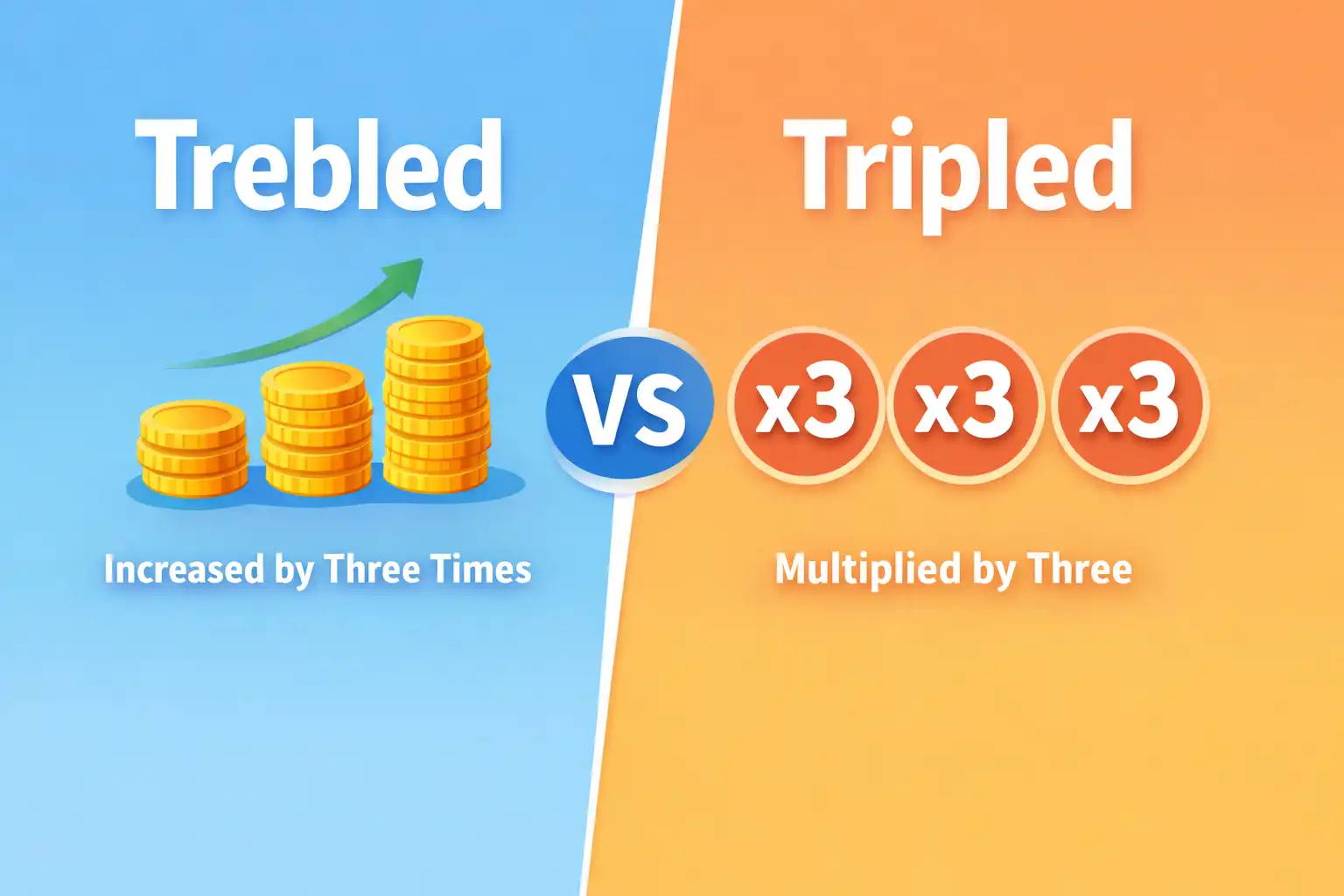
Trebled and tripled both mean something becomes three times bigger or three times the amount.
- Trebled → Often used in British English, music, or sports contexts.
- Tripled → More common in general English, business, and everyday writing.
Examples:
- Sales tripled last year.
- The team trebled its score.
- Her income tripled in five years.
Easy rule: Use tripled for normal writing. Use trebled mainly in British or specialized contexts.
The Origin of Trebled vs Tripled
Both words come from the idea of three times something. However, their roots developed in slightly different ways.
The word treble comes from Old French treble and Latin triplus. These words meant threefold or triple. In early English, treble worked as a noun, adjective, and verb. Writers used it to describe something multiplied by three.
Later, the verb form trebled appeared. It meant “made three times larger.” British writers used it in many situations.
The word triple came into English from Latin triplus as well. Over time, English created the verb tripled, which also means to become three times greater.
So both words share the same historical idea. That is why their meanings overlap today.
However, modern usage slowly separated them. Editors and writers began to prefer tripled in everyday writing. Meanwhile, trebled stayed common in music and some British contexts.
That small shift is the main reason people still search for trebled vs tripled today.
British vs American English Spelling
Spelling is another reason for confusion.
Both words exist in British and American English, but their frequency differs.
American writers strongly prefer tripled. British writers use tripled too, but they may also use trebled in certain contexts.
Here is a quick comparison.
| Feature | Trebled | Tripled |
| Meaning | Increased three times | Increased three times |
| Region preference | More common in UK contexts | Common worldwide |
| Usage type | Music, sports, British writing | General writing, business, news |
| Tone | Slightly traditional | Neutral and modern |
| Example | The club trebled its profits. | The company tripled its profits. |
In contrast, American journalism almost always uses tripled. Because of this, global readers often see tripled more often online.
How to Choose the Right Word Fast
Choosing between trebled vs tripled becomes easy once you know your audience.
For US Writing
Use tripled.
American style guides and news outlets almost always choose this word. It sounds natural and modern in reports, business writing, and everyday communication.
Example:
The company tripled its revenue in two years.
For UK or Commonwealth Writing
Both words can appear. However, tripled still dominates general writing.
Use trebled mostly when the context relates to sports or music.
Example:
The orchestra trebled the harmony in the final section.
For Global or Professional Writing
Choose tripled.
It is the safest option because international readers recognize it easily.
So the quick rule is simple:
Tripled works everywhere. Trebled works in specific contexts.
Common Mistakes with Trebled vs Tripled
Writers often make a few predictable mistakes.
Using “trebled” in everyday business writing
❌ Incorrect:
The startup trebled its user base this year.
✅ Correct:
The startup tripled its user base this year.
Explanation:
Tripled is the standard word in business and news.
Using “tripled” in music terminology
❌ Incorrect:
The choir tripled the high note.
✅ Correct:
The choir trebled the high note.
Explanation:
Music vocabulary often prefers treble-related wording.
Confusing “triple” with “three times”
❌ Incorrect:
Sales tripled to 30 after starting at 20.
✅ Correct:
Sales increased to 30 from 10, so they tripled.
Explanation:
Tripled means three times the original number, not just an increase.
Editors often see this mistake in reports and student writing.
Trebled vs Tripled in Real Life Examples
Understanding real usage helps remove confusion.
Emails
Our marketing results tripled after we improved the website.
News Writing
The company’s profits tripled in the last quarter.
Social Media
My followers tripled after one viral post.
Sports Writing
The club trebled its trophy count this season.
Professional Reports
Production tripled after the factory upgraded its machines.
These examples show a pattern. Most everyday writing uses tripled, while trebled appears in specific fields.
Trebled vs Tripled – Word Usage Patterns and Search Trends
Search behavior shows that many learners still question trebled vs tripled.
Students and ESL learners often search this phrase because grammar tools highlight trebled as unusual. Writers want to know if it is wrong or outdated.
In reality, trebled is correct, but it is less common in modern everyday English.
Journalists, bloggers, and business writers strongly prefer tripled. This choice keeps writing clear for global audiences.
A common real-world problem appears in data reports.
Imagine a report saying:
“Traffic trebled this month.”
Some readers may pause because they rarely see that word in analytics reports. The sentence is correct, but tripled would feel more natural to most readers.
Because of this, professional editors usually recommend tripled unless the context specifically supports trebled.
Trebled vs Tripled Comparison Table
| Feature | Trebled | Tripled |
| Meaning | Became three times larger | Became three times larger |
| Part of speech | Verb (past tense of treble) | Verb (past tense of triple) |
| Context of use | Music, sports, some UK writing | General English everywhere |
| Formal vs informal | Slightly traditional tone | Neutral and widely accepted |
| Common mistakes | Used in business writing | Misused when not exactly 3× |
| Correct example | The team trebled its score. | The company tripled its revenue. |
This table shows that meaning is identical, but context determines the best choice.
Frequently Asked Questions
Is trebled the same as tripled?
Yes. Both words mean something becomes three times larger. The difference mainly comes from usage context.
Which word is correct in formal writing?
Tripled is usually better for formal reports, news writing, and academic text because it sounds more standard.
Can trebled and tripled be used interchangeably?
In many cases, yes. However, tripled fits everyday writing better. Trebled appears more in music or sports contexts.
Why do people confuse trebled and tripled?
Both words share the same meaning and similar origins. Because they both refer to “three times,” learners often think one is incorrect.
Can grammar tools detect this mistake?
Some grammar tools mark trebled as uncommon but not wrong. They may suggest tripled because it appears more frequently in modern writing.
Is there a British vs American difference?
Yes, slightly. American English almost always uses tripled. British English may still use trebled in some contexts.
Which word should ESL learners use?
Most teachers suggest tripled because it is widely understood and used in international English.
Conclusion
The debate around trebled vs tripled mostly comes from usage patterns, not meaning. Both words describe the same idea: something becomes three times larger than before.
However, modern English strongly prefers tripled in everyday writing. You will see it in news reports, business documents, emails, and online content. It sounds natural to readers everywhere.
Meanwhile, trebled still appears in specific contexts such as music, sports writing, and some British English usage. The word is correct, but it is less common in global communication.
Many writers accidentally choose the wrong word because both look similar and share the same meaning. Editors usually replace trebled with tripled unless the context clearly supports it.
Overall, the easiest way to avoid mistakes is simple.
If you are unsure, choose tripled.
Finally, remember this quick rule:
Tripled works everywhere. Trebled works in specific contexts.

James Holloway writes detailed guides on confusing English words and grammar usage with clear side-by-side comparisons.