You see teams and team’s everywhere. They look almost the same, but they do not mean the same thing. Many learners stop and guess. Some add an apostrophe because it feels right. Others remove it because they feel unsure. So mistakes spread in emails, captions, and school papers.
This confusion happens because English uses apostrophes in tricky ways. A small mark changes the meaning of a whole sentence. A teacher might notice. A boss might notice. Even readers online may feel confused. Now the good news is simple. Once you understand the rule, the choice becomes easy and fast.
This guide shows the difference clearly. You will see when to use each form and why it matters in real life.
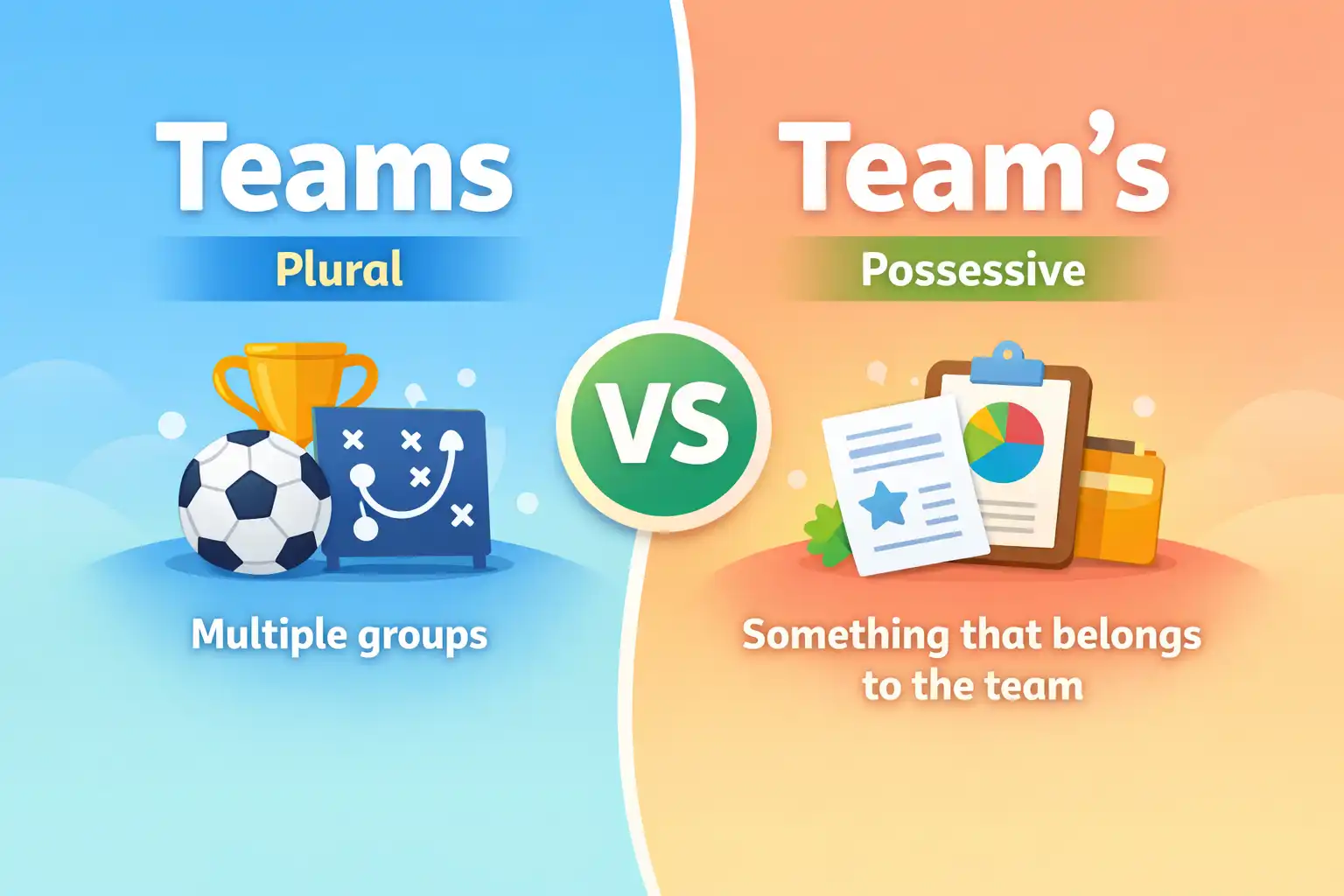
Teams vs Team’s – Quick Answer
- teams = more than one team
- team’s = something belongs to one team
Examples:
- The teams are ready.
- The team’s coach arrived late.
👉 Easy rule: If it shows ownership, use the apostrophe. If it shows plural, don’t.
Why People Confuse Teams vs. Team’s (Sound-Alike Issue)
The word team comes from Old English. It first meant a group pulling together, like animals tied to a cart. Later, it meant a group of people working together. Sports and business both adopted the word. So the meaning expanded, but the core idea stayed the same: unity.
The confusion started when English added apostrophes to show possession. Writers had to mark ownership clearly. Over time, plural words and possessive words began to look similar. Editors often see this mistake today because the spoken sound is identical. You hear no difference, but the written form changes meaning.
British vs American English: Same Apostrophe Rule (Verb Agreement Note)
There is no spelling difference between British and American English here. Both follow the same grammar rule. The confusion is about punctuation, not nationality.
However, style guides may differ in tone. British writing sometimes prefers collective nouns as plural in verbs, while American English treats them as singular. The apostrophe rule still stays the same.
| Style | Sentence Example |
| American | The team is winning. |
| British | The team are winning. |
The possessive form remains identical in both.
How to Choose the Right Word Fast
If you need a quick decision, focus on meaning, not spelling fear.
US:
Writers usually treat team as singular. So possession belongs to one group. Use team’s only when something belongs to that group.
UK / Commonwealth:
Verb agreement may change, but possession rules do not. Ownership still requires an apostrophe.
Global or professional writing:
Follow the ownership test. Ask: Does something belong to the team? If yes, add the apostrophe.
If no ownership exists, use the plural teams.
Common Mistakes with Teams vs Team’s
Writers often mix plural and possessive forms. The eye sees an “s” and panics. Here are frequent errors:
❌ The team’s are playing tonight.
✅ The teams are playing tonight.
(Plural, no ownership)
❌ The teams coach spoke.
✅ The team’s coach spoke.
(Ownership, add apostrophe)
❌ Many team’s joined the league.
✅ Many teams joined the league.
(Plural only)
Each mistake changes the message. Readers pause, and clarity drops.
Teams vs Team’s in Everyday Examples
Emails:
The team’s report is attached.
The teams will present tomorrow.
News:
The team’s captain scored twice.
Several teams entered the finals.
Social media:
Our team’s energy is amazing!
Both teams fought hard tonight.
Professional writing:
The team’s performance improved this quarter.
International teams attended the conference.
These examples show a simple pattern. Ownership equals apostrophe. Plural equals no apostrophe.
Teams vs Team’s – Usage Patterns & Search Interest
This comparison appears often in grammar searches. Students look it up before exams. ESL learners search for it during writing practice. Professionals double-check it before sending formal emails.
Editors usually see this mistake in fast typing. Apostrophes sneak in where they do not belong. One real-world problem happens in headlines. A news title with the wrong form can look careless. Readers may question credibility, even if the article is correct.
So the confusion matters because writing signals trust. Small marks shape big impressions.
Quick Comparison Table
| Feature | teams | team’s |
| Meaning | More than one team | Belonging to one team |
| Part of speech | Plural noun | Possessive noun |
| Context | Groups counted | Ownership shown |
| Formality | Neutral | Neutral |
| Common mistake | Adding apostrophe wrongly | Forgetting apostrophe |
| Correct example | The teams met early. | The team’s plan worked. |
FAQs
Is teams the same as team’s?
No. One is plural. The other shows ownership.
Which one is correct in formal writing?
Both are correct when used in the right context.
Can they be interchangeable?
No. Each has a different meaning.
Why do people confuse them?
They sound the same when spoken.
Can grammar tools catch this mistake?
Sometimes, but not always.
Is there a British vs American difference?
No. The rule stays the same.
Conclusion
English punctuation looks small, but it carries heavy meaning. Teams counts more than one group. Team’s shows that something belongs to a group. Writers mix them because speech hides the difference. However, the written rule stays clear and stable.
Overall, the safest method is the ownership test. Ask a quick question: Does something belong to the team? If yes, add the apostrophe. If not, keep the word plural. This single check prevents almost every mistake. Finally, remember one simple rule: Plural has no apostrophe. Possession always does.

D.H. Lawrence is a research-oriented writer focused on word comparison and semantic clarity within digital content. His work is grounded in close reading, source-based verification, and contextual language analysis, with an emphasis on how meaning shifts across usage, register, and intent. Drawing on editorial research practices, he examines words through their definitions, grammatical function, historical development, and contemporary application.
His approach is methodical rather than interpretive, aiming to present distinctions between similar terms in a way that is accurate, neutral, and easy to apply. By comparing words within real sentences and documented usage patterns, he helps readers avoid ambiguity and misinterpretation in both written and spoken language.
D.H. Lawrence writes for readers who rely on precision—students, writers, editors, and professionals—by offering content that prioritizes trust, clarity, and usefulness. Each article is structured to align with search intent while remaining informative beyond rankings, reflecting a consistent commitment to factual accuracy and reader understanding.