Many writers pause when they see strips and stripes. The words look similar, sound similar, and feel connected. So people guess they mean the same thing. But small spelling changes often carry big meaning changes. That is why this pair causes daily mistakes in school writing, emails, and social media posts.
The confusion matters because each word paints a different picture. One talks about pieces. The other talks about patterns. Writers mix them up, and then sentences feel odd or unclear. This guide solves that problem step by step. You will learn what each word means, where it came from, and how to choose the right one every time.
Difference Between Strips and Stripes
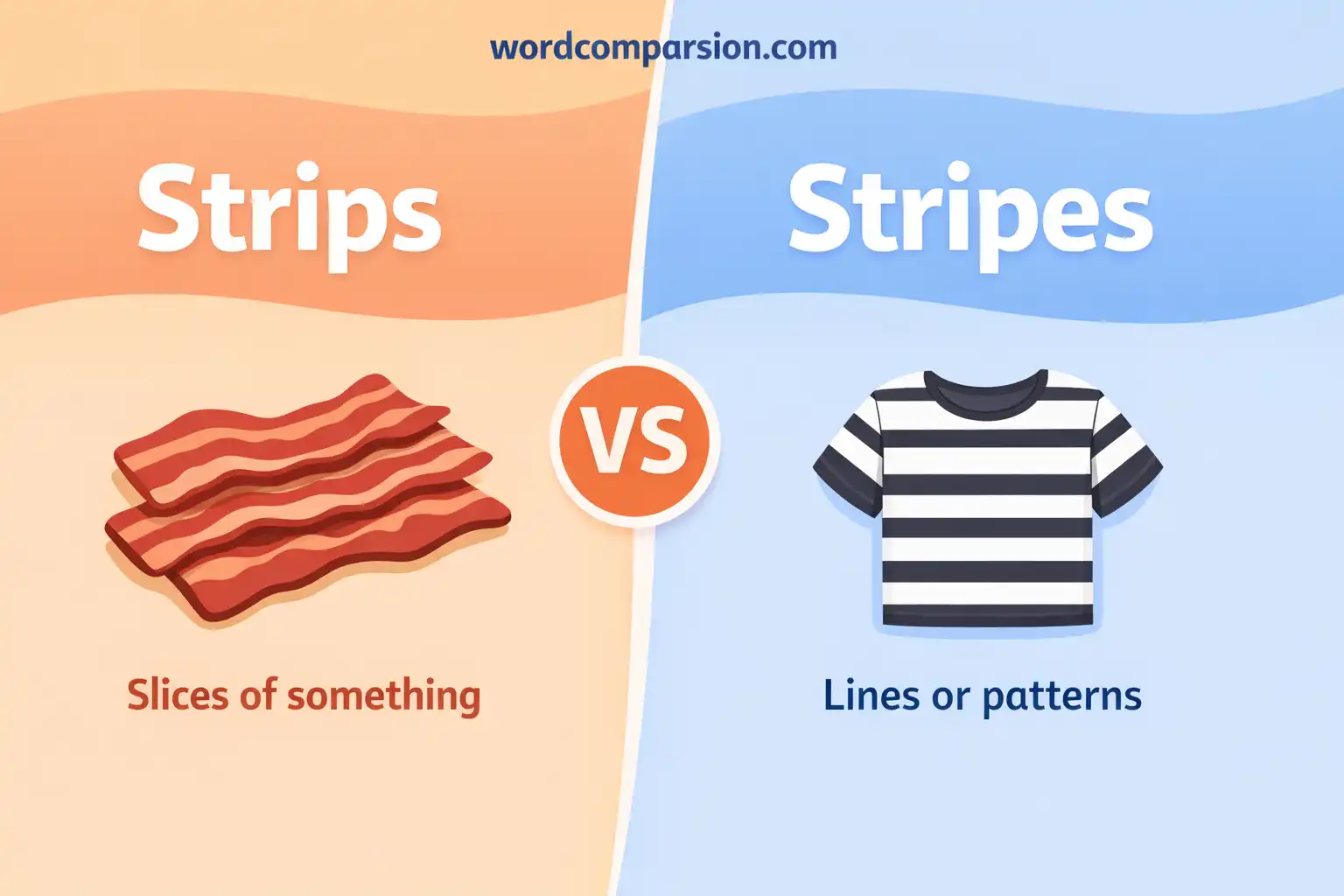
Strips are long, thin pieces cut or taken from something, like paper strips or chicken strips.
Stripes are long lines that stay on a surface as a design, like stripes on a shirt or a flag.
Strips vs Stripes – Quick Answer
Strips are long, thin pieces cut from something.
Stripes are lines or bands that form a pattern.
- You cut paper into strips
- A shirt has blue stripes
Easy rule:
👉 If you remove a piece, use strips.
👉 If you describe a pattern, use stripes.
Origins of “Strip” and “Stripe” (Simple History)
The word strip comes from very old Germanic roots that described pulling something off or taking a layer away. Early speakers used it when they talked about removing bark from wood or cloth from a surface. So the core idea is always connected to separation. A strip meant something that used to belong to a whole but got cut or peeled away.
The word stripe grew from the same family but moved in a different direction. Instead of focusing on removal, it described a visible mark left behind. People used it to talk about streaks of color, scratches, or painted lines. Over time, the meaning settled into the idea of decorative bands or natural patterns seen on animals and fabric.
Both words share a common ancestor, yet English slowly split their jobs. One kept the meaning of cutting pieces. The other kept the meaning of lines and markings. That historical split explains today’s confusion. They look related because they are related, but modern usage gives each word a clear and separate role.
British English vs American English Spelling
There is no spelling difference between British and American English for strips and stripes. Both regions use the same forms.
The spelling does not change, but everyday phrasing can feel a little different. In British writing, people often talk about a striped pattern when they describe design. In American writing, it sounds more natural to say striped fabric, especially when talking about clothes or materials. The words mean the same thing, yet the preferred expression shifts slightly by region.
| Region | Strip | Stripe |
| US | same spelling | same spelling |
| UK | same spelling | same spelling |
So the confusion is not regional. It is purely about meaning.
When to Use Strips vs Stripes (Easy Rule)?
Since spelling does not change by country, your choice depends only on meaning.
For US writing:
Use strips for pieces. Use stripes for patterns.
For UK or Commonwealth writing:
The rule stays the same.
For global or professional writing:
Clarity matters more than style. Readers expect precise word choice. Mixing them can distract your audience.
If you picture cutting something, choose strips.
If you picture lines or decoration, choose stripes.
Common Mistakes with Strips vs Stripes
Writers mix these words because both describe narrow shapes. But the action behind the shape changes everything.
❌ The flag has red and white strips
✅ The flag has red and white stripes
→ A flag shows a pattern, not loose pieces
❌ Cut the carrots into thin stripes
✅ Cut the carrots into thin strips
→ You are slicing pieces
❌ She wore a dress with green strips
✅ She wore a dress with green stripes
→ Clothing shows design
❌ The recipe calls for lemon stripes
✅ The recipe calls for lemon strips
→ Cooking uses cut pieces
ESL learners confuse them because both are narrow.
Strips vs Stripes in Everyday Examples
Understanding grows faster when you see real situations.
Emails
“Please send the paper in long strips for the craft project.”
News writing
“The zebra’s bold stripes help it blend into the herd.”
Social media
“I love these rainbow stripes on my new shoes!”
Professional writing
“The technician removed metal strips from the frame.”
Each sentence highlights the difference: removed piece vs visible pattern.
Strips vs Stripes – How People Use the Words & Why They Search Them
People confuse them because they learn both words early. Students, ESL readers, and beginner writers search this comparison often. The most common scenario happens in classroom writing. A student describes a flag or shirt and chooses strips instead of stripes. The teacher understands the meaning but marks it wrong. That small error creates frustration.
This guide removes that frustration by showing the visual logic behind each word. Writers tend to remember shapes better than rules. So connecting strips with cutting and stripes with decoration helps the brain store the difference. The difference between strip vs stripe: piece vs pattern becomes clear when you cut paper into strips but wear a shirt with stripes.
Comparison Table
| Feature | Strips | Stripes |
| Meaning | Long cut pieces | Decorative lines or bands |
| Part of speech | Noun / verb form of strip | Noun / plural of stripe |
| Context of use | Cooking, crafts, removal | Clothing, animals, flags |
| Formal vs informal | Neutral in all writing | Neutral in all writing |
| Common mistake | Used for patterns | Used for sliced pieces |
| Correct example | Cut paper into strips | The tiger has dark stripes |
This table shows the contrast instantly. One word belongs to action. The other belongs to appearance.
FAQs
Is strips the same as stripes?
No. Strips are pieces. Stripes are patterns.
Which one is correct in formal writing?
Both are correct. You must match the meaning.
Can they be used interchangeably?
No. Switching them changes the sentence image.
Why do people confuse them?
The spellings look similar and both describe narrow shapes.
Can grammar tools catch this mistake?
Sometimes. Tools may miss it because both words are real.
Is there a British vs American difference?
No. Both regions use the same spellings.
Conclusion
The difference between strips and stripes feels small at first, yet it shapes how readers picture your sentence. One word shows something removed. The other shows something displayed. Mixing them does not break grammar, but it breaks clarity. Readers pause and mentally fix the image.
Overall, remember the action behind the word. Strips come from cutting or separating. Stripes come from patterns that stay attached. This mental picture prevents most mistakes.
In short, imagine scissors for strips and decoration for stripes. Finally, keep one easy rule in mind: if it can fall off, it is a strip; if it stays as a design, it is a stripe.

James Holloway writes detailed guides on confusing English words and grammar usage with clear side-by-side comparisons.