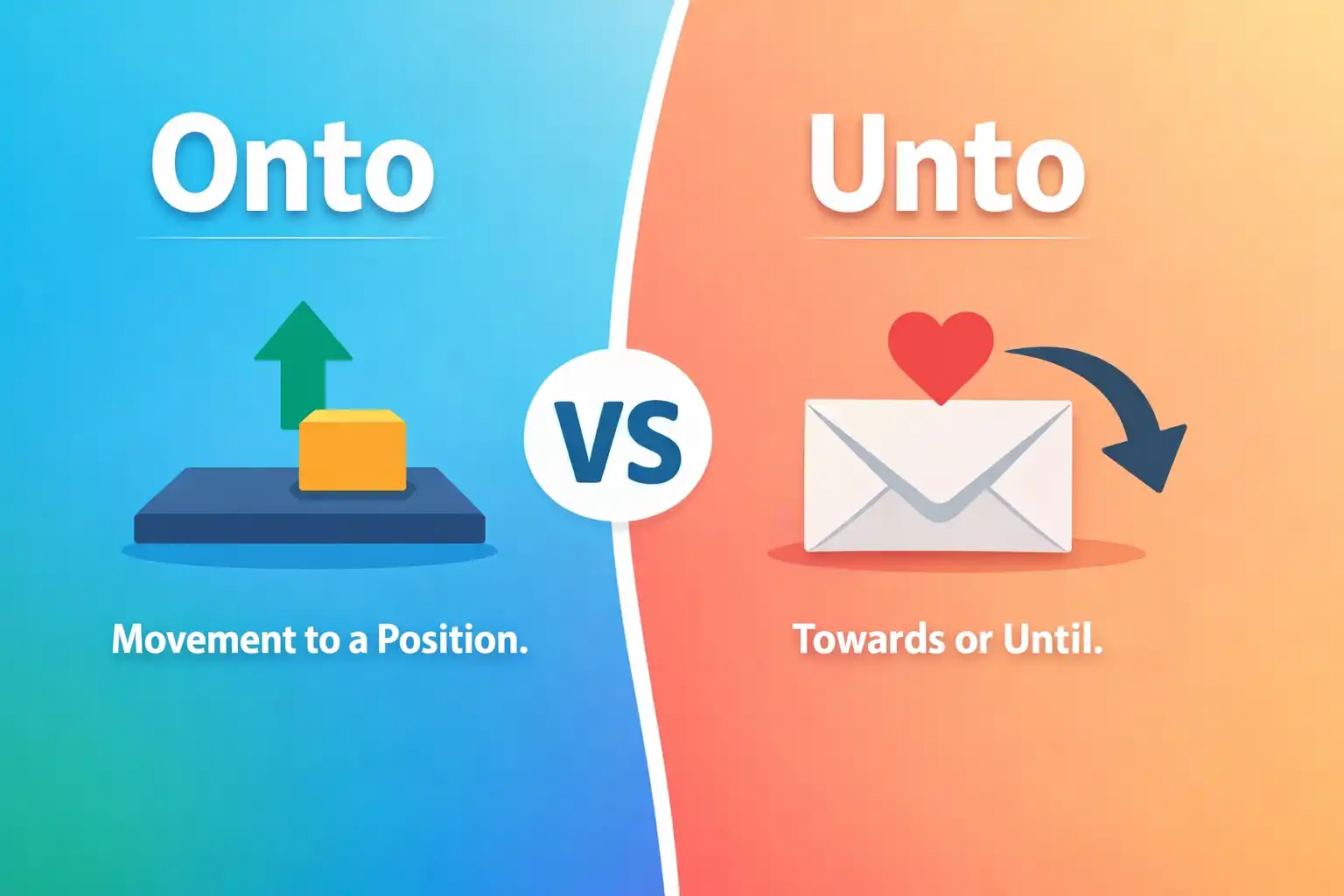
Many learners pause when they see onto vs unto. The words look very similar. Both also show direction or movement. Because of this, people often mix them up in writing.
However, the two words do not mean the same thing. One is common in daily English. The other appears mostly in old or formal language. Students, ESL learners, and even writers sometimes choose the wrong one because they only look at spelling.
This confusion matters in real writing. For example, a simple email, school essay, or article can sound strange if the wrong word appears. Editors often notice this mistake quickly.
So this guide explains the difference in very clear language. You will learn what onto means, what unto means, when to use each one, and how to avoid common mistakes. Simple examples will also help you remember the rule easily.
Onto vs Unto – Quick Answer
Onto and unto both relate to direction, but they are used in very different ways.
Meaning of Onto
- Shows movement to a surface
- Common in modern English
Examples
- The cat jumped onto the table.
- He climbed onto the bus.
Meaning of Unto
- Means to or toward in old or biblical language
- Rare in everyday English
Examples
- The king gave land unto his soldiers.
- Glory unto the brave.
Easy rule:
Use onto for movement. Use unto only in very formal or historical language.
The Origin of Onto vs Unto
Understanding the origin helps explain why these words confuse people.
The word onto formed from two parts: on + to. Over time, writers combined them into one word. The meaning stayed simple. It described movement to a surface or position.
For example, old English texts sometimes wrote on to. Later, modern grammar guides preferred onto when movement happens.
Example
- She stepped onto the stage.
The word unto, however, comes from Old English “unto.” It originally meant to, toward, or until. Early English writers used it often.
You can still see it in religious or historical texts.
Example
- Peace be unto you.
Today, the difference exists because language evolved. Modern English kept onto for physical movement. But unto became rare and stayed mostly in biblical or ceremonial language.
So the confusion happens because both contain the word to and both show direction. Yet their usage in modern English is very different.
British vs American English Spelling
There is no spelling difference between British and American English for these words. Both regions use the same spelling and the same meaning.
However, the frequency of use differs slightly.
Modern writers in both regions prefer onto for everyday writing. Meanwhile, unto appears mainly in historical or religious texts.
Example sentences:
British English
- The player ran onto the field.
American English
- The child climbed onto the couch.
But unto usually appears in traditional phrases.
Example
- Blessed are those who give unto others.
Small comparison table:
| Word | British Use | American Use | Modern Usage |
| Onto | Very common | Very common | Everyday writing |
| Unto | Rare | Rare | Religious or historical |
Therefore, the difference is about usage style, not spelling.
How to Choose the Right Word Fast
Choosing between onto vs unto becomes easy when you follow a simple context rule.
US Writers
Use onto when someone or something moves to a surface.
Example
- The dog jumped onto the bed.
UK / Commonwealth Writers
The same rule applies. Onto remains the normal choice in daily English.
Example
- She walked onto the balcony.
Global or Professional Writing
Professional writing almost always prefers onto because it sounds clear and modern.
Example
- The actor stepped onto the stage.
When should you use unto?
Use it only in these cases:
- Religious writing
- Historical quotes
- Formal ceremonial phrases
Example
- Give thanks unto the Lord.
Quick rule:
If the sentence talks about movement, choose onto.
Common Mistakes with Onto vs Unto
Writers often confuse these words because they look almost identical.
Here are frequent mistakes.
❌ The child jumped unto the chair.
✅ The child jumped onto the chair.
Explanation: movement to a surface requires onto.
❌ He climbed unto the roof.
✅ He climbed onto the roof.
Explanation: modern English prefers onto for physical movement.
❌ The teacher gave praise onto the student.
✅ The teacher gave praise unto the student.
Explanation: unto works here because it means to in a formal sense.
Another common error appears when writers separate the words incorrectly.
❌ She jumped on to the table quickly.
✅ She jumped onto the table quickly.
Editors usually recommend onto when movement happens.
These small mistakes can make writing sound unnatural. So understanding the context helps avoid them.
Onto vs Unto in Real Life Examples
You can see the difference clearly in everyday writing.
Emails
- Please place the files onto the shared drive.
- The manager stepped onto the stage during the meeting.
News
- The runner collapsed onto the track after the race.
Social Media
- My cat just jumped onto my keyboard.
Formal Writing
- The king bestowed honor unto the brave soldier.
Historical Writing
- The message was delivered unto the queen.
In daily communication, onto appears almost everywhere. Meanwhile, unto shows up mostly in ceremonial or historical sentences.
Onto vs Unto – Word Usage Patterns and Search Trends
Search patterns show that many users look up onto vs unto because the words look alike.
Students and ESL learners search this comparison frequently. They often see both words in books and wonder if they mean the same thing.
Writers also search for it when editing text. Grammar tools sometimes highlight onto, but they may not explain the difference clearly.
Generally, onto appears far more often in modern English. It shows up in articles, emails, instructions, and conversations.
Meanwhile, unto appears mainly in:
- Biblical texts
- Religious speeches
- Historical writing
A real-world confusion example can happen in academic writing. A student might write:
“The child climbed unto the chair.”
Teachers often correct this because modern grammar requires onto for movement.
So learning the difference improves clarity and professionalism.
Onto vs Unto Comparison Table
| Feature | Onto | Unto |
| Meaning | Movement to a surface | Formal word meaning “to” |
| Part of Speech | Preposition | Preposition |
| Context of Use | Everyday English | Religious or historical writing |
| Formal vs Informal | Neutral and common | Very formal or archaic |
| Common Mistake | Using unto instead | Using onto in formal phrases |
| Correct Example | She stepped onto the stage. | Praise be unto the hero. |
This table helps readers quickly see the difference.
FAQs About Onto vs Unto
Is onto the same as unto?
No. Onto shows movement to a surface. Unto means to in formal or old language.
Which word is correct in modern writing?
Most modern writing uses onto. The word unto appears rarely.
Can onto and unto be used interchangeably?
No. They have different meanings and contexts.
Why do people confuse onto and unto?
The spelling looks very similar. Both words also contain to, which creates confusion.
Do grammar tools detect this mistake?
Sometimes. But many tools only check spelling, not context.
Is there a British vs American difference?
No. Both regions use the same spelling and the same usage rules.
Is unto outdated?
In everyday English, yes. But it still appears in religious or ceremonial phrases.
Conclusion
Understanding onto vs unto becomes easy once you know the main difference.
Onto describes movement to a surface. This word appears in daily English. You will see it in emails, conversations, news, and professional writing.
Unto, however, belongs mostly to older or formal language. It appears in religious texts, historical writing, or ceremonial phrases. Modern writers rarely use it in normal sentences.
The most common mistake happens when people replace onto with unto while describing movement. This small error can make a sentence sound outdated or incorrect.
So remember this simple rule.
If someone moves to a place or surface, use onto.
If the sentence sounds religious, historical, or ceremonial, unto may appear.
Overall, clear context solves the confusion. Once you recognize the purpose of each word, choosing the correct one becomes quick and natural.

James Holloway writes detailed guides on confusing English words and grammar usage with clear side-by-side comparisons.