Many writers pause when they reach this phrase. Should it be onstage or on stage? Both look right, but they feel different. So people guess, and guessing creates small mistakes that spread fast. Students worry about exams, bloggers worry about grammar tools, and ESL learners feel stuck between rules that seem unclear.
This confusion happens because English changes words over time. Some phrases slowly merge into one word, while others stay open. Readers then see both versions online, and doubt grows.
So this guide clears that doubt in a simple way. You will learn the real difference, when to use each form, and how to avoid the most common mix-ups.
Onstage vs On Stage – Quick Answer
Both forms are correct, but they serve different roles.
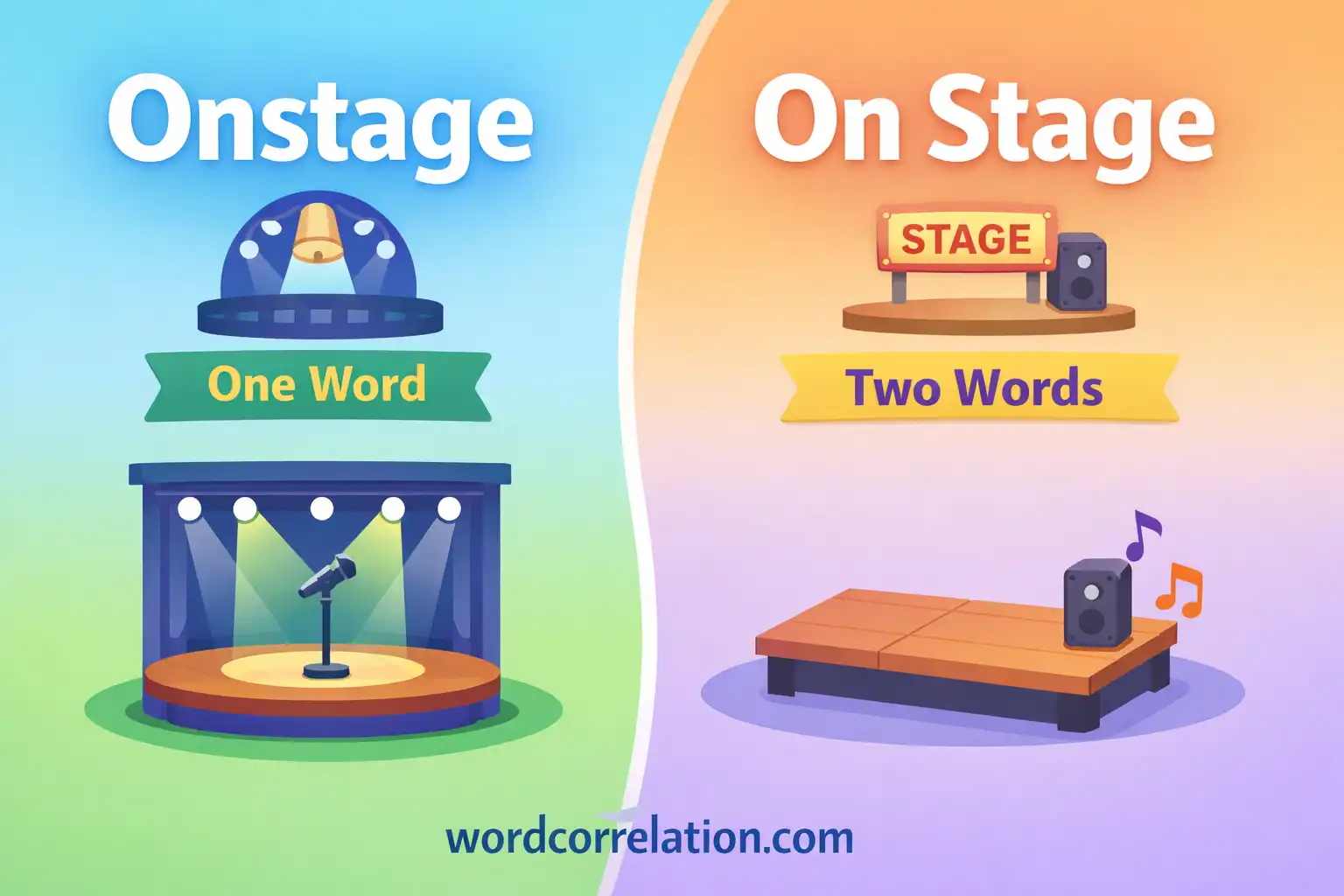
- On stage = location (someone is standing on a stage)
- Onstage = adjective (describes performance action)
Examples:
- She walked on stage.
- His onstage energy amazed the crowd.
👉 Easy rule: Use two words for place, one word for description.
The Origin of Onstage vs On Stage
The phrase began as on stage, a simple location marker. Actors stood on a raised platform, so the words described a physical place. Early theatre writing always used the open form.
However, language loves shortcuts. Over time, writers needed a faster way to describe performance style. So onstage became an adjective. It started to describe behavior, not position. Editors then accepted it as a compound word.
This shift explains today’s confusion. Both forms grew from the same root, but they now carry slightly different jobs. Writers often forget that small job difference, so they swap the forms without noticing.
British English vs American English Spelling
Both British and American English accept onstage and on stage. There is no spelling war here. The difference is about function, not geography.
| Region | Preferred Form | Notes |
| US | Both accepted | Usage depends on meaning |
| UK | Both accepted | Same rule applies |
| Global media | Mixed | Context decides |
In contrast to many spelling debates, this pair follows the same rule worldwide. So learners do not need to switch spelling by region.
Which Spelling Should You Use?
The choice depends on your audience and purpose.
For US writing, follow the meaning rule strictly. Editors expect clear separation between adjective and location.
For UK or Commonwealth writing, the same rule applies. Style guides still prefer accuracy over habit.
For global or professional writing, clarity matters most. Readers understand faster when the word matches its role. Therefore, using the correct form improves trust and flow.
If you remember the function rule, you will never choose wrong.
Common Mistakes with Onstage vs On Stage
Writers often mix location and description. That small switch changes the sentence rhythm.
❌ She felt nervous onstage before walking out.
✅ She felt nervous on stage before walking out.
Explanation: The sentence describes a physical place.
❌ His on stage performance was electric.
✅ His onstage performance was electric.
Explanation: The word describes a performance quality.
❌ The singer smiled onstage lights.
✅ The singer smiled under the onstage lights.
Explanation: Compound adjective modifies the noun.
These mistakes appear because the eye sees the same sound. However, grammar cares about the role, not the sound.
Onstage vs On Stage in Everyday Examples
Correct usage appears in many daily settings.
Emails:
“The speaker will step on stage at 9 PM.”
News writing:
“Her onstage presence drew loud applause.”
Social media:
“First time on stage and I survived!”
Professional writing:
“The actor’s onstage chemistry improved the play.”
Each example shows the same rule working in different tones.
Onstage vs On Stage – Usage Patterns & Search Interest
Search interest comes from learners and writers who want clarity. Students check before submitting papers. ESL learners search during homework. Bloggers verify while editing posts.
Misuse often causes subtle confusion. Imagine a theatre review saying:
“Her on stage voice filled the hall.”
Readers pause because the adjective looks broken. The message still works, but flow slows. Small friction weakens professional writing.
Therefore, correct usage improves reading speed and trust.
Comparison Table
| Feature | On Stage | Onstage |
| Meaning | Physical location | Descriptive adjective |
| Part of speech | Prepositional phrase | Compound adjective |
| Context of use | Position or movement | Performance qualities |
| Formal tone | Neutral | Neutral |
| Common mistake | Used as adjective | Used as location |
| Correct example | She stepped on stage | Her onstage style impressed |
This table removes confusion instantly.
FAQs
Is onstage the same as on stage?
No. They share roots but serve different grammar roles.
Which is correct in formal writing?
Both are correct when used in the right context.
Can they be interchangeable?
No. Swapping them changes sentence structure.
Why do people confuse them?
They sound identical and appear together online.
Can grammar tools catch this mistake?
Sometimes, but human judgment works better.
Is there a British vs American difference?
No. Both regions follow the same rule.
Conclusion
The difference between onstage vs on stage is small but important. One shows location, while the other describes performance. Writers mix them because they sound alike, yet grammar depends on role, not sound.
Overall, the safest approach is to pause and ask one question: Am I describing a place or a quality? If it is a place, use two words. If it is a description, use one word. That single check prevents almost every mistake.
Finally, remember the easy rule: two words for position, one word for performance. Keep that in mind, and this confusion disappears forever.

James Holloway writes detailed guides on confusing English words and grammar usage with clear side-by-side comparisons.