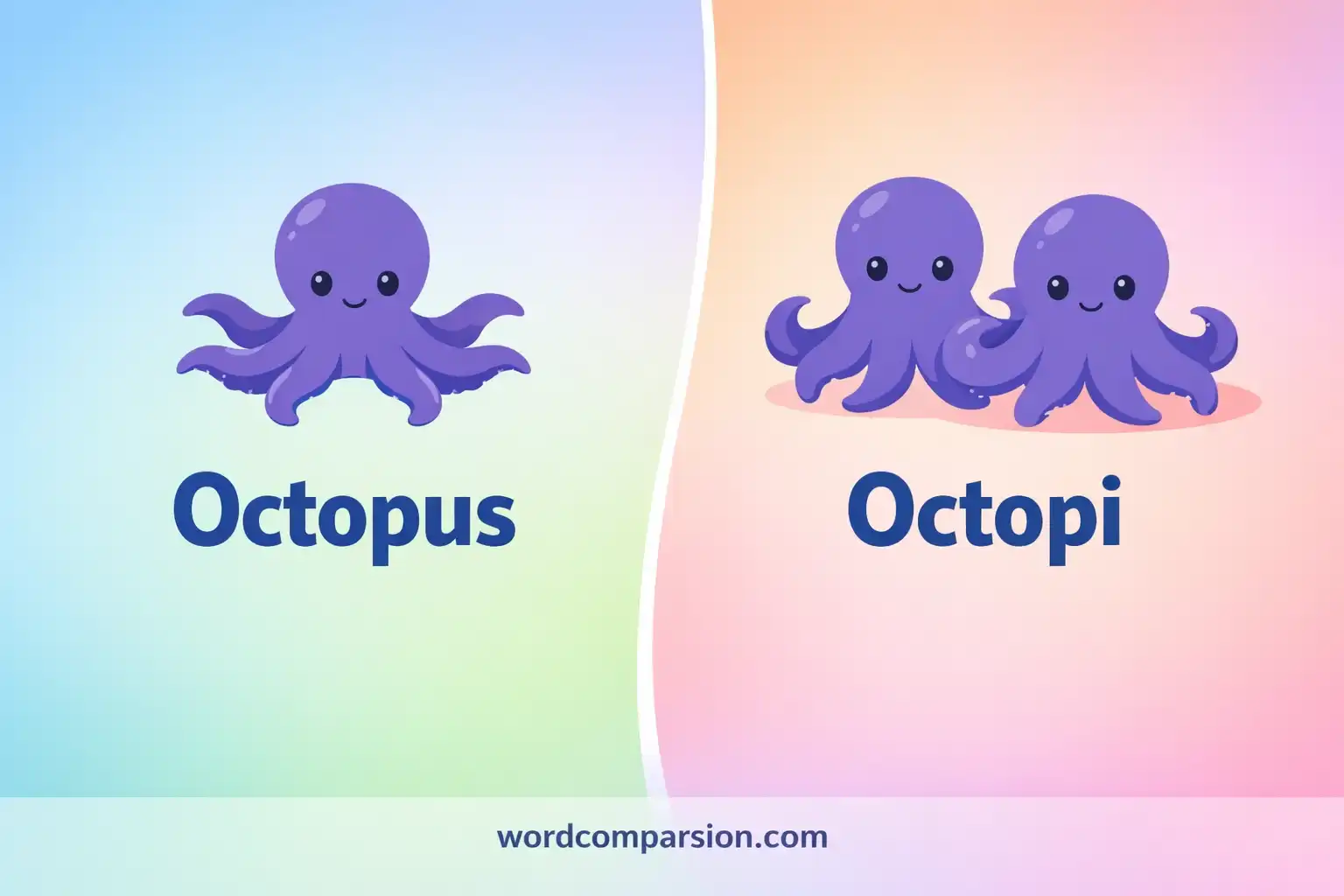
Many people stop when they write this word. They think. They doubt. They delete. Then they type again. Octopus or octopi feels confusing. However, this problem is very common. Students face it. Writers face it. Even teachers pause.
The confusion starts because English borrows words from other languages. As a result, plural rules sometimes clash. Moreover, spellcheck tools often disagree. Some show “octopi” as correct. Others prefer “octopuses.” Therefore, people feel unsure.
This article solves that exact problem. First, it explains where the words came from. Next, it shows why the confusion exists. Then, it clearly tells you which form to use and when. Additionally, you will see real examples from daily life. Finally, you will learn one simple rule you can always trust.
For more quick side-by-side checks, browse the “word comparison hub“.
Octopus or Octopi – Quick Answer
- Octopus is the singular form.
- Octopuses is the correct English plural.
- Octopi is a common but incorrect Latin-style plural.
For example:
- ✅ “I saw three octopuses.”
- ❌ “I saw three octopi.”
The Origin of Octopus or Octopi
The word octopus comes from Greek. It joins two Greek parts. “Okto” means eight. “Pous” means foot. Therefore, the word means “eight-footed.”
However, confusion began later. English borrowed the word. Meanwhile, many people assumed it was Latin. As a result, they tried to apply Latin plural rules. Latin words ending in “-us” often change to “-i.”
In contrast, octopus is not Latin. It is Greek. Because of that, “octopi” does not follow the real origin. Moreover, Greek plurals work very differently. The true Greek plural would be “octopodes,” which sounds strange in modern English. Therefore, English chose a simpler path.
Explore the “Plural Forms” category page for more plural rules.
British English vs American English Spelling
British English and American English agree on this point. However, usage habits still differ slightly.
| Aspect | British English | American English |
|---|---|---|
| Preferred plural | Octopuses | Octopuses |
| Acceptance of “octopi” | Rare | Rare |
| Formal writing | Octopuses | Octopuses |
In contrast to spelling differences like “colour” and “color,” this word stays the same. Therefore, location does not change the rule.
Which Spelling Should You Use?
The best choice depends on your audience. However, one form works almost everywhere.
For US readers, use octopuses. Teachers, editors, and exams expect it.
For UK or Commonwealth readers, the same rule applies.
For global or professional writing, octopuses stays safest.
Meanwhile, “octopi” may appear in casual speech. However, it can look incorrect in formal text. Therefore, writers should avoid it.
Common Mistakes with Octopus or Octopi
Many errors happen again and again. However, they are easy to fix.
- ❌ Octopi are very intelligent.
✅ Octopuses are very intelligent. - ❌ That aquarium has rare octopi.
✅ That aquarium has rare octopuses. - ❌ Octopi is the correct plural.
✅ Octopuses is the correct plural.
These mistakes happen because people rely on patterns instead of facts. Therefore, learning the origin helps a lot.
Octopus or Octopi in Everyday Examples
Usage becomes clear with real situations. Therefore, look at these examples.
Emails:
“I learned that octopuses can solve puzzles.”
News:
“Scientists studied deep-sea octopuses.”
Social media:
“Octopuses are smarter than we think!”
Formal writing:
“The behavior of octopuses shows advanced learning.”
In contrast, “octopi” appears mostly in jokes or casual posts. However, serious writing avoids it.
Octopus or Octopi – Google Trends & Usage Data
Search data shows interesting patterns. Therefore, usage tells a story.
- Students often search “octopus plural.”
- ESL learners ask “octopus or octopi.”
- Writers search for grammar confirmation.
- Professionals prefer safe, standard forms.
Country trends show similar confusion worldwide. However, trusted dictionaries and style guides favor octopuses. As a result, correct usage keeps rising. If you’re comparing similar terms, our “how to use bicep or biceps” article can help.
Comparison Table: Octopus vs Octopi vs Octopuses
| Feature | Octopus | Octopi | Octopuses |
|---|---|---|---|
| Meaning | One animal | Claimed plural | Correct plural |
| Part of speech | Noun | Noun | Noun |
| Context of use | Singular | Informal only | All contexts |
| Formal usage | Yes | No | Yes |
| Common mistakes | None | Wrong plural | None |
| Correct example | An octopus | ❌ Three octopi | ✅ Three octopuses |
This table removes doubt instantly. Therefore, writers can choose with confidence.
Semantic FAQs (People Also Ask)
Is octopus the same as octopi?
No. Octopus is singular. Octopi is an incorrect plural.
Which one is correct in formal writing?
Octopuses is correct.
Can they be used interchangeably?
No. Only octopuses works in standard English.
Why do people confuse them?
They assume the word is Latin.
Can grammar tools catch this mistake?
Yes. Most modern tools flag “octopi.”
Is there a British vs American difference?
No. Both prefer octopuses.
Conclusion
Overall, the confusion around octopus or octopi comes from history, not grammar. The word came from Greek. However, people treated it like Latin. As a result, “octopi” spread widely.
In short, English solved the issue by creating a simple plural. Octopuses follows normal English rules. Therefore, it works in schools, books, emails, and exams. Moreover, it sounds natural to native speakers.
Finally, remember one easy rule: If you write in English, use English plurals. That means octopus becomes octopuses. Avoid octopi every time.
Once you follow this rule, your writing becomes clear and confident. Related reading: see “alumni or alumnae” for another commonly mixed-up pair.

James Holloway writes detailed guides on confusing English words and grammar usage with clear side-by-side comparisons.