Many people feel confused when they see the words inquiries or queries. Both words look similar. Both sound formal. And both are used when someone asks a question. But they are not always the same. Students, office workers, and even teachers sometimes mix them up.
In daily life, we ask questions all the time. We ask our teacher and our parents. We ask online. When we write in English, we must choose the right word. Using the wrong word can change the meaning. It can also make your writing look unclear.
This 2026 guide will explain inquiries or queries in very simple English. You will learn the meanings, the easiest rule, real-life examples, and common mistakes. By the end, you will know which word to use and when to use it.
Quick Answer
✅ Correct: Use inquiry for general questions or help.
✅ Correct: Use query for a specific question or one clear problem.
Simple Rule:
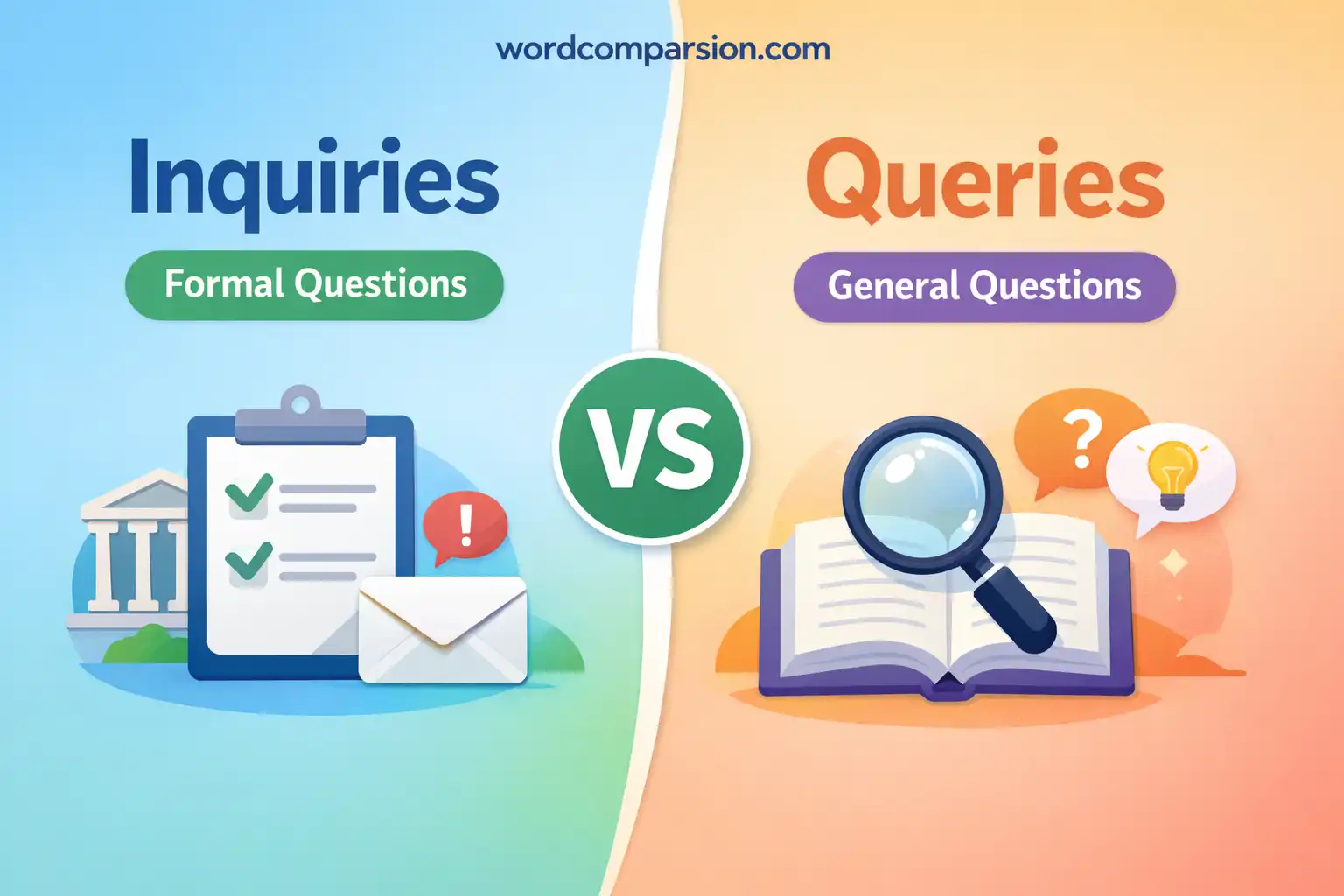
Inquiry = general information
Query = one exact question
What Each Word Means (Simple Meaning)
What Does “Inquiry” Mean?
An inquiry is a polite question. It is usually general. It means you want information, help, or details.
People often use inquiry in:
- schools
- offices
- businesses
- customer service
It sounds formal but friendly.
Examples of inquiry
- Asking about fees
- Asking about admission
- Asking about a service
- Asking for information
✅ Example sentences:
- I made an inquiry about the course.
- She sent an inquiry about the price.
- We received many inquiries today.
What Does “Query” Mean?
A query is a clear and exact question. It focuses on one point. It usually needs a direct answer.
People often use query in:
- exams
- study questions
- office tasks
- computer work and data
It sounds more technical.
Examples of query
- Asking about an error
- Asking about one problem
- Asking about data
- Asking about one line in a report
✅ Example sentences:
- I have a query about question 5.
- The student raised a query in class.
- The system shows a query error.
The Simple Rule (Easy Trick to Remember)
Here is the easiest trick:
Inquiry = “I need information”
Query = “I need an answer”
Ask yourself this:
✅ Is your question broad and general?
➡️ Use inquiry
✅ Is your question sharp and about one issue?
➡️ Use query
This one rule will help you every time.
Why People Get Confused
People get confused because both words mean “question.”
Also, both words sound formal. So they feel the same.
Here are the main reasons:
1) Both mean “asking”
Yes, both are about asking. That is why learners mix them up.
2) Both are used in offices
In emails, companies often use “inquiries.”
But in reports and tasks, people use “queries.”
3) Translation makes it harder
Many learners translate from their own language. In translation, both words may look like one word.
4) Social media mixes words
Online writing is not always correct. People use words freely. So you may see wrong examples.
But English has small rules. When you learn them, your writing becomes stronger.
Inquiries vs Queries: Which One Sounds More Polite?
This is a common question.
Inquiry sounds more polite
It is safe for:
- business messages
- customer support
- office emails
- school requests
Example:
- I would like to make an inquiry about your service.
Query sounds more direct
It is common in:
- study questions
- office problem-solving
- technical work
Example:
- I have a query about this error.
So if you want to sound polite and general, choose inquiry.
Examples in Real Life (Easy and Clear)
1) Emails
In emails, inquiry is very common.
✅ Example sentences:
- I am writing to make an inquiry about the course.
- Please reply to my inquiry soon.
- We received your inquiry and will respond shortly.
Query can also be used in emails, but usually for one issue.
✅ Example sentences:
- I have a query about my account balance.
- Can you answer my query about this invoice?
2) School / Exams
In school, teachers use inquiry for learning topics.
✅ Example sentences:
- The student made an inquiry about the exam date.
- Inquiry-based learning helps students think.
Students often use query for one exact doubt.
✅ Example sentences:
- The student raised a query about question five.
- I have a query about this math step.
3) Formal Writing
In formal writing, word choice matters a lot.
✅ Example sentences:
- All inquiries must be sent before Friday.
- Please clear this query before submission.
- We will respond to your inquiry within 24 hours.
4) Social Media
On social media, “inquiries” is often used for business.
✅ Example sentences:
- For business inquiries, send a message.
- We got many inquiries about this product.
“Query” is less common, but still correct.
✅ Example sentences:
- I have a query about this post.
- Can someone answer my query?
Common Mistakes (and Correct Sentences)
Many people use the wrong word. Let’s fix it.
❌ Mistake 1
❌ I have an inquiry about this spelling mistake.
✅ I have a query about this spelling mistake.
(Spelling mistake = one exact issue → query)
❌ Mistake 2
❌ Please answer my queries about admission in general.
✅ Please answer my inquiry about admission.
(Admission in general = broad topic → inquiry)
❌ Mistake 3
❌ The teacher solved my inquiry in math.
✅ The teacher solved my query in math.
(Math question = exact doubt → query)
❌ Mistake 4
❌ Send all queries to the office for help.
✅ Send all inquiries to the office for help.
(Office help = general request → inquiry)
Quick Tip
✅ General help = inquiry
✅ Exact problem = query
Inquiries or Queries in Business (Which One Is More Common?)
In business writing, you will see this line often:
✅ For business inquiries, contact us.
That is because “inquiries” is a common polite business word.
When to use “inquiries” in business
Use inquiries for:
- customer questions
- service details
- product information
- pricing requests
Example:
- For business inquiries, email us.
When to use “queries” in business
Use queries for:
- technical issues
- a specific billing problem
- a clear error
Example:
- Please send your billing queries to our support team.
Inquiries vs Queries in Computers (Very Simple)
In computer studies, query is a very common word.
A query can mean:
- a question sent to a system
- a request for data
Example:
- The database query shows the results.
“Inquiry” is not used much in computers.
So if your topic is technical or data-related, query is usually the better word.
Comparison Table: Inquiry vs Query
| Feature | Inquiry | Query |
| Type of question | General | Specific |
| Tone | Polite | Direct |
| Common in business | Very common | Less common |
| Common in exams | Rare | Common |
| Focus | Information | One issue |
| Example | Fee inquiry | Data query |
FAQs (People Also Ask)
1) What is the main difference between inquiries or queries?
The main difference is focus.
An inquiry asks for general information.
A query asks about one clear issue.
2) Can I use inquiries or queries in emails?
Yes, you can use both.
Use inquiry for help or services.
Use query for one clear problem.
3) Are inquiries or queries used in school English?
Yes.
Teachers use inquiry for learning topics.
Students use query for exam doubts.
4) Which word sounds more polite?
Inquiry sounds more polite.
It is safer for offices and schools.
5) Can I say “business queries”?
Yes, it is correct.
But business inquiries is more common.
Many companies prefer “inquiries.”
6) Is query used in computer studies?
Yes.
In computers, query is very common.
It means asking data from a system.
7) Can I use both words in one sentence?
Yes, if it makes sense.
✅ Example:
We received general inquiries and technical queries.
Conclusion
The words inquiries or queries look similar, but they are used differently. An inquiry is for general help or information. A query is for one exact question.
Remember this simple rule:
General question? Use inquiry.
Specific problem? Use query.
With practice, this choice becomes easy. Your writing will look clear and correct.
Short Summary:
Inquiry = general information
Query = one exact question
Use the right word to sound clear and professional.

James Holloway writes detailed guides on confusing English words and grammar usage with clear side-by-side comparisons.