Many English learners mix up his vs he’s. The words look almost the same. They sound similar in fast speech too. So mistakes happen in emails, homework, and even online posts.
The confusion usually starts with the apostrophe. Some writers think he’s shows ownership. Others believe his is a short form of he is. Because of this, sentences can quickly become unclear. For example, people sometimes write “He’s car is outside.” This small mistake changes the meaning and looks incorrect in formal writing.
Understanding the difference is simple once you see how each word works in a sentence. One word shows possession, while the other is a contraction. Knowing this rule helps you write clearly in school essays, work emails, and social media posts.
In this guide, you will learn the exact difference between his vs he’s, why people confuse them, and how to choose the right word every time.
His vs He’s – Quick Answer
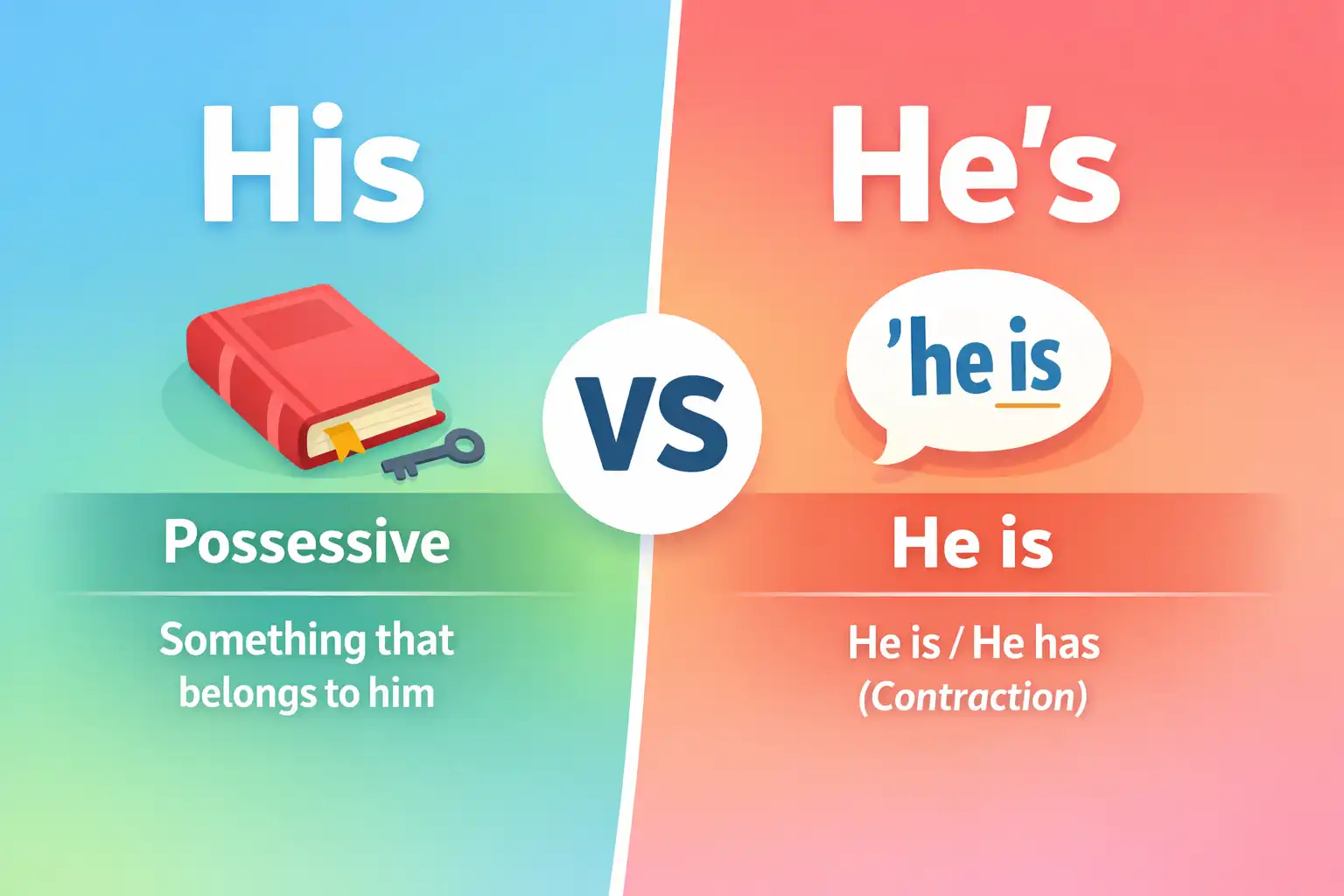
Meaning of His:
His is a possessive pronoun. It shows possession. It means something belongs to a man or boy.
• It shows ownership.
• It describes something that belongs to a male person.
Examples:
• His phone is on the table.
• I like his idea.
Meaning of He’s:
He’s is a contraction of he is or he has.
• It means he is or he has.
• The apostrophe replaces missing letters.
Examples:
• He’s working today. (He is working)
• He’s finished the report. (He has finished)
Easy rule:
If you can replace the word with he is or he has, use he’s. Otherwise, use his.
The Origin of His vs He’s
The word his is very old in English. It comes from Old English words like his and hys. These words always showed possession. For centuries, English speakers used his to describe something belonging to a man.
Example from early English writing:
“His sword was strong and sharp.”
The contraction he’s appeared much later. English writers began using contractions more often around the 1600s and 1700s. They shortened common phrases to make speech and writing faster. So he is became he’s.
Now both words exist in modern English, but they serve very different roles. The problem is that they sound almost identical when spoken quickly. Because of this, many learners write the wrong form.
Editors often see this mistake in student essays and casual writing. The confusion happens mainly because both words start with he and differ only by an apostrophe.
British vs American English Spelling
In some grammar topics, British and American English use different spellings. However, his vs he’s has no spelling difference between the two forms of English.
Both versions follow the same rule.
| Word | British English | American English |
| his | his | his |
| he’s | he’s | he’s |
So writers in the UK, the US, Canada, Australia, and other English-speaking countries use these words exactly the same way.
The only difference you may notice is writing style. For example:
• Formal academic writing sometimes avoids contractions like he’s.
• Casual writing uses them often.
However, the spelling rule itself never changes.
How to Choose the Right Word Fast
Choosing between his vs he’s becomes easy with a quick check.
For US Writers
In American English writing, contractions appear often in everyday communication. Emails, blogs, and social media frequently use he’s.
However, formal documents sometimes prefer the full phrase he is or he has.
Example:
He’s leading the meeting today.
For UK and Commonwealth Writers
British English follows the same grammar rules. Writers in the UK, Australia, and New Zealand also use contractions regularly in informal writing.
Example:
He’s waiting outside.
Formal reports may avoid contractions, but the grammar rule still stays the same.
For Global or Professional Writing
In international communication, clarity matters most. Writers often use his correctly to show ownership and use he’s only when needed.
Quick test:
If the sentence makes sense with he is → use he’s.
If the sentence shows ownership → use his.
Example:
His laptop is new.
He’s using a new laptop.
Common Mistakes with His vs He’s
Many mistakes happen because people think an apostrophe always shows possession. That rule is not true here.
Mistake 1
❌ He’s car is parked outside.
✅ His car is parked outside.
Explanation:
The sentence shows ownership, so his is correct.
Mistake 2
❌ I think his going to win.
✅ I think he’s going to win.
Explanation:
The sentence means he is going to win.
Mistake 3
❌ His working late tonight.
✅ He’s working late tonight.
Explanation:
The correct meaning is he is working.
Mistake 4
❌ The manager said he’s decision was final.
✅ The manager said his decision was final.
Explanation:
The word describes ownership, so his must be used.
These small errors appear often in quick typing, especially on phones or social media.
His vs He’s in Real Life Examples
Understanding grammar becomes easier when you see real examples.
In Emails
Correct examples:
His schedule changed this week.
He’s joining the meeting later.
In News Writing
Journalists often use clear grammar.
Example:
The coach said his team is ready for the final.
He’s confident about the result.
On Social Media
Social posts use contractions frequently.
Example:
He’s finally launching his new project.
In Professional Writing
Formal documents may avoid contractions.
Example:
He is responsible for his department’s success.
Still, when contractions appear, he’s remains correct grammar.
His vs He’s – Word Usage Patterns and Search Trends
Search data shows that his vs he’s is a common grammar question. Students, ESL learners, and beginner writers often search for this difference.
Several reasons explain this pattern.
First, spoken English blends sounds together. When people say his and he’s, they sound almost identical in fast speech.
Second, many grammar rules about apostrophes are confusing. Writers learn that apostrophes show missing letters or possession. Because of this, they sometimes apply the wrong rule.
Teachers and editors often notice this mistake in essays and online writing. For example, a sentence like “He’s idea was interesting” can make a document look less professional.
Fixing this confusion improves writing clarity immediately.
His vs He’s Comparison Table
| Feature | His | He’s |
| Meaning | Shows possession | Contraction of he is or he has |
| Part of Speech | Possessive pronoun | Contraction |
| Context of Use | Ownership | Actions or states |
| Formal vs Informal | Used everywhere | More common in informal writing |
| Common Mistake | Writers add apostrophe | Writers forget apostrophe |
| Correct Example | His book is new. | He’s reading a new book. |
This table shows the core difference quickly. One word describes ownership, while the other shortens two words into one.
FAQs About His vs He’s
Is his the same as he’s?
No. His shows possession, while he’s means he is or he has.
Which one is correct in formal writing?
Both are correct. However, formal writing sometimes prefers he is instead of he’s.
Can his and he’s be used interchangeably?
No. They have different meanings. Using the wrong one changes the sentence.
Why do people confuse his vs he’s?
They sound almost the same when spoken. Also, apostrophe rules can confuse learners.
Can grammar tools catch this mistake?
Many grammar tools detect it. However, writers should still check the sentence meaning.
Is there a British vs American difference?
No. Both forms follow the same spelling and grammar rules in all English varieties.
Does he’s always mean he is?
Usually yes, but sometimes it means he has, especially in perfect tenses.
Example:
He’s finished his homework.
Conclusion
The difference between his vs he’s becomes clear once you know their roles in a sentence.
His is a possessive pronoun. It shows that something belongs to a man or boy. You use it before a noun, such as his phone, his idea, or his car.
He’s, however, is a contraction. It replaces he is or he has. The apostrophe shows missing letters. Because contractions sound natural in speech, they appear often in everyday writing.
Many writers confuse these words because they sound similar when spoken quickly. Yet the meaning changes completely depending on which word you use.
Overall, remembering one simple rule helps avoid mistakes.
If the sentence shows ownership, use his.
If the sentence means he is or he has, use he’s.
In short, try the quick replacement test. If he is fits the sentence, then he’s is correct. If not, choose his.

James Holloway writes detailed guides on confusing English words and grammar usage with clear side-by-side comparisons.