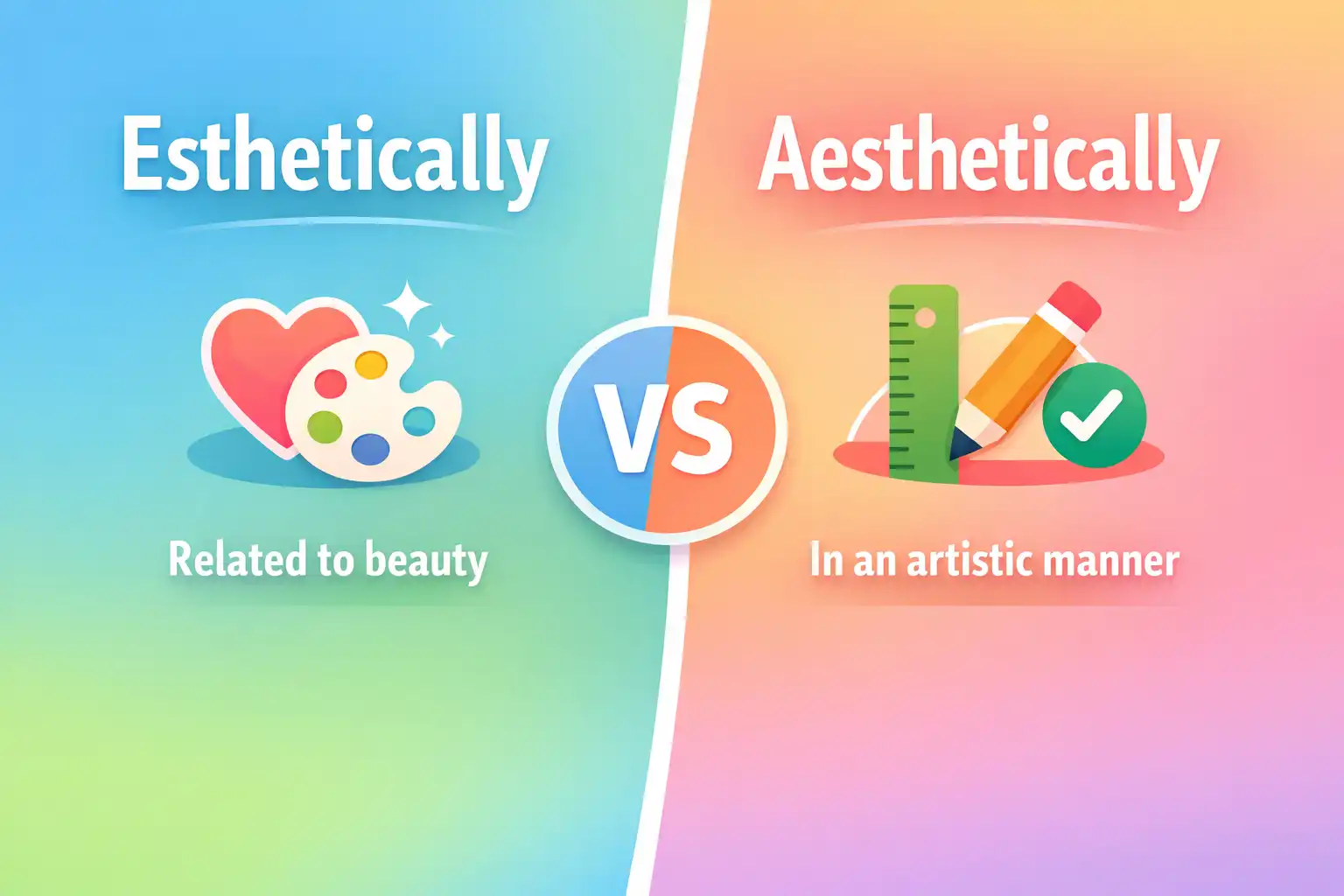
English spelling can be confusing. Some words look almost the same but use different letters. One common example is esthetically vs aesthetically. Many writers, students, and ESL learners are not sure which one to use.
You may see both spellings online, in magazines, or even in academic writing. Because of that, people often ask: Is it esthetically or aesthetically? The confusion grows because both words come from the same root word, aesthetic, which relates to beauty, style, or artistic taste.
Also, different countries sometimes prefer different spellings. Some forms appear more often in American English, while others appear in British English or academic writing.
In this guide, you will learn the real difference between esthetically vs aesthetically, where each spelling comes from, and how people use them today. You will also see clear examples, common mistakes, and simple rules that help you choose the right word quickly.
By the end, you will know exactly when each spelling works best.
Esthetically vs Aesthetically – Quick Answer
- Esthetically and aesthetically mean the same thing.
- Both describe something related to beauty, design, or visual appeal.
Examples
- The room looks aesthetically pleasing.
- The website is esthetically designed.
Easy rule
- Aesthetically is more common in modern writing.
- Esthetically is mostly used in American contexts or simplified spelling.
Meaning of esthetically vs aesthetically
Both words describe something connected to beauty, artistic style, or visual harmony.
They come from the word aesthetic, which refers to how something looks or feels from an artistic point of view.
For example:
- A building may be aesthetically pleasing because of its design.
- A painting may be admired esthetically for its colors and balance.
In simple terms, the words talk about how beautiful or visually appealing something appears.
The Origin of esthetically vs aesthetically
Simple history
The word aesthetic comes from the Greek word aisthētikos. It means related to perception or beauty.
In the 1700s, philosophers began using the term aesthetics to talk about art, beauty, and taste. Over time, the word entered English and developed different spelling styles.
Two forms appeared:
- Aesthetic / aesthetically
- Esthetic / esthetically
Both forms refer to the same idea of beauty or artistic value.
Reason for confusion today
The confusion happens because English kept two spelling traditions.
One follows the classical Greek spelling with “ae.”
The other simplifies it by removing the “a.”
Because both forms stayed in use, people now see:
- aesthetic
- esthetic
and therefore:
- aesthetically
- esthetically
Today, most modern writing prefers the aesthetic spelling.
British English vs American English Spelling
English spelling sometimes differs between countries. The case of esthetically vs aesthetically follows a similar pattern.
Spelling preference
- British English: aesthetically
- American English: aesthetically (most common) but esthetically also appears
Even in the United States, many writers still prefer aesthetically.
Short examples
British style
- The design is aesthetically pleasing.
American simplified style
- The clinic focuses on esthetic beauty.
Small comparison table
| Variant | Common Location | Example |
| Aesthetically | UK, global writing | The room is aesthetically balanced |
| Esthetically | Some US usage | The product is esthetically designed |
Contrast note:
Both spellings are correct, but aesthetically appears far more often worldwide.
How to Choose the Right Word Fast
Choosing between esthetically vs aesthetically becomes easier when you think about your audience.
US
Both spellings are acceptable.
However, most American publications still prefer:
aesthetically
You may see esthetic salon or esthetic treatments in beauty or skincare contexts.
UK / Commonwealth
Use:
aesthetically
British English almost always keeps the ae spelling.
Global or professional writing
Choose:
aesthetically
Academic writing, journalism, and international publications usually prefer this form.
Simple rule:
If you are unsure, use aesthetically.
Common Mistakes with esthetically vs aesthetically
Many writers make small errors when using these words.
1. Mixing spellings
❌ Incorrect
The design is estheticly pleasing
✅ Correct
The design is aesthetically pleasing
Explanation: The correct adverb form ends with -ally.
2. Using the wrong base word
❌ Incorrect
The room is aestheticly balanced
✅ Correct
The room is aesthetically balanced
Explanation: The correct spelling includes aesthetically.
3. Confusing noun and adjective forms
❌ Incorrect
The aesthetic of the website is pleasing (when meaning adverb)
✅ Correct
The website is aesthetically pleasing
Explanation: Use aesthetic as a noun or adjective, not an adverb.
4. Overusing simplified spelling
❌ Incorrect
Formal research papers using esthetic only
✅ Correct
Academic writing usually uses aesthetic
Explanation: Professional writing favors the classical spelling.
esthetically vs aesthetically in Everyday Examples
Seeing real examples makes the difference clearer.
Emails
“The presentation slides look aesthetically clean and modern.”
News
“The city redesigned the park to make it aesthetically pleasing.”
Social media
“This café is so aesthetic. The interior is aesthetically perfect.”
Formal or professional writing
“The building was planned to remain aesthetically consistent with the surrounding architecture.”
esthetically vs aesthetically – Usage Patterns & Search Interest
Search trends show that aesthetically appears much more often online.
General popularity trends
- Aesthetically dominates search engines, books, and articles.
- Esthetically appears less often but still exists.
Typical user groups
People searching this term often include:
- Students learning English
- ESL learners
- Writers and bloggers
- Designers discussing visual style
- Professionals in beauty or skincare
Real-world confusion scenario
A marketing team may write:
“The product is esthetic pleasing.”
This mistake makes the sentence look unprofessional. Correct spelling improves clarity and credibility.
Quick Comparison Table
| Feature | Esthetically | Aesthetically |
| Meaning | Related to beauty or artistic appeal | Same meaning |
| Part of speech | Adverb | Adverb |
| Context of use | Less common, sometimes American simplified spelling | Most common global spelling |
| Formal vs informal | Rare in formal writing | Preferred in formal writing |
| Common mistakes | Missing letters like “estheticly” | Misspelling the ending |
| Correct example | The room was esthetically balanced | The room was aesthetically pleasing |
People Also Ask
Is it esthetically or aesthetically?
Both are correct and mean the same thing. However, aesthetically is far more common in modern English.
What is the difference between aesthetic and esthetic?
There is no difference in meaning. Esthetic is simply a simplified spelling of aesthetic.
What is the difference between aesthetician and cosmetic?
An aesthetician works in skincare or beauty treatments. The word cosmetic usually refers to beauty products.
What is the difference between aesthetic and aesthetical?
Both words describe beauty or artistic appearance. However, aesthetic is used more often in modern English.
Why does Gen Z say “aesthetic”?
Gen Z often uses aesthetic as slang for a specific style or vibe. For example, a photo may look “very aesthetic.”
What does esthetic mean?
Esthetic means related to beauty, art, or visual appeal. It is a simplified spelling of aesthetic.
Is aesthetic the same as aesthetical?
They are almost the same. However, aesthetic is the more common and natural word in everyday English.
Which one is correct in formal writing?
Most formal writing uses aesthetic and aesthetically because they follow the traditional spelling.
What is the aesthetic noun form?
The noun form is aesthetic or aesthetics, which refers to the study or concept of beauty.
Conclusion
The debate around esthetically vs aesthetically mostly comes down to spelling tradition, not meaning. Both words describe something connected to beauty, design, or artistic appeal.
Historically, English borrowed the word from Greek. Over time, two spelling styles developed. The classical form kept the “ae”, while the simplified version removed it.
Today, aesthetically is the spelling most people use. It appears more often in books, academic writing, journalism, and global communication. The shorter form esthetically still exists, but it is less common.
The biggest mistake people make is spelling the word incorrectly, such as writing estheticly or mixing forms in the same document.
Overall, the safest choice is simple:
Use aesthetically in most writing situations.
In short, remember this rule:
If you are unsure, choose “aesthetically.”
Meta Description:
SEO Title:

James Holloway writes detailed guides on confusing English words and grammar usage with clear side-by-side comparisons.