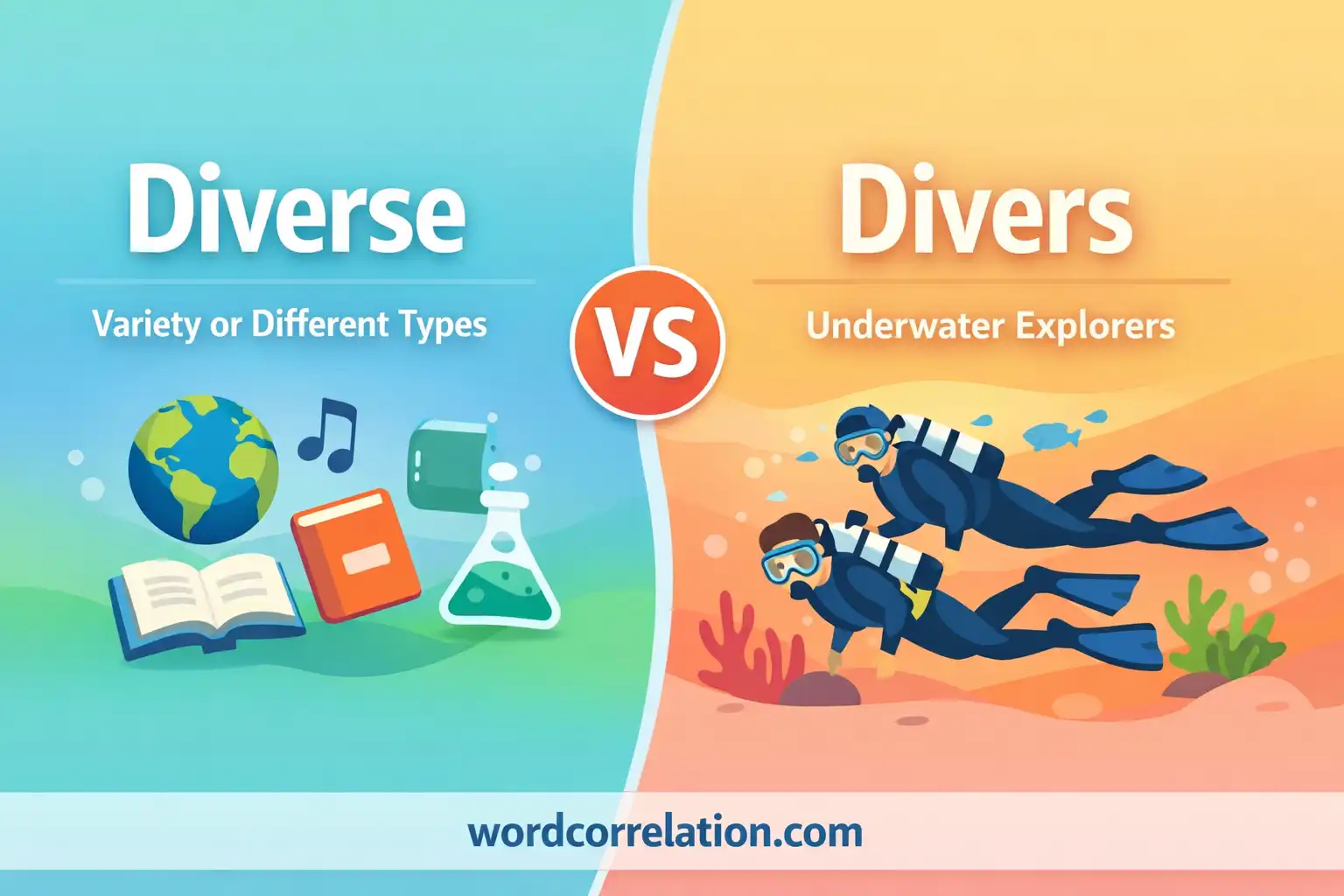
Many learners pause when they see diverse and divers in the same sentence. The words look close, so the brain tries to treat them as twins. But they are not twins. They are distant cousins with very different jobs. This small spelling gap causes real mistakes in essays, emails, and even news writing.
Writers often search diverse vs divers because grammar tools do not always explain the difference clearly. Some people guess. Others copy what they see online. However, guessing leads to awkward sentences. This article removes that confusion step by step. You will learn the meaning, origin, and real usage in everyday English. Then you will know exactly which word fits your sentence.
Diverse vs Divers – Quick Answer
- Diverse = showing variety or many differences
- Divers = several or various (formal, rare)
Examples:
- A diverse group of students
- Divers reasons explain the change
Easy rule:
👉 Use diverse in modern everyday English.
👉 Use divers only in formal or old-style writing.
The Origin of Diverse vs Divers
Both words come from Latin roots linked to the idea of turning in different directions. Old French later shaped them into forms that English adopted. At first, the meanings overlapped. Writers used them almost like synonyms.
Language slowly simplified. Over time, English speakers preferred diverse because it sounded clearer and more natural. Meanwhile, divers stayed alive in formal and literary contexts. Therefore, modern readers see it far less often.
The confusion survives because both words still exist in dictionaries. Students assume equal use. Editors, however, rarely choose divers today unless the tone demands an older style.
British English vs American English Spelling
There is no spelling difference between British and American English for these words. Both regions spell them the same way.
| Region | Preferred Word | Notes |
| US | diverse | Standard modern usage |
| UK | diverse | Also standard |
| Formal literature | divers | Rare, stylistic |
In contrast to many spelling debates, this pair does not divide by country. The difference is about tone, not geography.
Which Spelling Should You Use?
Most writers should choose diverse.
US writing favors clear, modern language, so diverse fits best. UK and Commonwealth writing follow the same rule. Professional and academic writing also prefers diverse because readers expect contemporary style.
However, some legal, historical, or poetic texts may still use divers. In those cases, the word signals tradition rather than variety.
If your goal is clarity, choose diverse. It works everywhere.
Common Mistakes with Diverse vs Divers
Writers mix the words when they assume both mean “many.” The meanings overlap slightly, but the tone differs.
❌ A divers group of opinions
✅ A diverse group of opinions
Explanation: modern English expects diverse.
❌ The company hired divers employees
✅ The company hired diverse employees
Explanation: divers sounds outdated here.
❌ Divers cultures enrich society
✅ Diverse cultures enrich society
Explanation: everyday writing needs diverse.
The mistake happens because divers looks like a shorter version. In reality, it belongs to a different register.
Diverse vs Divers in Everyday Examples
Email
“Our team values diverse perspectives.”
News
“The city celebrates its diverse population.”
Social media
“I love meeting people from diverse backgrounds.”
Professional writing
“The study includes a diverse sample group.”
You will almost never see divers in casual writing. When it appears, it often comes from legal or literary sources.
Diverse vs Divers – Usage Patterns & Search Interest
Search interest comes mostly from students and ESL learners. Writers want reassurance before submitting essays or reports. Grammar forums also receive this question often.
Misuse can create confusion in academic settings. A reader may think the writer copied an archaic style without understanding it. Therefore, clarity matters.
Modern English trends strongly toward diverse. Divers survives mainly as a stylistic relic.
Comparison Table
| Feature | Diverse | Divers |
| Meaning | Showing variety | Several / various |
| Part of speech | Adjective | Adjective |
| Context | Modern everyday English | Formal, literary |
| Formal tone | Neutral | Old-fashioned |
| Common mistake | None | Used instead of diverse |
| Correct example | A diverse team | Divers causes were listed |
FAQs
Is diverse the same as divers?
No. Diverse is modern and common. Divers is formal and rare.
Which one is correct in formal writing?
Diverse is safer in most professional contexts.
Can they be used interchangeably?
Not in modern everyday English.
Why do people confuse them?
The spelling looks similar, so learners assume identical meaning.
Can grammar tools catch this mistake?
Some tools flag divers as outdated, but not all.
Is there a British vs American difference?
No. Both regions prefer diverse.
Conclusion
Overall, the confusion between diverse and divers comes from history, not grammar failure. Both words share roots, but English evolved. Diverse became the everyday choice, while divers stayed behind in formal tradition.
Modern readers expect clarity. Using divers in casual writing feels stiff and outdated. In short, choose diverse for emails, essays, reports, and social media. Finally, remember one rule:
👉 If your sentence sounds modern, use diverse.
This simple habit prevents awkward tone and keeps your writing natural. Once you understand the difference, the mistake almost disappears.

James Holloway writes detailed guides on confusing English words and grammar usage with clear side-by-side comparisons.