Many people confuse continuously and consistently because both relate to time and repetition. They look similar, and both often appear in work, study, and daily communication. But they do not mean the same thing. This small difference can change your message.
Writers often mix them in emails, reports, and even social media posts. For example, saying “I work continuously” instead of “I work consistently” can give the wrong idea. One means “without stopping,” while the other means “in a regular pattern.”
So, this article solves that confusion. You will learn the exact meanings, when to use each word, and how to avoid common mistakes. You will also see real-life examples that make the difference very clear.
Continuously vs Consistently – Quick Answer
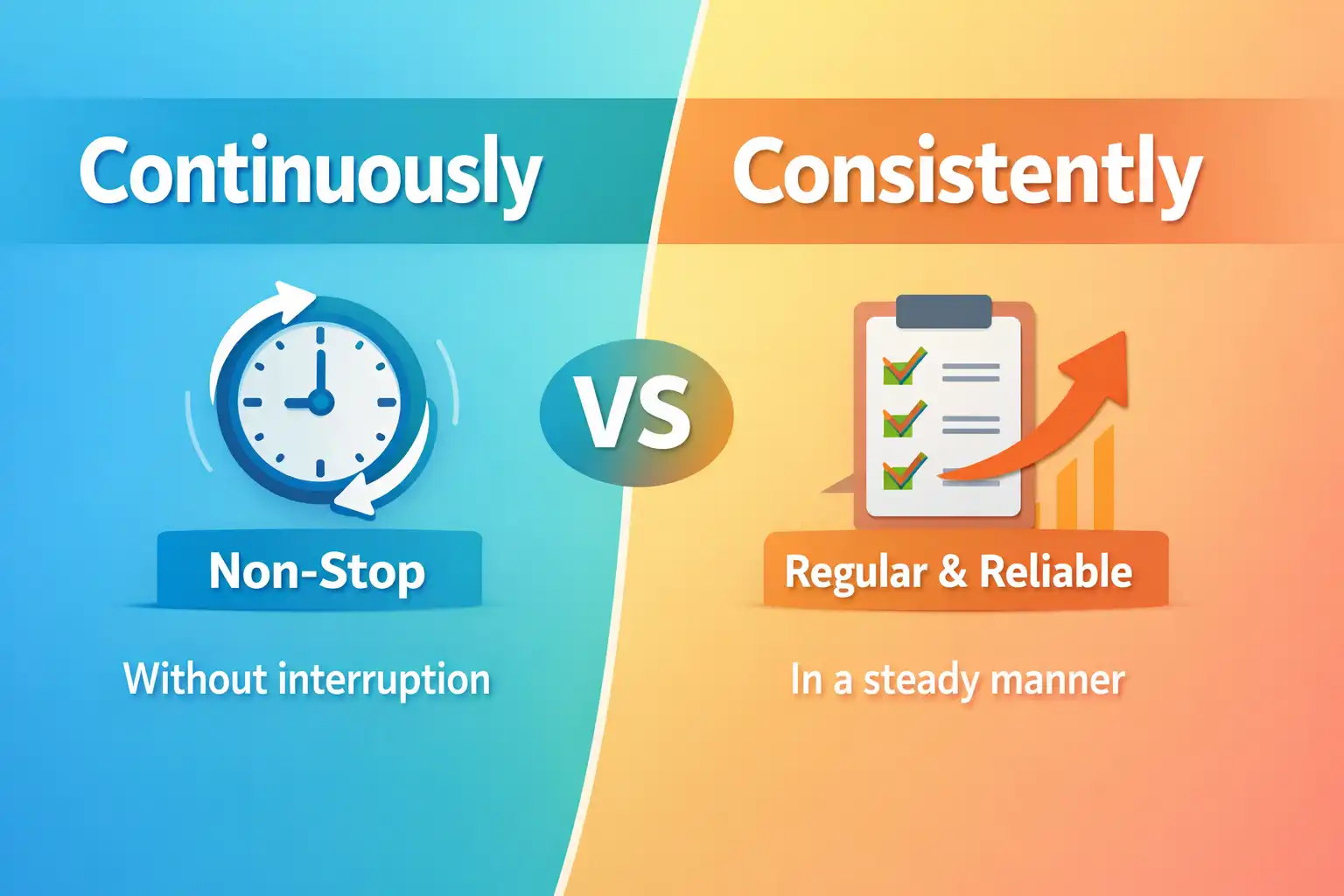
- Continuously means without stopping at all
- Consistently means in a steady, repeated way over time
Quick rule:
Use continuously for nonstop action. Use consistently for regular patterns.
Meaning of Continuously
- Means something happens without any pause
- It does not stop or break
Examples:
- The machine runs continuously for 24 hours.
- It rained continuously all night.
Meaning of Consistently
- Means something happens in the same way again and again
- It shows regular effort or pattern
Examples:
- She studies consistently every day.
- The team performs consistently well.
The Origin of Continuously vs Consistently
The word continuously comes from the Latin word continuus, which means “unbroken” or “without interruption.” So, its meaning stayed very close to its origin.
On the other hand, consistently comes from consistent, which comes from Latin consistere. It means “to stand firm” or “remain steady.” So, it developed the idea of stability and regular behavior.
Because both words relate to time and repetition, people often confuse them today. However, their roots clearly show the difference. One is about no breaks. The other is about steady patterns.
British vs American English Spelling
There is no spelling difference between British and American English for these words. Both use:
- continuously
- consistently
However, usage tone may vary slightly.
| Aspect | Continuously | Consistently |
| UK Usage | Common in technical writing | Common in daily and academic writing |
| US Usage | Same as UK | Same as UK |
In contrast to other words like “colour” vs “color,” these words remain the same globally.
How to Choose the Right Word Fast
Choosing the correct word is simple if you focus on meaning.
- Use continuously when something never stops
- Use consistently when something happens regularly
By audience:
- US users: Both words are used the same way
- UK users: Same usage rules apply
- Global writing: Focus on clarity, not spelling
Quick tip:
If you can replace it with “nonstop,” use continuously.
If you can replace it with “regularly,” use consistently.
Common Mistakes with Continuously vs Consistently
Writers often use the wrong word because they focus on repetition, not meaning.
❌ Incorrect: I go to the gym continuously.
✅ Correct: I go to the gym consistently.
Explanation: Gym visits are regular, not nonstop.
❌ Incorrect: The alarm rings consistently for 5 minutes.
✅ Correct: The alarm rings continuously for 5 minutes.
Explanation: The ringing does not stop.
❌ Incorrect: She continuously improves her skills.
✅ Correct: She consistently improves her skills.
Explanation: Improvement happens over time, not nonstop.
Continuously vs Consistently in Real Life Examples
Emails
- Please monitor the system continuously during testing.
- We need to perform consistently to meet targets.
News
- The river flowed continuously after heavy rain.
- The company has consistently grown over five years.
Social Media
- I am learning continuously every day
- Stay consistent and keep going
Professional Writing
- Machines must run continuously for production efficiency
- Employees must perform consistently to maintain quality
Continuously vs Consistently – Word Usage Patterns and Search Trends
Both words are common, but they are used differently.
- Consistently is more popular in self-improvement, education, and business
- Continuously is more common in technical and scientific contexts
Students and ESL learners often search for this keyword because the meanings overlap slightly. Writers also struggle with choosing the correct word in formal writing.
A real-world confusion example:
In a job report, saying “work continuously” may suggest no breaks at all, which is unrealistic. But “work consistently” shows reliability, which is correct.
Comparison Table
| Feature | Continuously | Consistently |
| Meaning | Without stopping | Regular and steady |
| Part of Speech | Adverb | Adverb |
| Context of Use | Machines, weather, processes | Habits, performance, behavior |
| Formal vs Informal | More formal/technical | Common in both |
| Common Mistake | Used instead of regularly | Used instead of nonstop |
| Example | The engine runs continuously | She studies consistently |
Frequently Asked Questions
Is continuously the same as consistently?
No. Continuously means nonstop. Consistently means regular over time.
Which one is correct in formal writing?
Both are correct. However, you must choose based on meaning.
Can they be used interchangeably?
No. They have different meanings and cannot replace each other.
Why do people confuse them?
Because both relate to repetition and time, but in different ways.
Can grammar tools catch this mistake?
Sometimes. But tools may miss context, so understanding is better.
Is there a British vs American difference?
No. Both words are spelled and used the same way.
Which word is better for habits?
Use consistently because habits happen regularly, not nonstop.
Conclusion
Continuously and consistently may look similar, but their meanings are very different. Continuously means something never stops. Consistently means something happens regularly over time.
This difference matters in real communication. Using the wrong word can confuse your message, especially in work or study writing. Writers often mix them because both involve time, but the key idea is simple.
In short, remember this rule:
If there is no break, use continuously. If there is a steady pattern, use consistently.
Finally, always check the context. Ask yourself whether the action is nonstop or repeated. That one step will help you choose the right word every time.