Ayaan was 11. He liked writing little stories for class. One day, he wrote a line that sounded smart in his head: “I will compair the two bikes.” He felt proud. Then his teacher circled one word in red.
That word was “compair.”
Many people search “compair vs compare” for the same reason Ayaan got stuck. They hear the sound “com-pair,” so they guess the spelling. Also, phones and fast typing make mistakes easier. So the wrong spelling spreads in chats, comments, and even emails.
This confusion matters because one small spelling error can change how your writing looks. A reader may pause. A teacher may mark it wrong. A client may think you rushed. But the fix is simple, and you can learn it in minutes.
In this guide, you will learn the real difference, why the mistake happens, and how to choose the correct word every time.
Compair vs Compare – Quick Answer
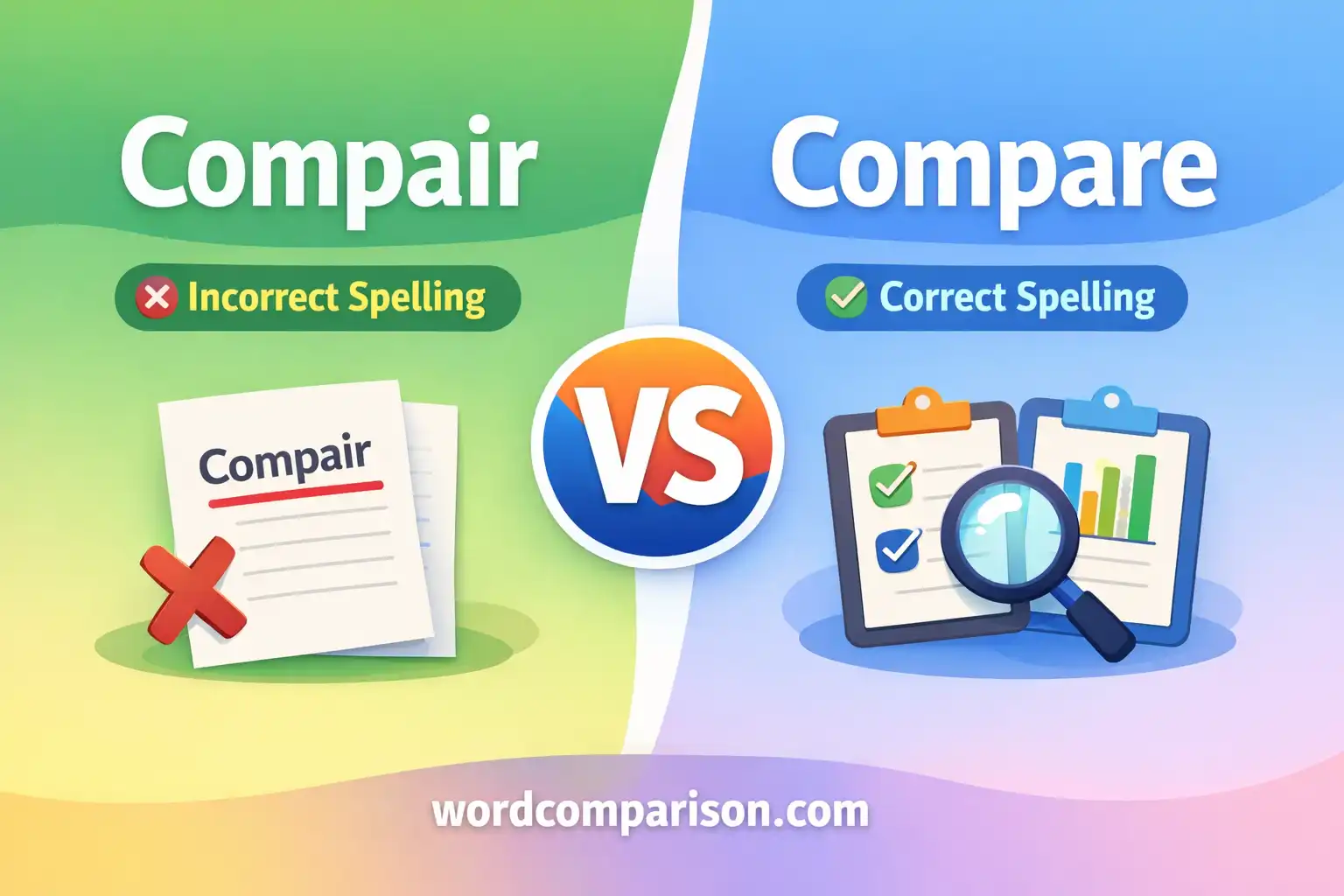
- Compare is the correct word in English. It means “look at two things and find what is same or different.”
- Compair is almost always a spelling mistake.
Examples:
- ✅ “Please compare these two prices.”
- ✅ “I compare my notes with yours.”
Easy rule: If you mean “check differences,” always write “compare.”
The Origin of Compair vs Compare
Long ago, English borrowed many words from French and Latin. The word compare comes from a Latin root that means “to match” or “to bring together.” Over time, English kept the spelling compare.
So why does “compair” show up today?
Because English has many words that end with “-pair” in sound and meaning, like pair, repair, and despair. Also, “compare” is said like “com-pair” in many accents. So the ear hears “pair,” and the hand types “pair.”
Editors often see this mistake in:
- school essays
- quick emails at work
- social media captions
- product reviews
The problem is not your idea. The problem is the spelling pattern your brain tries to follow.
British English vs American English Spelling
This one is simple: there is no spelling change here.
Both American English and British English use:
- ✅ compare
- ❌ compair
So, in contrast to words like “colour/color” or “centre/center,” this word stays the same in both styles.
Here is a small table to make it clear:
| Region | Correct spelling | Wrong spelling |
| United States | compare | compair |
| United Kingdom | compare | compair |
| Canada / Australia | compare | compair |
So, the spelling rule is easy: “compare” is correct everywhere.
Which Spelling Should You Use?
Use compare for all audiences, all the time.
If you write for the US:
- Use compare in school work, emails, ads, and blogs.
If you write for the UK / Commonwealth:
- Use compare in reports, CVs, articles, and messages.
If you write for a global or professional audience:
- Use compare because it is standard English.
Meanwhile, if you see compair in a comment or a post, read it as a typo. The writer almost always means compare.
Common Mistakes with Compair vs Compare
These are the mistakes people make most:
- Using the wrong spelling in a sentence
- ❌ “Can you compair these two files?”
- ✅ “Can you compare these two files?”
- Writing “compair” because of the sound “pair”
- ❌ “I will compair the phones before I buy.”
- ✅ “I will compare the phones before I buy.”
- Mixing compare with “pair” (the noun)
- ❌ “I want to compare of shoes.”
- ✅ “I want a pair of shoes.”
- ✅ “I want to compare two shoes.”
- Wrong form: “comparing” spelled badly
- ❌ “I am compairing prices today.”
- ✅ “I am comparing prices today.”
Short tip: If you can replace the word with “check differences,” you need compare.
Compair vs Compare in Everyday Examples
Let’s bring it into real life. Imagine Ayaan grows up and starts sending messages, writing posts, and doing work emails. He will need this word a lot.
Emails
- ✅ “Please compare the two invoices and tell me which one is correct.”
- ✅ “I compared the meeting times, so we can pick the best slot.”
News
- ✅ “Reporters compare the new policy with the old one.”
- ✅ “The article compares prices in different cities.”
Social media
- ✅ “Don’t compare your start to someone else’s middle.”
- ✅ “I compared two cameras, and this one wins.”
Formal or professional writing
- ✅ “This paper compares two methods and explains the results.”
- ✅ “We will compare last year’s data with this year’s data.”
Now, notice something: every sentence looks normal and clean with compare. But with “compair,” the reader stops. That pause is what you want to avoid.
Compair vs Compare – Usage Patterns & Search Interest
People search “compair vs compare” because the mistake is common and easy to make.
You often see this search from:
- students writing essays
- ESL learners practicing spelling
- new writers and bloggers
- professionals writing fast emails
- online shoppers comparing products
Overall, the confusion grows because typing is fast now. Autocorrect also misses it sometimes. Some tools accept “compair” as a “possible” word in names or older texts, so the error can slip through.
One real-world scenario where misuse causes confusion:
A person writes a work email: “Compair the contract versions.”
The reader may understand, but the spelling looks careless. So the message feels less professional. That can hurt trust, even if the work is good.
So, the problem this article solves is simple: you stop guessing and start using one correct spelling every time.
Comparison Table
| Feature | Compare | Compair |
| Meaning | To look at two things and find similarities or differences | Usually no meaning in modern English (common misspelling) |
| Part of speech | Verb (compare, compared, comparing) | Not standard as a verb |
| Context of use | School, work, news, social media, formal writing | Typos, informal posts, spelling errors |
| Formal vs informal | Works in both formal and informal writing | Looks incorrect in all styles |
| Common mistakes | Wrong form like “compare of” | Using it instead of “compare” |
| Correct example | “Let’s compare the two plans.” | ❌ “Let’s compair the two plans.” |
Semantic FAQs (People Also Ask)
Is compair the same as compare?
No. Compare is correct. Compair is almost always a spelling mistake.
Which one is correct in formal writing?
Use compare in formal writing, emails, reports, and essays.
Can compair and compare be used interchangeably?
No, because compair is not standard English usage.
Why do people confuse compair vs compare?
People confuse them because compare sounds like “com-pair,” so they copy the sound into spelling.
Can grammar tools catch this mistake?
Yes, many tools catch it. But some tools miss it, so it helps to learn the rule.
Is there a British vs American difference?
No. Both British and American English use compare.
What is the easiest way to remember the right spelling?
Think: “I compare to compare.” The word has -pare, not -pair.
Conclusion
Ayaan fixed his sentence, and his story became cleaner. You can do the same, because this is one of the easiest spelling problems to solve.
Here is what matters most: compare is the correct spelling in modern English. People use it to check what is same and what is different. The spelling stays the same in the US, the UK, and everywhere else.
The one mistake to always avoid is writing compair just because the word sounds like “pair.” That sound trick catches many writers, so you are not alone. But now you have a simple rule you can trust.
Overall, remember this: If you mean “look at two things,” write “compare.”
Finally, if you ever feel unsure, replace it with “check differences.” If it fits, compare is your answer.

James Holloway writes detailed guides on confusing English words and grammar usage with clear side-by-side comparisons.