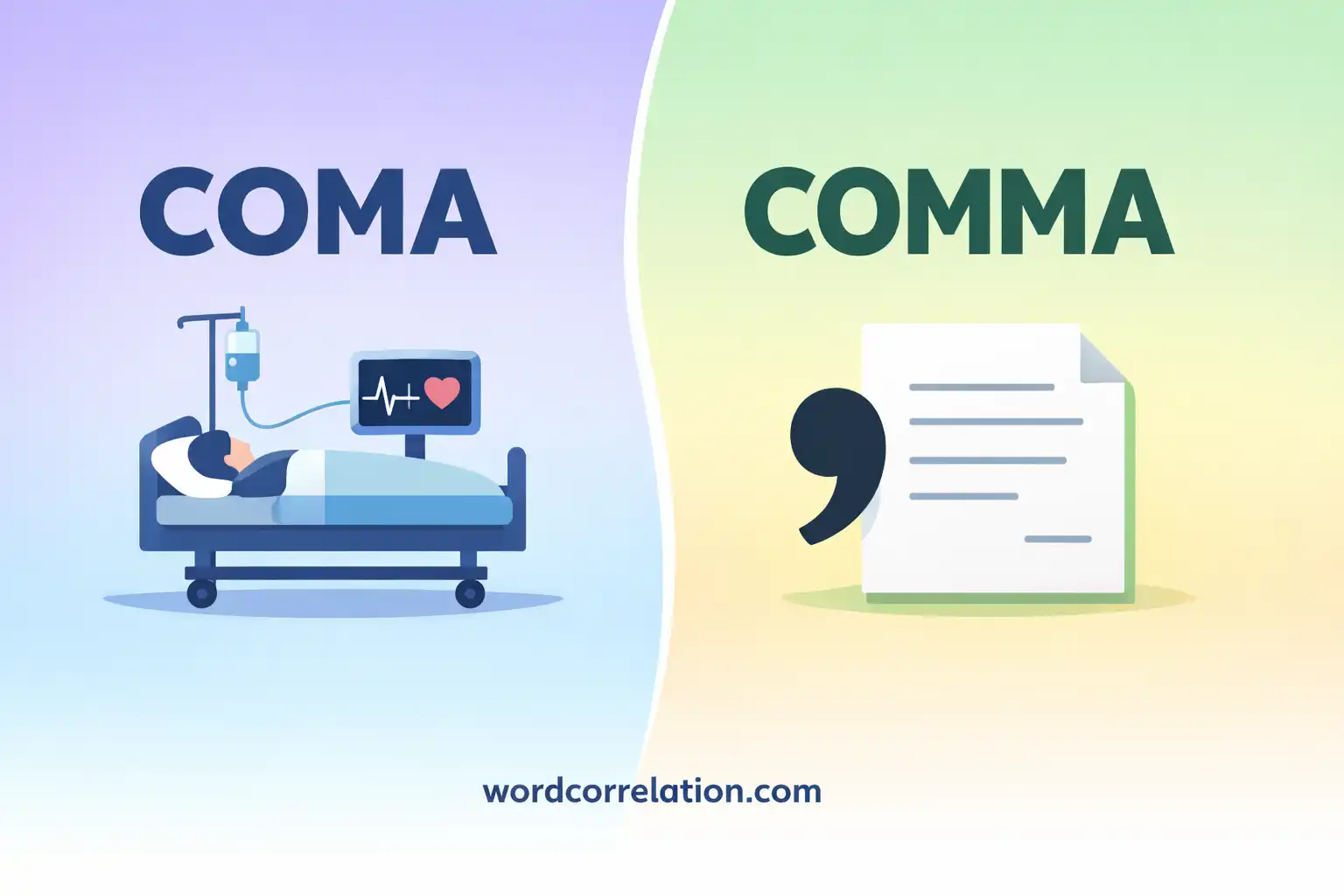
Many people search for coma or comma because these two words look almost the same. However, their meanings are very different. A small spelling change can cause a big mistake. Therefore, writers, students, and ESL learners often feel confused. Moreover, grammar tools do not always explain the difference clearly. As a result, errors appear in emails, exams, and even news writing.
This confusion happens because both words sound similar when spoken. In addition, fast typing and autocorrect also cause errors. Meanwhile, many beginners do not know that one word is medical, while the other is grammatical. Consequently, the wrong word can completely change the meaning of a sentence.
In this guide, you will learn everything about coma or comma. First, you will understand their meanings. Then, you will see how they are used in real life. Moreover, you will learn common mistakes and how to avoid them. Finally, you will get one simple rule to remember forever.
Need another pair? The “word comparison index” lists all comparisons in one place.
Coma or Comma – Quick Answer
- Comma is a punctuation mark (,).
- Coma is a medical condition of deep unconsciousness.
For example:
- ✅ I bought apples, oranges, and bananas.
- ✅ The patient is in a coma after the accident.
They are not interchangeable.
The Origin of Coma or Comma
The word comma comes from the Greek word komma, meaning “a cut” or “short pause.” Therefore, it became part of writing to show breaks in sentences. Over time, it turned into a key punctuation mark in English.
In contrast, coma also comes from Greek. However, it comes from koma, meaning “deep sleep.” As a result, doctors use it to describe a serious medical state.
The confusion exists because both words share Greek roots. Moreover, their spelling differs by only one letter. Consequently, learners often mix them up. For similar mix-ups, visit the “commonly confused words” pillar page.
British English vs American English Spelling
Both coma and comma are spelled the same in British and American English. However, their usage remains very different.
| Aspect | Comma | Coma |
|---|---|---|
| Type | Punctuation | Medical term |
| UK spelling | Comma | Coma |
| US spelling | Comma | Coma |
However, British English uses commas slightly differently in lists. In contrast, American English often uses the Oxford comma.
Which Spelling Should You Use?
You should choose based on meaning, not region.
- US writers: Use comma for writing and coma for health topics.
- UK / Commonwealth writers: The same rule applies.
- Global or professional writing: Always double-check context.
Therefore, if you are writing about sentences, choose comma. Meanwhile, if you are writing about health, choose coma.
Common Mistakes with Coma or Comma
Many errors happen in daily writing. However, they are easy to fix.
- ❌ He forgot to add a coma in the sentence.
✅ He forgot to add a comma in the sentence. - ❌ The man fell into a comma after surgery.
✅ The man fell into a coma after surgery.
The mistake happens because people rely on sound, not meaning. Therefore, always check context.
Coma or Comma in Everyday Examples
In emails, commas help clarity. For example, they separate ideas clearly. Meanwhile, using “coma” in an email usually means a medical topic. In news writing, commas improve readability. However, coma appears only in health reports.
On social media, people often misuse the words. As a result, confusion spreads quickly. In formal or professional writing, mistakes look unprofessional. Therefore, correct usage matters a lot.
Related reading: see “manor or manner” for another commonly mixed-up pair.
Coma or Comma – Google Trends & Usage Data
Search data shows strong interest in coma or comma. Students search it during exams. Moreover, ESL learners search it while learning writing basics. Additionally, professionals search it to avoid mistakes.
- Highest searches: Students and bloggers
- Countries: USA, UK, India, Pakistan
- Main issue: Spelling confusion
Correct usage appears far less than mistakes. Therefore, learning this difference gives you an advantage.
Coma vs Comma: Simple Comparison Table
| Feature | Comma | Coma |
|---|---|---|
| Meaning | Punctuation mark | Medical condition |
| Part of speech | Symbol | Noun |
| Context | Writing and grammar | Health and medicine |
| Formal or informal | Both | Mostly formal |
| Common mistake | Used instead of coma | Used instead of comma |
| Correct example | Use a comma here. | The patient is in a coma. |
FAQs About Coma or Comma
Is coma the same as comma?
No. They have different meanings and uses.
Which one is correct in formal writing?
Both are correct, but only in the right context.
Can they be used interchangeably?
No. Doing so changes meaning completely.
Why do people confuse them?
Because they sound similar and look alike.
Can grammar tools catch this mistake?
Sometimes. However, context errors may slip through.
Is there a British vs American difference?
No. Both use the same spelling.
Conclusion
Overall, coma or comma confusion is very common. However, the solution is simple. A comma belongs to writing. A coma belongs to medicine. Therefore, always look at context first.
Moreover, remember that one tiny letter changes everything. In short, grammar uses commas, while doctors deal with comas. Finally, follow this one rule: If you can replace it with a pause, use comma; if it involves health, use coma.
You might also like our “reining or reigning explanation” for a similar issue.

James Holloway writes detailed guides on confusing English words and grammar usage with clear side-by-side comparisons.