Many people feel stuck when they write catchup vs catch-up. They see both forms online, so they pause. Is one wrong? Is one more formal? Does the hyphen matter?
This small dash causes big confusion. Students mix it up in essays. Writers change it inside the same article. Even brands use different styles. So readers feel unsure, and mistakes happen in emails, news posts, and social media.
Now the good news is simple. This guide will clear everything. You will learn the meaning, the difference, the origin, and the correct usage. You will also see real examples. By the end, you will know exactly which form to use and why.
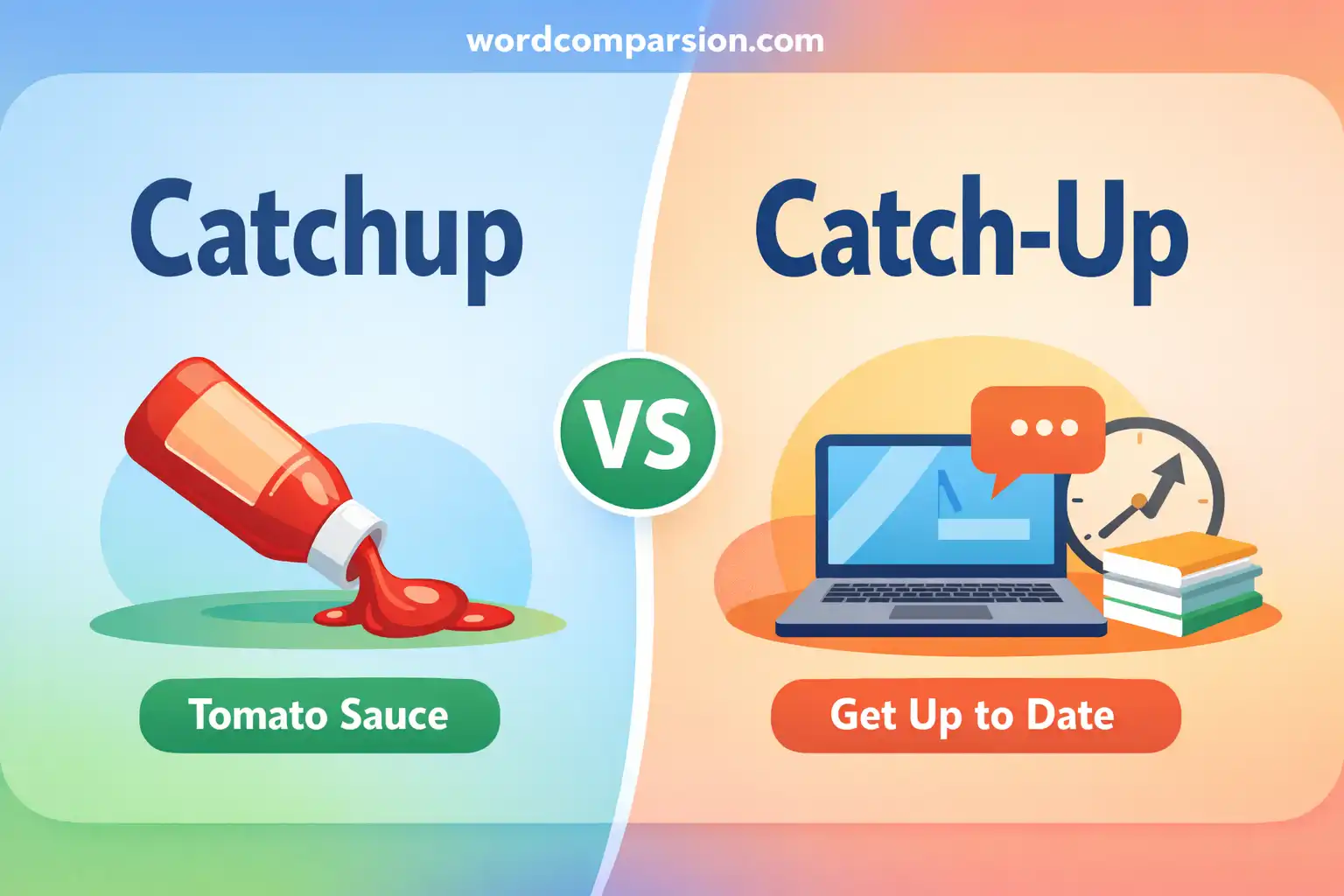
Catchup vs Catch-Up – Quick Answer
- Catch-up (with a hyphen) is correct in most formal writing.
- It works as a noun or adjective.
- Catchup (one word) is informal and less common.
Example:
- ✅ Let’s have a catch-up tomorrow.
- ❌ Let’s have a catchup tomorrow.
Easy rule: Use catch-up with a hyphen in standard writing.
The Origin of Catchup vs Catch-Up
The word started from the verb phrase “catch up.”
For example:
- I need to catch up on work.
Over time, people turned the phrase into a noun. So they added a hyphen:
- We had a catch-up yesterday.
Writers often create nouns from verb phrases. The hyphen helps show that the two words now act as one idea.
So why do people write catchup as one word?
Language changes. Some words lose their hyphen over time. For example:
- E-mail became email.
- Online used to be on-line.
Because of this pattern, some writers removed the hyphen from catch-up. But most dictionaries still prefer catch-up with a hyphen.
That is the main reason for confusion today.
British English vs American English Spelling
There is no major difference between British and American English for this word.
Both prefer:
- catch-up (noun or adjective)
- catch up (verb phrase)
However, informal American writing sometimes uses catchup. Still, it is less common in professional settings.
Here is a simple table:
| Form | US English | UK English |
| catch up (verb) | ✅ Standard | ✅ Standard |
| catch-up (noun) | ✅ Preferred | ✅ Preferred |
| catchup (noun) | Informal | Rare |
So the spelling does not change by country. The difference is about formality, not location.
How to Choose the Right Word Fast
Choosing the correct form is easy when you follow this guide.
In the US
Use:
- catch up for verbs
- catch-up for nouns
Avoid writing catchup in formal emails or business writing.
In the UK / Commonwealth
Use the same rule:
- Verb = catch up
- Noun = catch-up
Editors in the UK usually expect the hyphen.
In Global or Professional Writing
Always choose:
- catch-up
This keeps your writing clear and safe.
If you want one simple memory trick:
If it names a meeting or event, use a hyphen.
Common Mistakes with Catchup vs Catch-Up
Writers often mix forms in the same text. That creates confusion.
Here are common mistakes:
❌ We had a catch-up call to catch-up on updates.
✅ We had a catch-up call to catch up on updates.
❌ I need to catch-up on homework.
✅ I need to catch up on homework.
The biggest error happens when people use a hyphen with the verb. Remember:
- No hyphen for verbs
- Hyphen for nouns
That small difference matters.
Catchup vs Catch-Up in Everyday Examples
Now let’s see how this works in real life.
In Emails
- Let’s have a quick catch-up next week.
- I need to catch up on your last message.
In News
- The team held a catch-up meeting after the holiday.
- The player hopes to catch up with rivals.
On Social Media
- Coffee catch-up with old friends!
- Time to catch up on my favorite show.
In Professional Writing
- The manager scheduled a quarterly catch-up.
- Staff must catch up on missed training sessions.
These examples show the pattern clearly. Once you see it, the choice feels natural.
Catchup vs Catch-Up – Usage Patterns & Search Interest
Many students search for catchup vs catch-up because they see both online. Spell check tools sometimes allow both forms. That adds more doubt.
Editors often notice that learners:
- Forget the hyphen
- Add a hyphen to the verb
- Mix styles in one document
The confusion usually appears in:
- Business emails
- Academic writing
- Blog articles
One real problem happens in formal reports. If someone writes “monthly catchup,” it may look informal. That can lower the tone of the document.
So this article solves a clear issue:
It helps writers stay consistent and professional.
Catchup vs Catch-Up Comparison Table
Here is a quick summary table to remove confusion instantly:
| Feature | catch up | catch-up | catchup |
| Meaning | To reach same level | A meeting or update | Same as catch-up |
| Part of Speech | Verb phrase | Noun / Adjective | Noun |
| Context | Action | Event or description | Informal writing |
| Formal Use | Yes | Yes | Not recommended |
| Common Mistake | Adding hyphen | Removing hyphen | Using in formal text |
| Example | I need to catch up. | We had a catch-up. | Let’s have a catchup. |
This table shows everything clearly.
Frequently Asked Questions
Is catchup the same as catch-up?
They mean the same thing. However, catch-up is the standard spelling.
Which one is correct in formal writing?
Use catch-up with a hyphen.
Can they be used interchangeably?
In meaning, yes. In spelling, no. Formal writing prefers the hyphen.
Why do people confuse them?
Language often removes hyphens over time. So writers assume both are equal.
Can grammar tools catch this mistake?
Some tools do. However, many allow both forms. So manual checking helps.
Is there a British vs American difference?
No major difference. Both prefer catch-up.
Should I ever use catchup?
You can use it in casual writing, but avoid it in professional texts.
Conclusion
The confusion around catchup vs catch-up looks bigger than it really is. Once you understand the pattern, the choice becomes simple.
Use:
- catch up when it is a verb.
- catch-up when it names a meeting or event.
Avoid writing catchup in formal settings. It may look careless.
Overall, the key mistake to avoid is adding a hyphen to the verb. That small dash changes grammar. So check your sentence carefully.
Finally, remember this easy rule:
Action = no hyphen.
Event = hyphen.
If you follow this, you will never feel unsure again.

James Holloway writes detailed guides on confusing English words and grammar usage with clear side-by-side comparisons.