You are writing a sentence, and you want one simple word that means “power” or “being on top.” Then you type “ascendency” and your spellchecker looks upset. You type “ascendancy” and it looks calm again. Now you pause, because both words seem real, and both sound the same in your head.
This confusion happens a lot. Students see both spellings in old books. ESL learners hear the word but do not see it often. Writers also mix them up because they share the same root idea: to rise. So people search “ascendency vs ascendancy” to stop guessing and start feeling sure.
In this guide, you will learn the difference, the history, and the safest choice for modern writing. You will also see clear examples for emails, news, and social posts, so you can use the right word fast.
Ascendency vs Ascendancy – Quick Answer
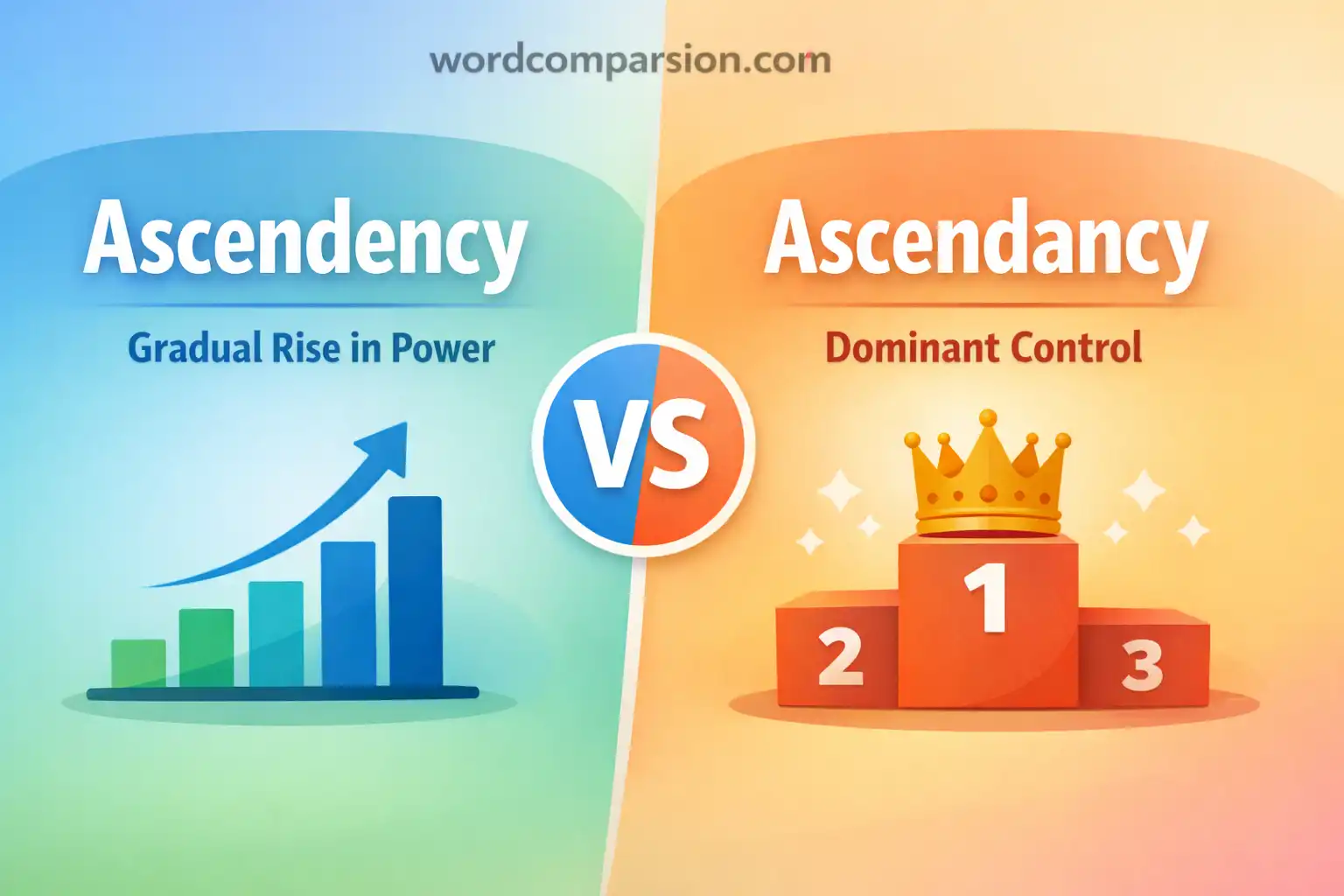
Ascendancy is the standard modern word for “dominance” or “controlling influence.”
Ascendency exists, but it looks old-fashioned and can feel like a spelling mistake.
- Use ascendancy in almost all writing today.
- Use ascendency only if you quote older text or match a historical style.
Example: “The team gained ascendancy in the second half.”
Easy rule: If you want the safe, common choice, pick ascendancy.
The Origin of Ascendency vs Ascendancy
Both words come from the idea of rising. They connect to the Latin root that leads to “ascend,” which means “to go up.” Long ago, English writers formed nouns from that root in more than one way. So two spellings grew side by side.
Over time, one spelling became the clear favorite. Editors, publishers, and dictionaries leaned toward ascendancy. It looked tidy, and it matched other common patterns in English.
So why does confusion still happen today? Because ascendency never fully disappeared. You can still find it in older writing, and sometimes in modern text that copies older style. Also, when people hear the word, they cannot “hear” the letters. Both spellings sound the same, so spelling becomes a guess unless you learn the pattern.
In simple terms, ascendancy won the popularity race. Ascendency stayed in the background.
British English vs American English Spelling
This is not like “color vs colour.” British and American English do not split here in a clean way. Both regions use ascendancy as the normal spelling in modern writing. In contrast, ascendency appears less often on both sides, and many readers treat it as unusual.
Still, you may see ascendency in older British texts more often than in modern American ones, mainly because many older formal works came from Britain. Yet that does not make it a “British spelling” today. It is better to think of it as an older variant.
Here is a quick view:
| Item | Ascendancy | Ascendency |
| Modern standard spelling | Yes | No (rare) |
| Seen in US writing today | Common | Uncommon |
| Seen in UK writing today | Common | Uncommon |
| “Looks correct” to most readers | Yes | Often questioned |
So, the spelling difference is not really a US vs UK issue. The bigger issue is modern vs older style.
Which Spelling Should You Use?
Pick the spelling that fits your reader, because your reader decides what feels “right.”
US audience
Use ascendancy. Teachers, editors, and spellcheck tools expect it. It also keeps your writing smooth, so your reader stays focused on your message.
UK / Commonwealth audience
Use ascendancy as well. It is the common modern form, and it avoids the “Is this a typo?” moment.
Global or professional writing
Use ascendancy almost every time. In global English, clarity matters more than rarity. Also, most style guides and workplaces prefer the spelling that looks standard.
When would ascendency make sense? Use it when you quote an older source and you want to keep the original spelling. You might also use it in a historical story, where the tone aims to feel old. Even then, you should know that some readers may still think it is a mistake, so you may want to keep the context very clear.
Common Mistakes with Ascendency vs Ascendancy
Writers make a few repeat mistakes with this pair. These errors matter because they can reduce trust. A reader may stop and doubt the sentence, even if your idea is strong.
- Using ascendency as the default modern spelling
❌ “The company gained ascendency in the market.”
✅ “The company gained ascendancy in the market.”
Why it happens: People hear the word and guess the spelling. - Mixing the two spellings in the same piece
❌ “Their ascendancy grew, but their ascendency did not last.”
✅ “Their ascendancy grew, but it did not last.”
Why it matters: It looks inconsistent, and it distracts the reader. - Using the word when “ascent” fits better
❌ “During the climb, she felt her ascendancy.”
✅ “During the climb, she felt her ascent.”
Ascendancy is about influence or dominance, not physical rising. - Using it like a verb
❌ “They will ascendancy over their rivals.”
✅ “They will gain ascendancy over their rivals.”
Ascendancy is a noun, so it needs a support verb like gain, take, or achieve.
Ascendency vs Ascendancy in Everyday Examples
Think of a school debate. Two students start strong, but one finds a better point and the room shifts toward them. That shift is ascendancy. The student did not just “go up.” They gained influence.
Emails
- “Our team gained ascendancy after we fixed the main issue.”
- “We need to keep that ascendancy by responding faster this week.”
News
- “The party gained ascendancy in key districts.”
- “The player took ascendancy late in the match.”
Social media
- “We finally got ascendancy in the game after halftime!”
- “Small wins can build ascendancy over time.”
Formal or professional writing
- “The new policy gave the agency ascendancy in oversight.”
- “The brand maintained ascendancy through consistent quality.”
Now compare a rare, older-style use:
- “The minister’s ascendency grew within the court.”
This can appear in a historical text, but many modern readers will still expect ascendancy.
Ascendency vs Ascendancy – Usage Patterns & Search Interest
People search this topic because the words feel like twins, but they do not live the same life today. Ascendancy shows up more in sports writing, politics, business, and history. It fits any situation where one side gains control, influence, or advantage.
Ascendency interests a smaller group. Students may see it in older novels or history sources. ESL learners may also meet it while reading classic texts. Writers sometimes find it because they type “ascend” and try to build a noun by feel.
Here is one real-world scenario where misuse causes confusion:
A job applicant writes, “I helped our brand gain ascendency in the market.” The recruiter pauses. They may think the applicant made a spelling mistake. That moment is small, but it can hurt the impression. If the applicant writes ascendancy, the sentence stays clean, and the focus stays on the achievement.
So the problem this article solves is simple: it removes doubt. You stop guessing, and you choose the word that keeps trust.
Comparison Table: Ascendency vs Ascendancy
| Feature | Ascendancy | Ascendency |
| Meaning | Dominance, controlling influence, advantage | Same general meaning, but feels older |
| Part of speech | Noun | Noun |
| Context of use | Politics, sports, business, social influence | Older texts, historical tone, rare modern use |
| Formal vs informal | Works in both, often formal | Mostly formal or historical, can look odd today |
| Common mistakes | Confusing it with “ascent” | Using it as the modern standard spelling |
| Correct example | “The team gained ascendancy after halftime.” | “In older accounts, his ascendency at court grew.” |
Semantic FAQs (People Also Ask)
Is ascendency the same as ascendancy?
They share the same core meaning. Still, ascendancy is the normal modern spelling.
Which one is correct in formal writing?
Ascendancy is the safest choice for formal writing today.
Can I use them interchangeably?
You can in meaning, but you should not in style. Ascendancy reads standard. Ascendency reads rare.
Why do people confuse them?
They sound the same. Also, both connect to “ascend,” so spelling feels like a guess.
Can grammar tools catch this mistake?
Many tools flag ascendency or suggest ascendancy. Still, they may miss it in quotes or older text.
Is there a British vs American difference?
Not in a clear way. Both regions mostly use ascendancy in modern writing.
Is ascendancy about physical climbing?
No. Use ascent for physical rising. Use ascendancy for influence or advantage.
Conclusion
Ascendency vs ascendancy looks tricky, but the solution is simple. Both words relate to rising, and both can point to dominance or influence. Yet modern English strongly favors ascendancy, so readers trust it more. That trust matters in school, work, and public writing, because small spelling doubts can steal attention from your message.
Ascendency still appears, but it usually lives in older texts, quotes, or writing that aims for a historical feel. So you should not treat it as your default choice. Instead, you use it only when the context clearly supports it, and when you want to match the original wording.
Overall, remember one easy rule: when you want the standard modern form, write ascendancy. Finally, avoid the biggest mistake of all: do not use ascendency in modern writing unless you have a clear reason.

James Holloway writes detailed guides on confusing English words and grammar usage with clear side-by-side comparisons.