Many learners pause when they see anyway and any way. They look the same. They sound the same. Yet they do not mean the same thing. Because of this, emails, posts, and essays often contain small but confusing mistakes. That confusion matters, especially in clear writing.
So why does this happen? First, English joins words over time. Second, speech hides spaces. As a result, writers guess. They also rely on autocorrect. That guess is often wrong. Now the reader feels unsure, even if the message is simple.
In this guide, you will learn the difference in plain English. You will see fast rules, real examples, and common errors. You will also learn when each form fits best. By the end, you will choose the right one without stopping to think.
Anyway vs Any Way – Quick Answer
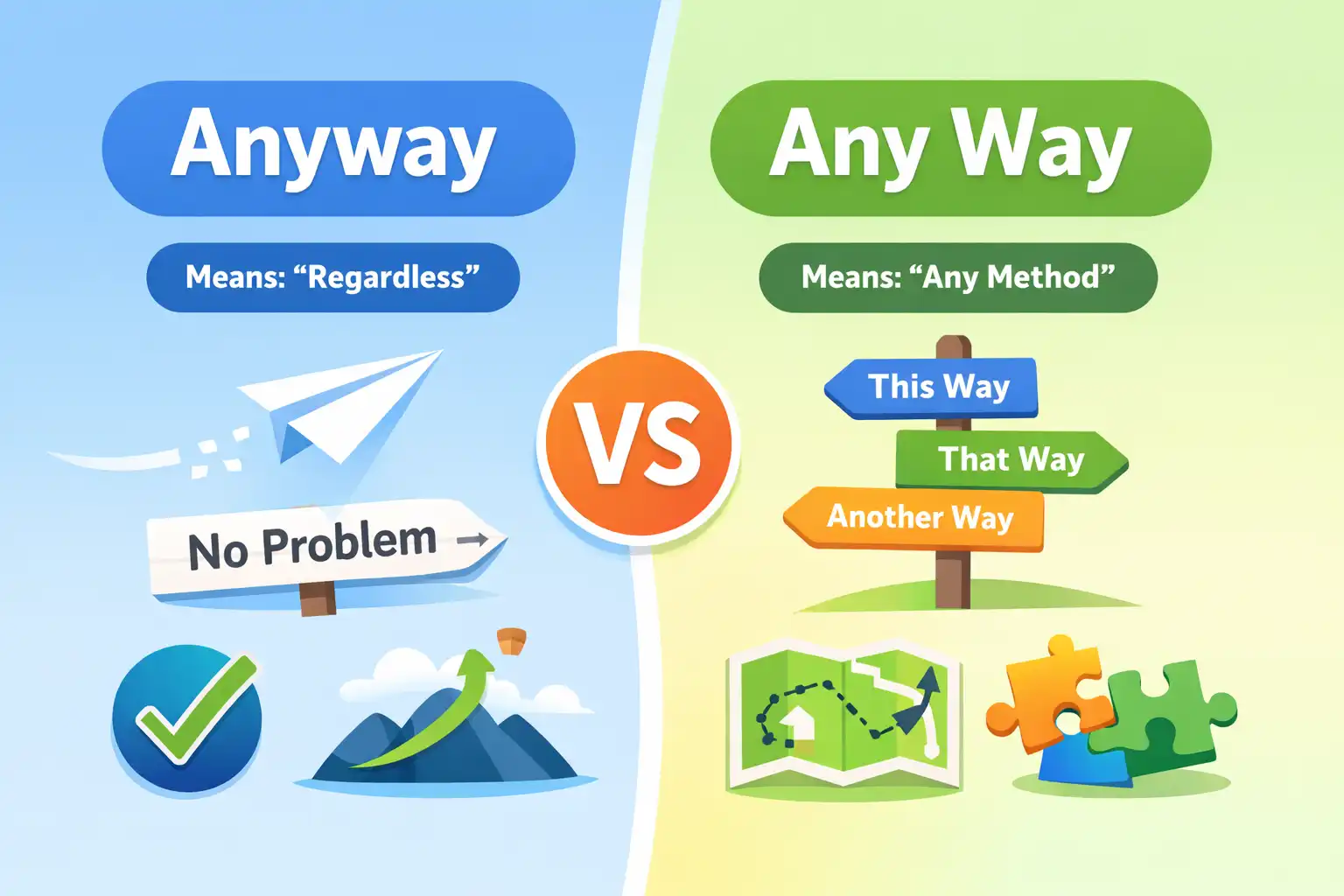
- Anyway is an adverb. It means “in spite of that” or “moving on.”
Example: “It was raining, anyway we left.” - Any way is a phrase. It means “in any manner or method.”
Example: “Is there any way to fix this?” - Easy rule: If you mean method, use any way. If you mean transition or emphasis, use anyway.
The Origin of Anyway vs Any Way
English often turns phrases into single words. That is how anyway was born. Long ago, people said any way to mean “in any manner.” Over time, speakers also used it to change topics or soften statements. Then writers joined the words.
As a result, anyway became a separate adverb with new uses. Meanwhile, any way stayed as a normal phrase. It kept its old meaning about methods and choices.
Today, the confusion exists because both forms still live side by side. They also sound identical in speech. So writers must decide by meaning, not sound. That is the key.
British English vs American English Spelling
There is no spelling difference between British and American English for these terms. Both varieties use anyway and any way in the same forms.
However, usage tone can differ slightly. In contrast, British writing may use anyway more often in conversation and informal text. American writing does the same, but style guides may suggest fewer fillers in formal work.
Quick contrast table
| Point | British English | American English |
| Spelling | Same | Same |
| Meaning | Same | Same |
| Formal tone | Slightly cautious | Slightly cautious |
So, choose by meaning, not by region.
How to Choose the Right Word Fast
US readers
Use anyway to move on or soften a point. Use any way when you ask about options.
UK / Commonwealth readers
Follow the same rule. Tone matters more than location.
Global or professional writing
Prefer clarity. If you mean a method, keep the space: any way. If you mean contrast or transition, join it: anyway.
If spelling does not vary, focus on usage tone. That choice keeps your message clear everywhere.
Common Mistakes with Anyway vs Any Way
Writers often mix these up because they rush. Editors usually see the same patterns again and again.
- ❌ Is there anyway to contact support?
✅ Is there any way to contact support?
Reason: You are asking about a method. - ❌ I was tired. Any way, I finished the work.
✅ I was tired. Anyway, I finished the work.
Reason: You are moving the story forward. - ❌ We can do it anyway you like.
✅ We can do it any way you like.
Reason: You mean “in any manner.”
These small fixes change clarity fast.
Anyway vs Any Way in Everyday Examples
Emails
- “The file was late. Anyway, here is the update.”
- “Is there any way you can resend it today?”
News
- “The vote failed. Anyway, talks will continue.”
- “Officials asked if there was any way to prevent delays.”
Social media
- “Missed the bus. Anyway, coffee time.”
- “Is there any way to mute this thread?”
Formal or professional writing
- “The data was limited. Anyway, the trend is clear.”
- “Is there any way to reduce costs without risk?”
Each pair shows a different meaning, not just a different spelling.
Anyway vs Any Way – Usage Patterns & Search Interest
People search this comparison because tools do not always help. Spellcheck often accepts both forms. So the writer must decide.
Students, ESL learners, and busy professionals ask this most. They want a fast rule. They also want confidence.
One real-world problem appears in support emails. If a company writes, “Is there anyway to help?” it sounds careless. The reader pauses. That pause hurts trust. A simple space fixes it.
Overall, correct use improves tone and speed of reading.
Comparison Table: Anyway vs Any Way
| Feature | Anyway | Any way |
| Meaning | In spite of that; moving on | In any manner or method |
| Part of speech | Adverb | Phrase (determiner + noun) |
| Context of use | Transitions, emphasis | Questions about options |
| Formal vs informal | More informal | Neutral |
| Common mistakes | Used for methods | Used as a filler |
| Correct example | “It was late. Anyway, we left.” | “Is there any way to leave early?” |
This table removes the confusion at a glance.
Semantic FAQs (People Also Ask)
Is anyway the same as any way?
No. They look similar, but their meanings differ.
Which one is correct in formal writing?
Both are correct. Choose by meaning and tone.
Can they be used interchangeably?
No. Swapping them can change or break the sentence.
Why do people confuse them?
They sound the same in speech and autocorrect allows both.
Can grammar tools catch this mistake?
Sometimes, but not always. Meaning matters more.
Is there a British vs American difference?
No. Usage rules are the same.
How can I remember the rule?
Think: method needs a space.
Conclusion
Overall, anyway and any way serves different jobs. One helps the flow of ideas. The other asks about methods and choices. Because they sound the same, writers guess. That guess causes small but real confusion.
So remember this: use anyway when you mean “in spite of that” or when you move on. Use any way when you mean “by any method.” This single check solves most errors.
In short, do not rely on sound. Check the meaning. Finally, keep this easy rule in mind: space for methods, no space for transitions. With that, your writing stays clear and confident every time.

James Holloway writes detailed guides on confusing English words and grammar usage with clear side-by-side comparisons.