Many people search for alumni or alumnae because the words feel confusing. However, the confusion is very common among students, writers, and professionals. For example, emails, LinkedIn posts, and school websites often use the wrong form. As a result, readers feel unsure and embarrassed.
Moreover, the problem gets worse for non-native English users. In contrast, grammar books explain the rule in complex language. Therefore, learners still feel lost after reading them. Meanwhile, grammar tools sometimes miss the mistake.
This article solves that exact problem. First, you will learn what alumni and alumnae really mean. Next, you will see where people usually go wrong. Additionally, you will learn which word fits your audience. Finally, you will get one simple rule to remember forever.
Overall, this guide uses very simple English. As a result, anyone can understand and use these words correctly. For more quick side-by-side checks, browse the “word comparison hub“.
Alumni or Alumnae – Quick Answer
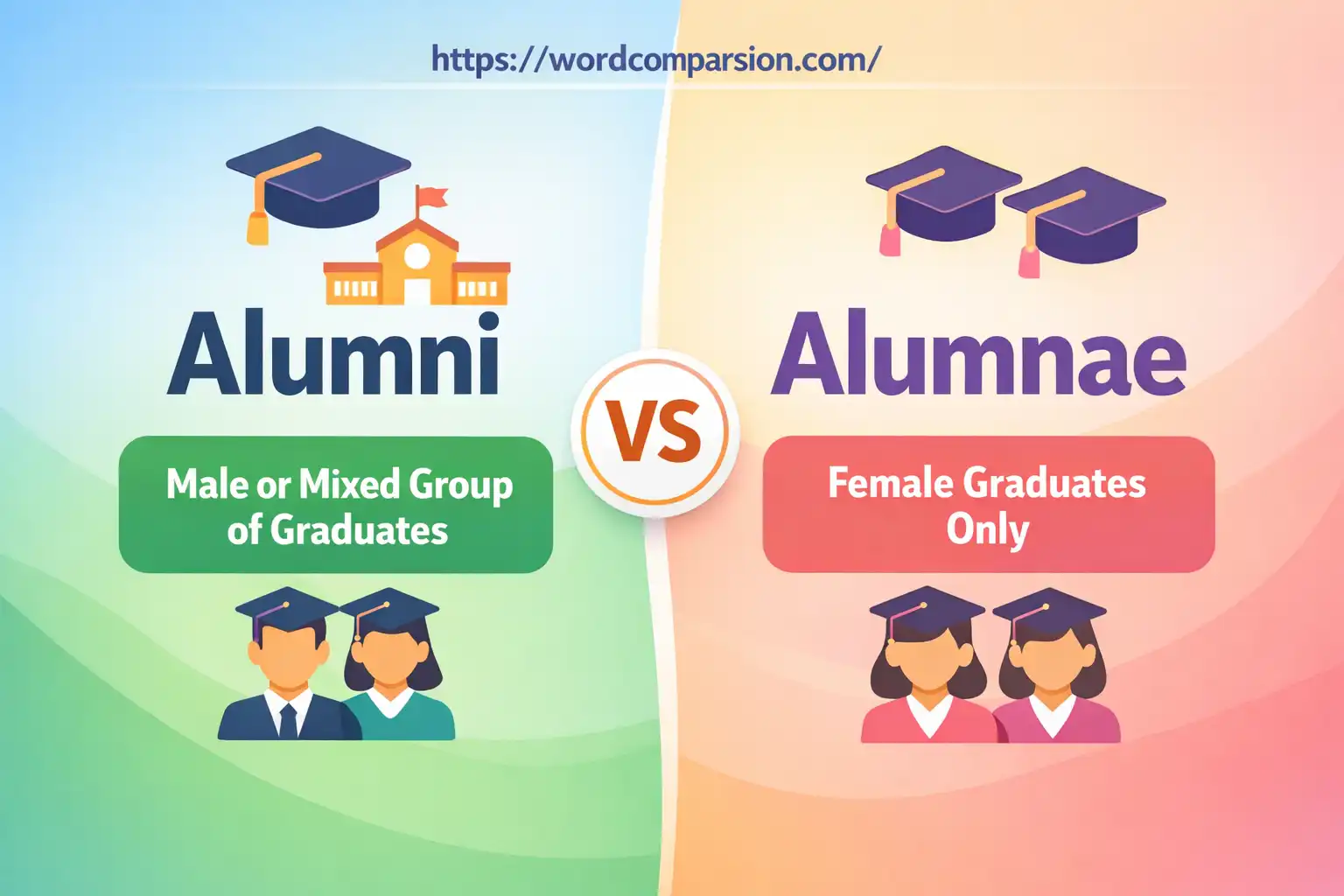
Alumni and alumnae both mean former students.
However, gender and number change the word.
- Alumni → group of men or mixed gender group
- Alumnae → group of women
Example:
- The alumni met at the reunion.
- The alumnae organized a women’s event.
The Origin of Alumni or Alumnae
The words come from Latin. Originally, Latin used gendered word forms. Therefore, English borrowed those exact forms.
Alumnus meant one male student.
Alumna meant one female student.
Later, plural forms appeared as alumni and alumnae.
However, English speakers do not use Latin daily. As a result, many people forget these rules. Moreover, modern English prefers simpler words. Therefore, confusion continues even today. For more pluralization questions, see the “Plural Forms guide” pillar.
British English vs American English Spelling
There is no spelling difference between British and American English.
However, usage style changes slightly.
| Aspect | British English | American English |
| Common usage | Alumni preferred | Alumni preferred |
| Gender focus | Less strict | Still taught |
| Formal writing | Alumni | Alumni |
In contrast to spelling differences like colour and color, this rule stays the same.
Therefore, location does not change correctness.
Which Spelling Should You Use?
Your audience decides the best choice.
For US audiences:
Use alumni for mixed or unknown gender groups.
However, use alumnae only in formal women-only contexts.
For UK / Commonwealth readers:
Prefer alumni almost always.
Moreover, readers expect simple wording.
For global or professional writing:
Choose alumni to avoid confusion.
As a result, your message stays clear for everyone.
Common Mistakes with Alumni or Alumnae
Many writers repeat the same errors.
However, each mistake has an easy fix.
❌ She is an alumni → ✅ She is an alumna
❌ Female alumni group → ✅ Female alumnae group
❌ Alumnae association (mixed) → ✅ Alumni association
Therefore, number and gender must match. Moreover, singular and plural forms matter a lot. If you’re comparing similar terms, our “how to use deers or deer” article can help.
Alumni or Alumnae in Everyday Examples
These words appear everywhere.
However, context changes the correct choice.
Emails:
- “Dear alumni, welcome back.”
News:
- “The alumni donated funds.”
Social media:
- “Proud to be part of our alumni network.”
Formal writing:
- “The alumnae council hosted the event.”
As a result, professional tone stays accurate.
Alumni or Alumnae – Google Trends & Usage Data
Search interest shows clear patterns.
Students search this topic the most.
Meanwhile, ESL learners ask this question often.
Professionals search it before sending emails.
By country, global searches favor alumni.
However, grammar learners still study alumnae.
As a result, correct usage matters more in education.
Comparison Table: Alumni vs Alumnae
| Feature | Alumni | Alumnae |
| Meaning | Former students | Former female students |
| Part of speech | Noun | Noun |
| Context of use | Mixed or male groups | Female-only groups |
| Formal vs informal | Both | Mostly formal |
| Common mistakes | Used for one person | Used for mixed group |
| Correct example | Alumni reunion | Alumnae meeting |
This table removes confusion instantly.
Semantic FAQs (People Also Ask)
Is alumni the same as alumnae?
No. Alumni is mixed or male. Alumnae is female only.
Which one is correct in formal writing?
Both are correct. Context decides.
Can they be used interchangeably?
No. Gender and number must match.
Why do people confuse them?
Latin rules feel unfamiliar.
Can grammar tools catch this mistake?
Sometimes. However, not always.
Is there a British vs American difference?
No. Usage rules stay the same.
Conclusion
Overall, alumni or alumnae confuses many people. However, the rule is actually simple. Alumni refers to mixed or male groups. Alumnae refers only to female groups.
Moreover, modern writing prefers clarity. Therefore, alumni is usually the safest choice. In contrast, alumnae fits formal women-only contexts.
As a result, knowing your audience matters most. Finally, remember this one rule: When unsure, use “alumni.” In short, clarity beats perfection every time.
Related reading: see “octopus or octopi” for another commonly mixed-up pair.

James Holloway writes detailed guides on confusing English words and grammar usage with clear side-by-side comparisons.