You sit to write a simple sentence: “The teacher ___ the papers.”
You pause. Should it be weighed or weighted?
This small doubt stops many writers, students, and ESL learners every day. These words look almost the same. Both come from the word weight. Both sound correct in many places. So people mix them without knowing.
But the meaning is not the same.
This mistake often appears in emails, essays, reports, and even news writing. And when you use the wrong one, the sentence feels odd or confusing. Readers may not understand what you mean.
In this guide, you will learn the clear difference between weighed vs weighted, when to use each word, and how to never confuse them again.
Weighed vs Weighted – Quick Answer
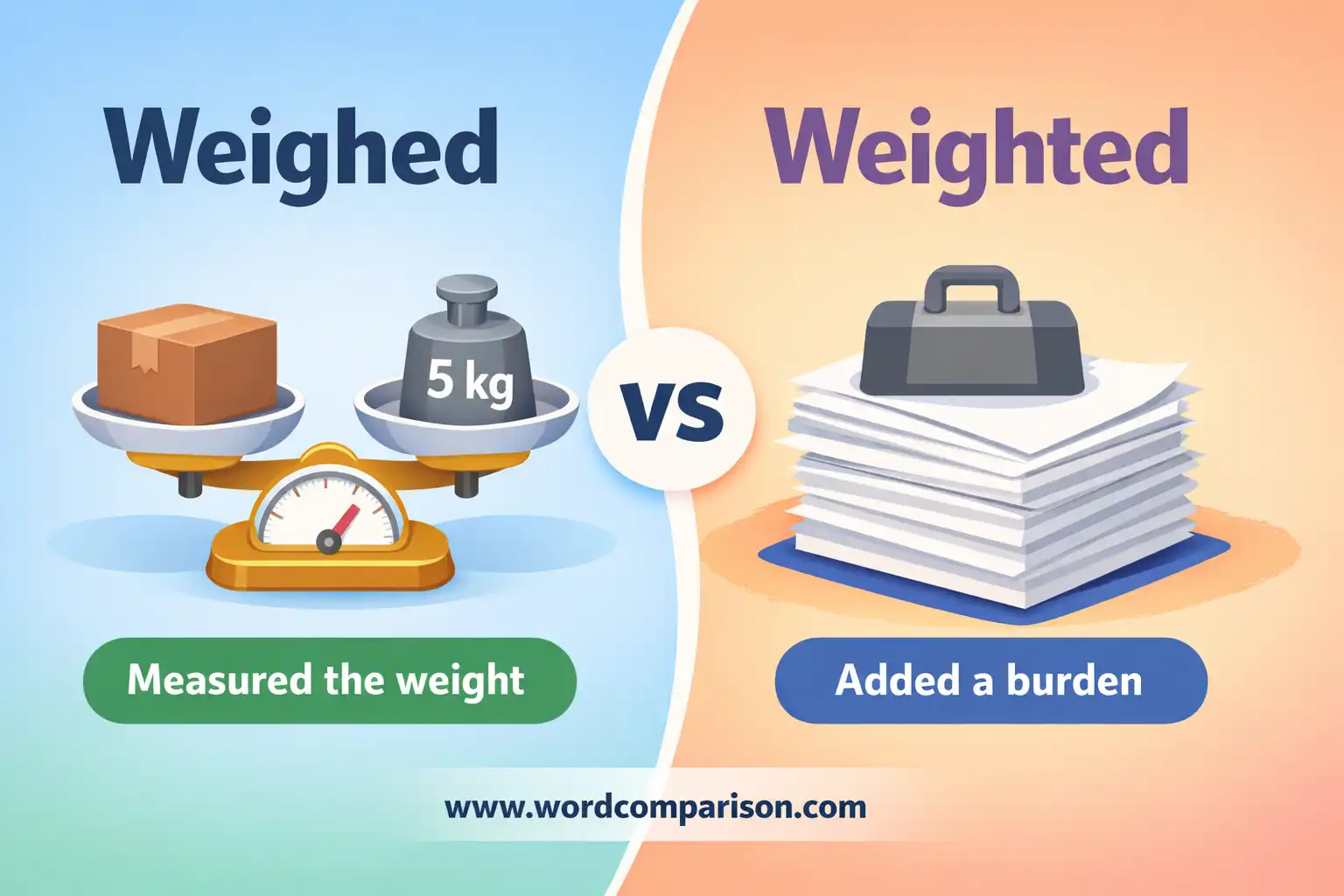
- Weighed = measured the weight of something
- Weighted = added importance or extra value to something
Examples:
- She weighed the apples. ✅ (measured weight)
- The test is weighted heavily. ✅ (given more importance)
Easy rule:
If you can use a scale → weighed
If you mean importance or value → weighted
The Origin of Weighed vs Weighted
Both words come from the noun weight.
- Weighed is the past tense of the verb weigh.
- Weighted is an adjective or verb form that means given weight or importance.
Long ago, weigh only meant to measure heaviness. Later, people began to use weight in a figurative way. They started to say things like “give weight to an idea.” From this, the word weighted was born.
However, because both words look so similar, modern writers often confuse them.
Writers often confuse these words when talking about exams, scores, or decisions.
British English vs American English Spelling
There is no spelling difference between British and American English.
| Word | US Spelling | UK Spelling |
| Weighed | Weighed | Weighed |
| Weighted | Weighted | Weighted |
The confusion is not about spelling. It is about meaning.
Which Spelling Should You Use?
This is not about region. It is about context.
- Use weighed when you talk about physical weight
- Use weighted when you talk about importance, value, or scoring
This rule works for:
- US writing
- UK writing
- Academic writing
- Professional writing
So the choice depends on what you mean, not where you live.
Common Mistakes with Weighed vs Weighted
Here are mistakes editors usually see:
❌ The teacher weighed the final exam more than quizzes.
✅ The teacher weighted the final exam more than quizzes.
(importance, not scale)
❌ She weighted the vegetables before cooking.
✅ She weighed the vegetables before cooking.
(used a scale)
❌ The score is weighed at 40%.
✅ The score is weighted at 40%.
❌ He weighted himself at the gym.
✅ He weighed himself at the gym.
Weighed vs Weighted in Everyday Examples
Emails
- “We weighed the package before shipping.”
- “Your assignment is weighted at 30% of the grade.”
News
- “The officers weighed the evidence.”
- “Some factors were weighted more than others.”
Social Media
- “I just weighed myself. Time to diet!”
- “This part of the game is weighted unfairly.”
Professional Writing
- “The survey responses were weighted for accuracy.”
- “The lab technician weighed the samples carefully.”
Weighed vs Weighted – Usage Patterns & Search Interest
Many students search this because of school grading systems. Tests are often weighted, and learners write weighed by mistake.
ESL learners also struggle because both words come from the same root.
One real problem happens in academic writing. A student may write:
“The exam was weighed at 50%,” which sounds incorrect to teachers.
This small word choice can affect clarity and credibility.
Quick Comparison Table
| Feature | Weighed | Weighted |
| Meaning | Measured weight | Given importance or extra value |
| Part of speech | Verb (past of weigh) | Adjective / verb form |
| Context of use | Scales, mass, heaviness | Scores, decisions, value |
| Formal vs informal | Used everywhere | Common in academic and professional use |
| Common mistake | Used for grades or scoring | Used for physical weight |
| Correct example | She weighed the flour. | The quiz is weighted at 20%. |
Semantic FAQs
Is weighed the same as weighted?
No. Weighed is about physical weight. Weighted is about importance.
Which one is correct in formal writing?
Both are correct. It depends on the meaning you need.
Can they be used interchangeably?
No. They change the meaning of the sentence.
Why do people confuse them?
They look similar and come from the same root word.
Can grammar tools catch this mistake?
Sometimes. But many tools miss it because both words are correct spellings.
Is there a British vs American difference?
No. The spelling and meaning are the same in both.
Is weighted only used for exams?
No. It is also used in data, surveys, math, and decision-making.
Conclusion
The confusion between weighed vs weighted is very common. Both words come from weight. Both look almost the same. But their meanings are very different.
Weighed is simple. It talks about measuring heaviness with a scale.
Weighted is about importance, value, and scoring. It is often used in schools, surveys, data, and decisions.
Many writers mix them when talking about exams, grades, or percentages. This small mistake can make writing look careless or unclear.
Overall, the solution is easy.
If you use a scale → weighed
If you talk about importance → weighted
Finally, remember this one rule, and you will never confuse these two words again.

James Holloway writes detailed guides on confusing English words and grammar usage with clear side-by-side comparisons.