Many learners search for want vs won’t because the two words look similar but mean very different things. The confusion often happens when people read quickly or hear the words in conversation. For ESL learners and students, this small difference can change the whole meaning of a sentence.
The problem usually appears in writing, emails, and messages. For example, someone may write “I want to help you tomorrow,” when they actually mean “I won’t help you tomorrow.” One word shows desire. The other shows refusal or future negative action. Because the spelling is close, writers often mix them up.
This article solves that problem in a simple way. You will learn the meaning of each word, where they come from, and how they are used in real life. You will also see common mistakes, easy rules, and clear examples so you can quickly choose the correct word every time.
Want vs Won’t – Quick Answer
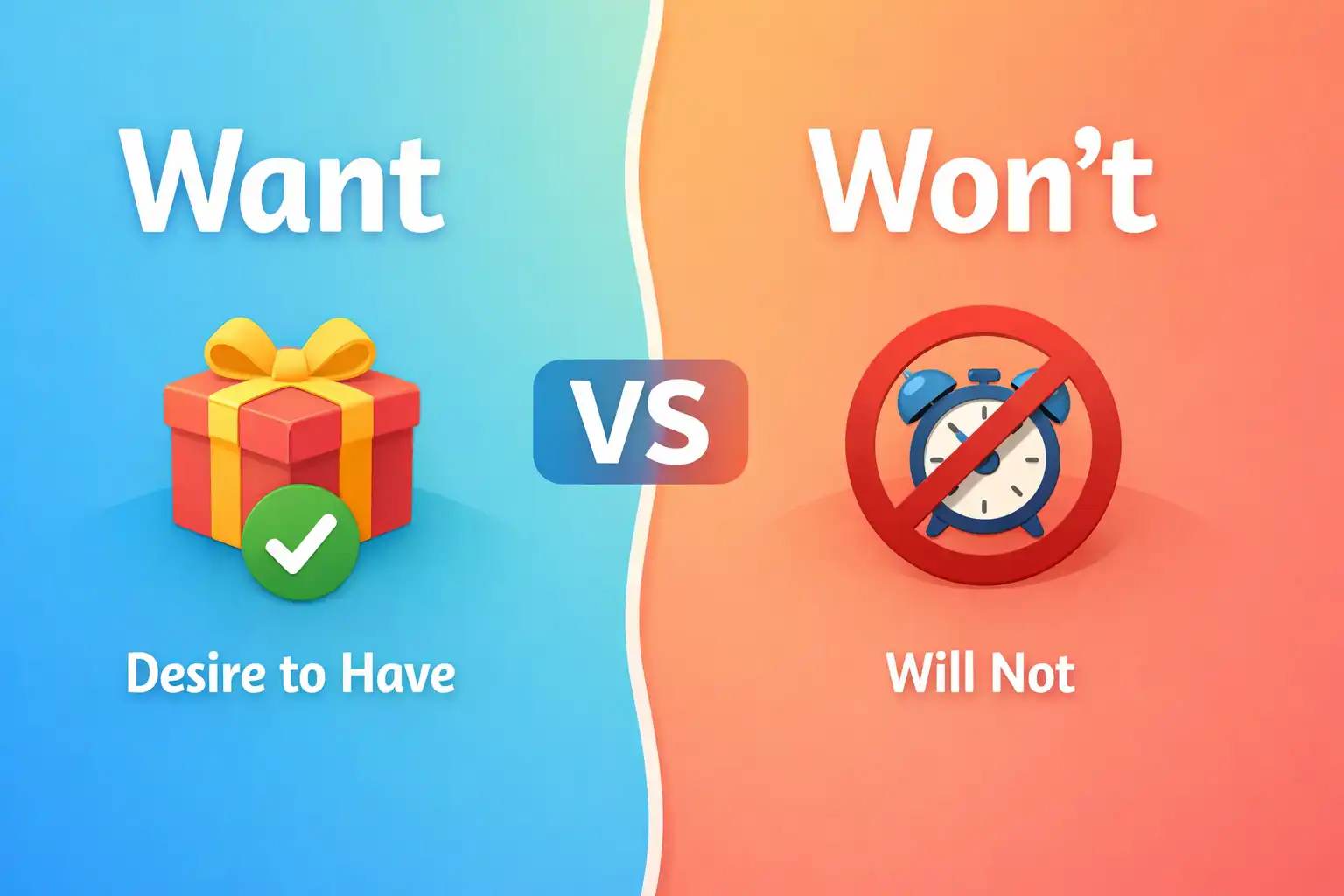
Want Meaning: Want means to desire or wish for something.
Won’t Meaning: Won’t means will not. It shows refusal or future negative action.
Key difference:
• Want = desire or need
• Won’t = contraction of will not
Examples:
• I want a cup of tea.
• She won’t come to the meeting.
• They want more time, but the manager won’t allow it.
Easy rule:
Use want for desire. Use won’t when something will not happen.
The Origin of Want vs Won’t
Understanding the origin helps explain why these words are so different.
The word want comes from Old Norse and Old English influences. In early English, it meant “to lack” or “to need.” Over time, the meaning shifted. Today, want usually means a strong wish or desire.
Example from older usage:
“The plant wants water.”
This means the plant needs water.
Now the word mainly shows desire:
• I want a new phone.
• She wants to learn English.
The word won’t has a different history. It is a contraction of will not. Contractions became common in spoken English because they make sentences shorter and faster to say.
Examples:
• will not → won’t
• do not → don’t
• cannot → can’t
However, won’t is special. It does not follow the usual pattern. Instead of “willn’t,” English speakers gradually changed the sound to won’t.
Today, the word won’t simply means will not.
Examples:
• I won’t go there.
• He won’t answer the question.
• The system won’t start.
So the confusion exists because want and won’t look similar, but their origins and meanings are completely different.
British vs American English Spelling
When learners compare English words, they often ask if spelling changes between British and American English.
In the case of want vs won’t, there is no spelling difference between British and American English.
Both regions use the same forms:
• want
• won’t
The meaning and grammar also stay the same.
Small pronunciation differences may appear in spoken English. For example, British speakers may pronounce won’t slightly softer. American speakers may stress the “o” sound more. However, the spelling remains identical.
Quick comparison:
Word | British English | American English
want | want | want
won’t | won’t | won’t
Therefore, the confusion is not related to regional spelling. It usually happens because readers miss the apostrophe in won’t or read the word too quickly.
How to Choose the Right Word Fast
Choosing between want and won’t is simple once you know the rule.
First, ask what the sentence means.
If the sentence shows desire or need, use want.
Examples:
• I want coffee.
• She wants a better job.
• They want to travel.
If the sentence shows refusal or negative future action, use won’t.
Examples:
• I won’t go there.
• He won’t agree with the plan.
• The door won’t open.
Audience guidance:
US English
Use both words exactly the same way.
UK / Commonwealth English
Usage stays identical.
Global writing or professional communication
The difference depends only on meaning, not location.
Quick check rule:
If you can replace the word with will not, the correct word is won’t.
Example:
“She won’t attend the meeting.”
“She will not attend the meeting.”
If the replacement does not work, the correct word is want.
Common Mistakes with Want vs Won’t
Writers often confuse these words when typing quickly. Editors frequently see these mistakes in emails and messages.
Here are common errors.
❌ I won’t a new laptop.
✅ I want a new laptop.
Explanation: The sentence expresses desire, not refusal.
❌ I want help you tomorrow.
✅ I won’t help you tomorrow.
Explanation: The sentence shows refusal.
❌ She want come today.
✅ She won’t come today.
Explanation: Use won’t because the action will not happen.
❌ They won’t more information.
✅ They want more information.
Explanation: The sentence expresses a need.
A simple trick helps prevent mistakes. Always check if the sentence talks about desire or future refusal.
Want vs Won’t in Real Life Examples
These words appear often in everyday communication.
Email example
Correct:
“I want to discuss the project tomorrow.”
“I won’t be available after 5 PM.”
Here the first sentence shows intention. The second shows a negative future action.
News example
“Citizens want better public services.”
“The government won’t change the policy this year.”
Social media example
“I want pizza tonight.”
“My computer won’t update again!”
Professional writing
“Many employees want flexible working hours.”
“The company won’t release the report yet.”
In each case, the meaning changes completely depending on the word used.
Want vs Won’t – Word Usage Patterns and Search Trends
Search interest for want vs won’t usually comes from students, ESL learners, and new English writers. The confusion happens because both words appear often in everyday speech.
Students learning contractions often struggle with won’t. It does not look like “will not,” so the connection feels unclear at first.
Meanwhile, beginners sometimes misread won’t as want when they read quickly.
A real-world example shows why the difference matters.
Imagine an email from a manager:
“I want to approve this request.”
The sentence sounds strange and confusing. The correct sentence should be:
“I won’t approve this request.”
Now the meaning becomes clear. The request will not be approved.
Because small mistakes like this change meaning, writers frequently search for this comparison.
Want vs Won’t Comparison Table
Feature | Want | Won’t
Meaning | Desire or wish | Will not
Part of Speech | Verb | Contraction of auxiliary verb phrase
Context of Use | Expressing desire, need, or preference | Expressing refusal or negative future action
Formal vs Informal | Neutral in all writing | Slightly informal but widely accepted
Common Mistake | Used when refusal is intended | Used when desire is intended
Correct Example | I want more information. | I won’t attend the meeting.
This table helps remove confusion quickly. If the sentence expresses desire, use want. If the sentence means will not, use won’t.
FAQs About Want vs Won’t
Is want the same as won’t?
No. Want expresses desire. Won’t means will not and shows refusal or negative future action.
Can want and won’t be used interchangeably?
No. The meanings are completely different. Using the wrong word changes the meaning of the sentence.
Which one is correct in formal writing?
Both are correct. However, some formal documents may use will instead of won’t.
Why do people confuse want and won’t?
They look similar when written and may sound close in fast speech. The apostrophe in won’t is also easy to miss.
Can grammar tools catch this mistake?
Sometimes. However, grammar tools may miss the error if the sentence still looks grammatically correct.
Is there a British vs American difference?
No. Both British and American English use want and won’t the same way.
Is won’t always a contraction of will not?
Yes. The word won’t always means will not in modern English.
Conclusion
The difference between want vs won’t is simple once you understand their meanings. The word want shows desire, need, or preference. People use it when they wish for something or hope to do something.
In contrast, won’t is a contraction of will not. It shows refusal, denial, or a negative future action. This word tells the reader that something will not happen.
Many learners mix these words because the spelling looks similar. The confusion becomes worse when readers overlook the apostrophe in won’t. However, the meanings remain completely different.
Overall, the best way to avoid mistakes is to check the sentence’s meaning. Ask yourself whether the sentence shows desire or refusal.
In short, remember this simple rule:
Use want for desire. Use won’t for will not.
Once you follow this rule, choosing the correct word becomes easy and clear.

James Holloway writes detailed guides on confusing English words and grammar usage with clear side-by-side comparisons.