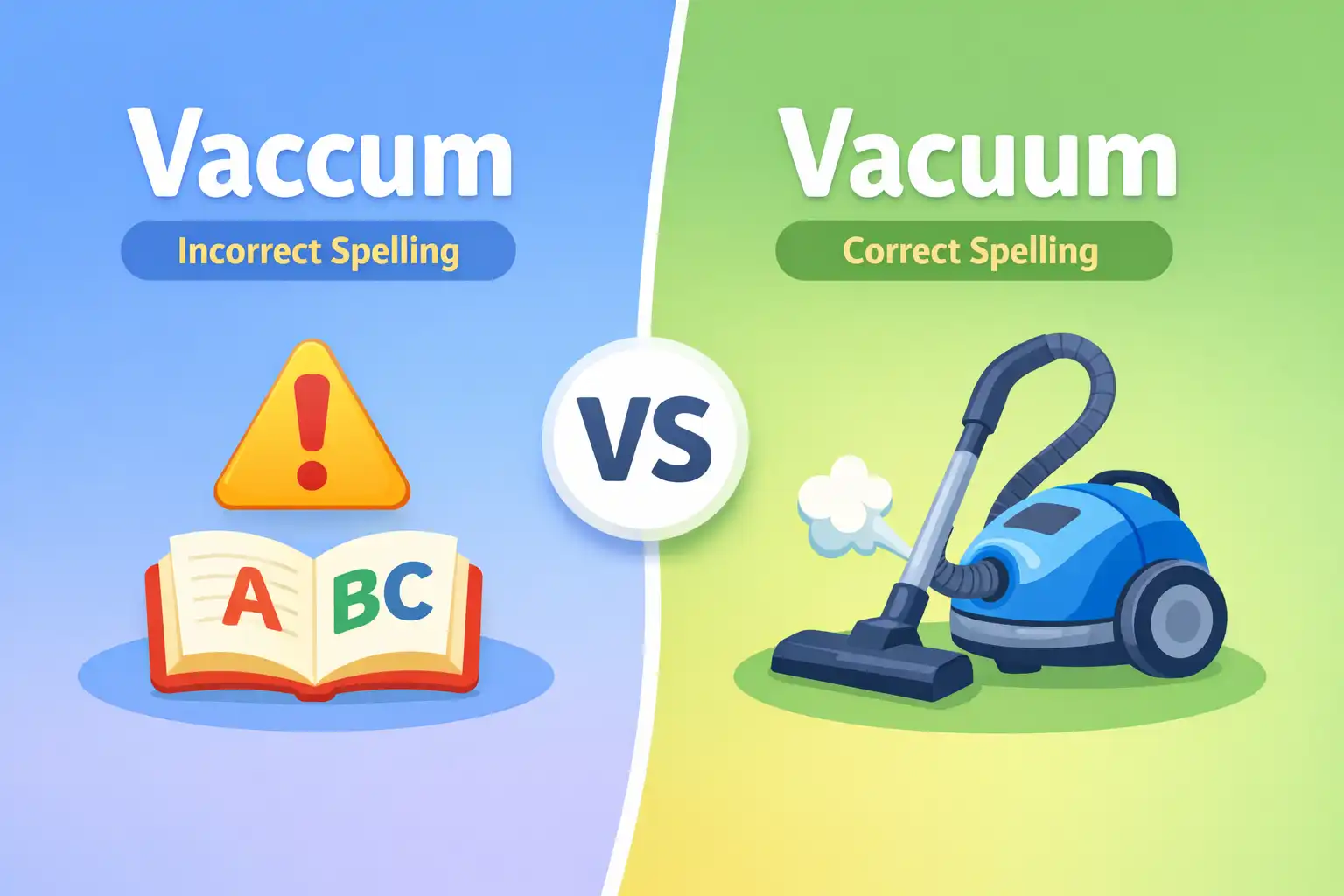
Many people search “vaccum vs vacuum” because they are unsure which spelling is correct. The confusion is common. You often see the word in daily life when talking about cleaning, science, or machines. Yet one missing letter can change everything.
Writers, students, and ESL learners often type “vaccum” by mistake. The error usually happens because the word looks complicated. It has double letters and an unusual sound pattern. As a result, many people guess the spelling and drop one letter. That guess creates the common misspelling.
This small spelling mistake matters more than people think. Spell-check tools may catch it, but sometimes they do not. In professional emails, school assignments, or published writing, the wrong spelling can reduce clarity and credibility.
In this guide, you will learn the real difference between vaccum vs vacuum, why people confuse them, and how to choose the correct spelling quickly. You will also see examples from real life writing so the rule becomes easy to remember.
Vaccum vs Vacuum – Quick Answer
Vacuum is the correct spelling.
Vaccum is a misspelling.
Key points:
- Vacuum means a space with no air or a machine that removes dust.
- Vaccum appears when someone forgets the second “u.”
- It has no meaning in standard English.
Examples:
- I need to vacuum the living room.
- Space is close to a vacuum.
Easy rule: If the word has two “u” letters, the spelling is correct.
The Origin of Vaccum vs Vacuum
The correct word vacuum comes from Latin. It comes from the word “vacuus,” which means empty or void. Early scientists used the term to describe a place where no air exists.
During the 1600s and 1700s, scientists studied the idea of empty space. They used the Latin term when writing about physics experiments. Later, English adopted the spelling vacuum.
The spelling stayed complex because English kept the Latin structure. That structure created the unusual “uu” pattern inside the word.
So where did vaccum come from?
The mistake appears because many English words do not place two “u” letters together. When people type quickly, they often remove one letter without noticing. Over time, this typo became one of the most common spelling errors in English writing.
Editors often report that vacuum appears on lists of the most frequently misspelled words. Students and new writers struggle with it because the pronunciation sounds shorter than the spelling.
British vs American English Spelling
Unlike many English words, vacuum has the same spelling in both British and American English.
Some words change spelling across regions. For example:
| American English | British English |
| color | colour |
| center | centre |
| organize | organise |
However, vacuum never changes.
| Feature | Vacuum |
| American English | vacuum |
| British English | vacuum |
| Correct spelling | vacuum |
| Common error | vaccum |
Therefore, the confusion does not come from regional spelling differences. It comes only from typing or spelling mistakes.
How to Choose the Right Word Fast
Choosing the correct spelling is simple once you know one rule.
Use “vacuum” every time.
Audience guidance:
United States
Professional writing, school papers, and emails always use vacuum.
Example:
The robot vacuum cleans the floor automatically.
UK and Commonwealth countries
The spelling stays exactly the same.
Example:
She bought a new vacuum cleaner yesterday.
Global or professional writing
International publications, news articles, and research papers also use vacuum.
Example:
Scientists tested how plants grow in a vacuum environment.
So the decision is quick: vaccum is never correct.
Common Mistakes with Vaccum vs Vacuum
Writers often make the same small errors. These mistakes usually happen during fast typing.
❌ Incorrect: I need to vaccum the carpet.
✅ Correct: I need to vacuum the carpet.
Explanation: The correct spelling contains two “u” letters.
❌ Incorrect: The vaccum of space is silent.
✅ Correct: The vacuum of space is silent.
Explanation: Scientific writing always uses the standard spelling.
❌ Incorrect: She bought a new vaccum cleaner.
✅ Correct: She bought a new vacuum cleaner.
Explanation: Product names and manuals always use vacuum.
Another mistake appears when writers avoid the word entirely. Some people replace it with phrases like clean the floor just to avoid spelling errors. Learning the correct spelling removes this problem.
Vaccum vs Vacuum in Real Life Examples
The word vacuum appears in many types of writing. Seeing it in real contexts helps make the spelling easier to remember.
Emails
Hi Alex,
Please vacuum the meeting room before the clients arrive.
News writing
Scientists tested how materials behave in a vacuum chamber.
Social media
Finally bought a robot vacuum. Cleaning feels so easy now.
Professional writing
The system removes air to create a vacuum environment for testing electronics.
These examples show that the word appears in both everyday and technical contexts.
Vaccum vs Vacuum – Word Usage Patterns and Search Trends
Online searches show that many users type “vaccum.” This mistake happens often because the word looks complex.
Several groups commonly search this term:
- students writing homework
- ESL learners practicing spelling
- bloggers and content writers
- people typing quickly on phones
Search patterns also show that people usually realize the mistake after seeing a red spelling underline. Then they search “vaccum vs vacuum” to confirm the correct spelling.
A common real-world situation appears in online shopping. Someone may search:
“best vaccum cleaner”
Even though the search engine understands the intent, the correct spelling remains vacuum cleaner.
Misusing the spelling rarely changes meaning, but it can affect professional writing quality.
Vaccum vs Vacuum Comparison Table
| Feature | Vaccum | Vacuum |
| Meaning | No meaning in standard English | Empty space or cleaning machine |
| Part of speech | None | Noun or verb |
| Context of use | Typing mistake | Daily language and science |
| Formal vs informal | Never used | Used in all writing styles |
| Common mistake | Missing second “u” | None |
| Correct example | Incorrect spelling | I need to vacuum the floor |
This table shows clearly that only one word is correct.
Frequently Asked Questions
Is vaccum the same as vacuum?
No. Vacuum is the correct word. Vaccum is simply a spelling mistake.
Which spelling is correct in formal writing?
Formal writing always uses vacuum. Academic papers, books, and news articles follow this spelling.
Can vaccum ever be correct?
No. Standard English dictionaries do not recognize vaccum as a valid word.
Why do people confuse vaccum and vacuum?
The word contains two “u” letters, which looks unusual. Many people drop one letter when typing.
Can grammar tools detect this mistake?
Yes, most spell-check tools flag vaccum as an error. However, some typing systems may miss it during fast writing.
Is there a British vs American difference?
No. Both British and American English use vacuum with the same spelling.
Does vacuum have more than one meaning?
Yes. It can mean empty space without air or a machine that cleans dust from surfaces.
Conclusion
The confusion around vaccum vs vacuum comes from one simple spelling issue. The correct word is vacuum, which includes two “u” letters. The spelling comes from the Latin word vacuus, meaning empty space. Because the spelling looks unusual, many writers accidentally remove one letter and create vaccum.
However, the rule is very clear. Dictionaries, news publications, and professional writing always use vacuum. The spelling does not change between American and British English. That means there is no regional variation to worry about.
Writers often make the mistake when typing quickly or relying on memory instead of checking the spelling. Learning the correct form helps avoid errors in emails, assignments, and online posts.
Overall, the easiest way to remember the rule is simple: vacuum always contains two “u” letters. If one “u” is missing, the spelling is wrong.

James Holloway writes detailed guides on confusing English words and grammar usage with clear side-by-side comparisons.