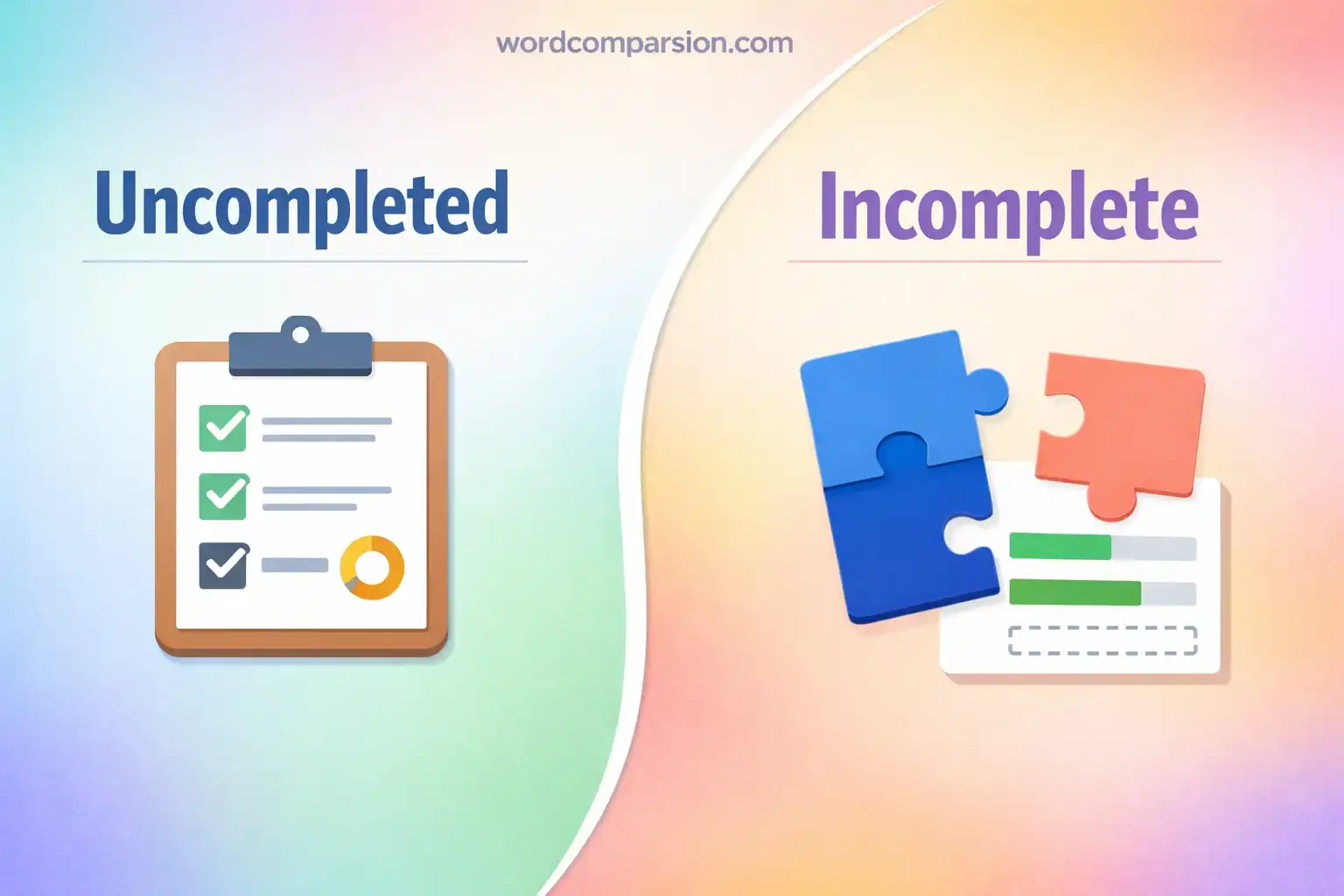
Have you ever wondered about the difference between the words “uncompleted” vs “incomplete”? Even though they seem to mean the same thing—something that isn’t finished—there’s a key difference in how they’re used. Many people, especially beginners or learners of English, often mix up these two words. It’s easy to get confused because both describe something that’s not yet done, but the way we use them is important.
In everyday English, “incomplete” is the word most people prefer. You’ll hear it in everything from emails to news stories. “Uncompleted” is much rarer and tends to sound awkward, especially in modern writing. So, if you’re wondering which word to use, it’s crucial to understand the difference to make your writing clearer and sound more natural.
This article will help clear up that confusion. You’ll learn exactly when to use “incomplete” and when, if ever, “uncompleted” might be okay. We’ll also explore common mistakes people make and give you some easy-to-follow examples. By the end, you’ll be confident in using the right word every time.
Uncompleted vs Incomplete – Quick Answer
People often search uncompleted vs incomplete when they want the correct adjective for unfinished work. Incomplete is the more common and standard word in modern English. You may also see searches like uncomplete or incomplete and incompleted or uncompleted because of grammar confusion.
- Uncompleted means something that is not yet completed. It is rarely used.
- Incomplete means something that is missing parts or not whole. It’s more commonly used.
Example:
- Uncompleted task (a task that has not been finished yet, but this is rarely used).
- Incomplete homework (homework that’s missing some parts, more commonly used).
The Origin of Uncompleted vs Incomplete
Both “uncompleted” and “incomplete” stem from the word “complete.” The word “complete” comes from the Latin “completus,” which means “to fill up or finish.” However, the prefixes “un-” and “in-” change the meaning slightly.
- Un- is a prefix that means “not” or “reverse of.”
- In- also means “not,” but it is often used in more formal situations.
The difference comes from the way these prefixes are traditionally used. While “uncompleted” is technically correct, it’s a bit more unusual. Most writers prefer “incomplete” in everyday and formal contexts.
Reason for Confusion Today
The main reason people mix up “uncompleted” and “incomplete” is because both can refer to something that isn’t finished. This makes it easy to assume they’re interchangeable. The confusion arises because “incomplete” is widely accepted, while “uncompleted” is rarely used.
In fact, editors and grammar experts often prefer “incomplete” over “uncompleted.” It sounds more natural and fits better in formal writing.
British English vs American English Spelling
Interestingly, neither “uncompleted” nor “incomplete” changes spelling between British and American English. Both forms are the same in both versions of English. The only real difference you’ll find here is usage. As mentioned, “incomplete” is far more common.
Quick Example:
- Uncompleted: His uncompleted homework was lying on the desk.
- Incomplete: His incomplete homework was lying on the desk.
As you can see, the words are spelled the same, but “incomplete” flows better and is used more often.
Which Spelling Should You Use?
- Use “incomplete”: This is the more common and accepted form in both British and American English. It’s appropriate for formal writing, emails, news, and everyday speech.
- Use “uncompleted” only in specific, rare cases: You might find this used in more technical or historical contexts.
If you’re unsure, “incomplete” is the safe and widely accepted choice.
Common Mistakes with Uncompleted vs Incomplete
Many learners mix these words because they feel similar, but here are some common errors:
❌ Incorrect → ✅ Correct format:
- Uncompleted homework → Incomplete homework
- Uncompleted building → Incomplete building
- Uncompleted task → Incomplete task
These are all examples where “incomplete” is the correct word to use. It’s important to avoid “uncompleted” because it sounds awkward and outdated.
Uncompleted vs Incomplete in Everyday Examples
Let’s look at some practical examples to understand the difference better.
1. Emails:
- Uncompleted: “Please send your uncompleted form back.”
- Incomplete: “Please send your incomplete form back.”
Here, “incomplete” sounds better and is easier to understand.
2. News:
- Uncompleted: “The construction of the bridge uncompleted.”
- Incomplete: “The construction of the bridge is incomplete.”
“Incomplete” is the preferred choice for news writing.
3. Social Media:
- Uncompleted: “My uncompleted project needs to be finish.”
- Incomplete: “My incomplete project needs to finish.”
Again, “incomplete” feels more natural here.
4. Formal or Professional Writing:
- Uncompleted: “The uncompleted research was presented at the meeting.”
- Incomplete: “The incomplete research was presented at the meeting.”
“Incomplete” sounds better and is more common in formal writing.
Uncompleted vs Incomplete – Usage Patterns & Search Interest
The term “incomplete” is much more popular in search interest. It’s the word most people use when they’re talking about something that is unfinished.
For example, students often use “incomplete” to describe homework or assignments that aren’t finished. This word is also common in technical and academic contexts.
On the other hand, “uncompleted” is much less common and is typically found only in older texts or very specific cases. It’s a word that often confuses learners, especially those trying to find synonyms for “incomplete.”
Comparison Table(uncompleted vs incomplete)
| Aspect | Uncompleted | Incomplete |
| Meaning | Not yet finished | Missing parts, not whole |
| Part of Speech | Adjective | Adjective |
| Context of Use | Rarely used | Common in everyday speech and writing |
| Formal vs Informal | More formal | Can be both formal and informal |
| Common Mistakes | Incorrectly used as a synonym for “incomplete” | Used correctly in most situations |
| Correct Example | The uncompleted work was left on the desk. | The incomplete work was left on the desk. |
Semantic FAQs (uncompleted vs incomplete)
Which one is correct in formal writing?
Incomplete is the correct word for formal writing.
Is there a British vs American difference?
No, there’s no difference in spelling or usage between British and American English for these words.
Uncompleted or incomplete which is correct
Incomplete is usually the best and most standard choice.
Uncomplete or incomplete which should I use
Use incomplete because uncomplete is uncommon and often treated as non standard.
Incompleted or uncompleted which is correct
Neither is common and most writers choose incomplete instead.
Not complete or incomplete what is better
Incomplete is the natural single word choice for most contexts.
Incomplete building or uncompleted building which sounds correct
Incomplete building is more natural in modern English.
Conclusion
In short, the key takeaway is this: “Incomplete” is the word you should use in nearly every situation. It’s the more common, correct, and widely accepted choice in both informal and formal contexts. “Uncompleted” rarely used and should avoided unless you’re dealing with technical or outdated language.
Remember, to avoid confusion, always use “incomplete” to describe something that isn’t finish. It’s simple, clear, and the best choice for most contexts.

James Holloway writes detailed guides on confusing English words and grammar usage with clear side-by-side comparisons.