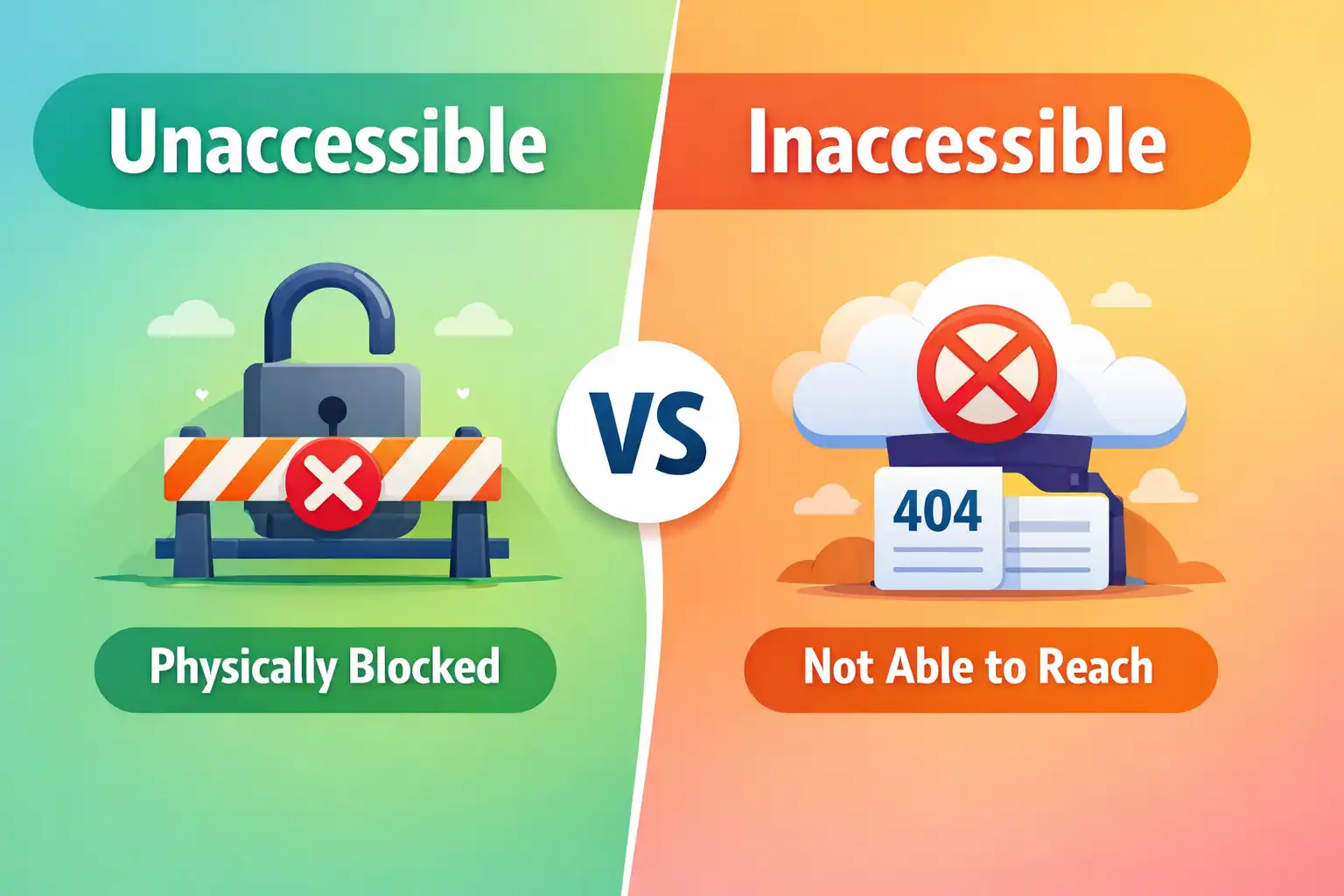
Many people search “unaccessible vs inaccessible” because both words look logical. At first glance, they seem the same. Each appears to mean something that cannot be reached or used. Because of this, students and writers often use unaccessible by mistake.
However, English does not treat these words equally. One form is widely accepted. The other appears mostly as an error or a rare historical variant.
Editors often see this confusion in essays, emails, and online posts. ESL learners also struggle because English has many prefixes like un- and in- that look similar.
So the question becomes simple: Which word should you actually use?
This guide explains the difference in very clear language. You will learn:
- The real meaning of both words
- Why people confuse them
- Which spelling is correct in modern English
- How writers and professionals use the word today
By the end, you will know the easy rule that removes the confusion forever.
Unaccessible vs Inaccessible – Quick Answer
Inaccessible means something cannot be reached, used, or understood.
Unaccessible appears logical but is not standard English. Most dictionaries and editors treat it as incorrect or obsolete.
Key points:
- Correct word: inaccessible
- Avoid using: unaccessible
- Meaning: something difficult or impossible to reach
Examples:
- The mountain area is inaccessible during winter.
- The website became inaccessible after the server failed.
- The old files were inaccessible without a password.
Easy rule: If you mean “not easy to reach,” always use inaccessible.
The Origin of Unaccessible vs Inaccessible
Understanding the history helps explain the confusion.
The word accessible comes from the Latin word accessus. It means “a way to approach” or “a way to reach something.”
English added prefixes to change its meaning.
- Accessible → easy to reach
- Inaccessible → not easy to reach
The prefix in- often creates the negative form in English. For example:
- complete → incomplete
- visible → invisible
- correct → incorrect
So the word inaccessible formed naturally and became standard.
However, English also uses the prefix un- in many negatives, such as:
- happy → unhappy
- fair → unfair
Because of this pattern, some people assume unaccessible should also work.
Historically, the word unaccessible appeared in a few texts centuries ago. Yet it never became common. Over time, dictionaries and style guides chose inaccessible as the correct form.
Today, editors and grammar tools strongly prefer inaccessible.
British vs American English Spelling
In many word comparisons, British and American English use different spellings. Examples include:
- color vs colour
- organize vs organise
However, unaccessible vs inaccessible does not follow this pattern.
Both American and British English agree on the same spelling.
The correct form in both varieties is inaccessible.
| Feature | Inaccessible | Unaccessible |
| Standard spelling | Yes | No |
| Used in US English | Yes | Rare / incorrect |
| Used in UK English | Yes | Rare / incorrect |
| Dictionary acceptance | Yes | Usually rejected |
Example sentences:
US English
The remote village is inaccessible by car.
UK English
The documents remained inaccessible without permission.
In contrast, unaccessible rarely appears in modern professional writing.
How to Choose the Right Word Fast
Choosing the correct word is simple once you know the rule.
For US writing
Use inaccessible in all cases. American style guides and dictionaries support this spelling.
Example
The data became inaccessible after the system update.
For UK and Commonwealth writing
The same rule applies. British English also prefers inaccessible.
Example
The island is inaccessible during storms.
For global or professional writing
Use inaccessible in emails, reports, research papers, and websites.
Professional editors avoid unaccessible because it looks like a spelling mistake.
Quick decision rule:
If you mean “not easy to reach or use,” choose inaccessible every time.
Common Mistakes with Unaccessible vs Inaccessible
Writers often create mistakes because they apply normal prefix patterns.
Here are some frequent errors.
❌ Incorrect
The building became unaccessible after the earthquake.
✅ Correct
The building became inaccessible after the earthquake.
Explanation: English already has the correct negative form inaccessible.
Another mistake appears in digital writing.
❌ Incorrect
The page is unaccessible right now.
✅ Correct
The page is inaccessible right now.
Writers also confuse the word when talking about people.
❌ Incorrect
The manager is unaccessible to staff.
✅ Correct
The manager is inaccessible to staff.
In this context, the word means someone is difficult to approach.
Editors usually correct these errors during proofreading because unaccessible looks unprofessional.
Unaccessible vs Inaccessible in Real Life Examples
Understanding real situations helps make the meaning clear.
Email communication
Correct example
The shared drive is inaccessible until the IT team restores the server.
News reporting
Correct example
Heavy snow made several mountain roads inaccessible overnight.
Social media
Correct example
The game servers are inaccessible after the update.
Professional writing
Correct example
Certain files remain inaccessible without security clearance.
The word also appears in discussions about digital accessibility.
Example
Images without text descriptions can make a website inaccessible to screen readers.
In contrast, professional writing almost never uses unaccessible.
Unaccessible vs Inaccessible – Word Usage Patterns and Search Trends
Search trends show an interesting pattern.
Many people type “unaccessible vs inaccessible” because the first word sounds correct. The prefix un- feels natural to English learners.
Students and ESL learners search this comparison often. They want to confirm which spelling works.
However, writers, editors, and journalists use inaccessible almost exclusively.
Grammar tools also flag unaccessible as an error.
A real-world confusion often happens in digital work.
For example, a developer may write:
“The page is unaccessible.”
Readers may think it is a typo or poor grammar. This small mistake can reduce trust in professional content.
So choosing the correct spelling helps writing look clear and reliable.
Quick Comparison Table
| Feature | Inaccessible | Unaccessible |
| Meaning | Not reachable, usable, or understandable | Intended to mean the same |
| Part of speech | Adjective | Adjective (rare variant) |
| Correct in modern English | Yes | No |
| Common usage | Writing, news, academic text | Mostly spelling mistake |
| Formal writing | Accepted | Avoid |
| Typical mistake | None | Used instead of inaccessible |
| Correct example | The road is inaccessible after the storm. | Not recommended |
This table shows the main point clearly: inaccessible is the standard word.
Frequently Asked Questions
Is unaccessible the same as inaccessible?
People often intend the same meaning. However, unaccessible is not standard English, while inaccessible is correct.
Which word is correct in formal writing?
Formal writing always uses inaccessible. Editors and style guides avoid unaccessible.
Can the two words be used interchangeably?
No. Modern English treats inaccessible as the correct form. Using unaccessible may appear as a spelling mistake.
Why do people confuse these words?
English uses both un- and in- prefixes for negatives. Because of this pattern, learners assume unaccessible should exist.
Can grammar tools detect this mistake?
Yes. Most grammar checkers flag unaccessible and suggest inaccessible.
Is there a British vs American difference?
No. Both British and American English use inaccessible.
Does unaccessible appear in dictionaries?
Some dictionaries mention it as a rare or obsolete variant. However, they still recommend inaccessible.
Conclusion
The confusion between unaccessible vs inaccessible comes from normal English prefix patterns. Since words like unhappy and unfair exist, many people assume unaccessible should also work.
However, modern English follows a different rule here.
The correct and accepted word is inaccessible. It means something cannot be reached, used, or approached easily.
You will see this spelling in news articles, academic writing, professional emails, and official documents. Editors and dictionaries support it consistently.
On the other hand, unaccessible rarely appears in modern writing. Most style guides treat it as an incorrect or outdated form.
Overall, the easiest rule to remember is simple:
If you want to describe something that cannot be reached, always use “inaccessible.”
This small choice keeps your writing clear, correct, and professional.

James Holloway writes detailed guides on confusing English words and grammar usage with clear side-by-side comparisons.