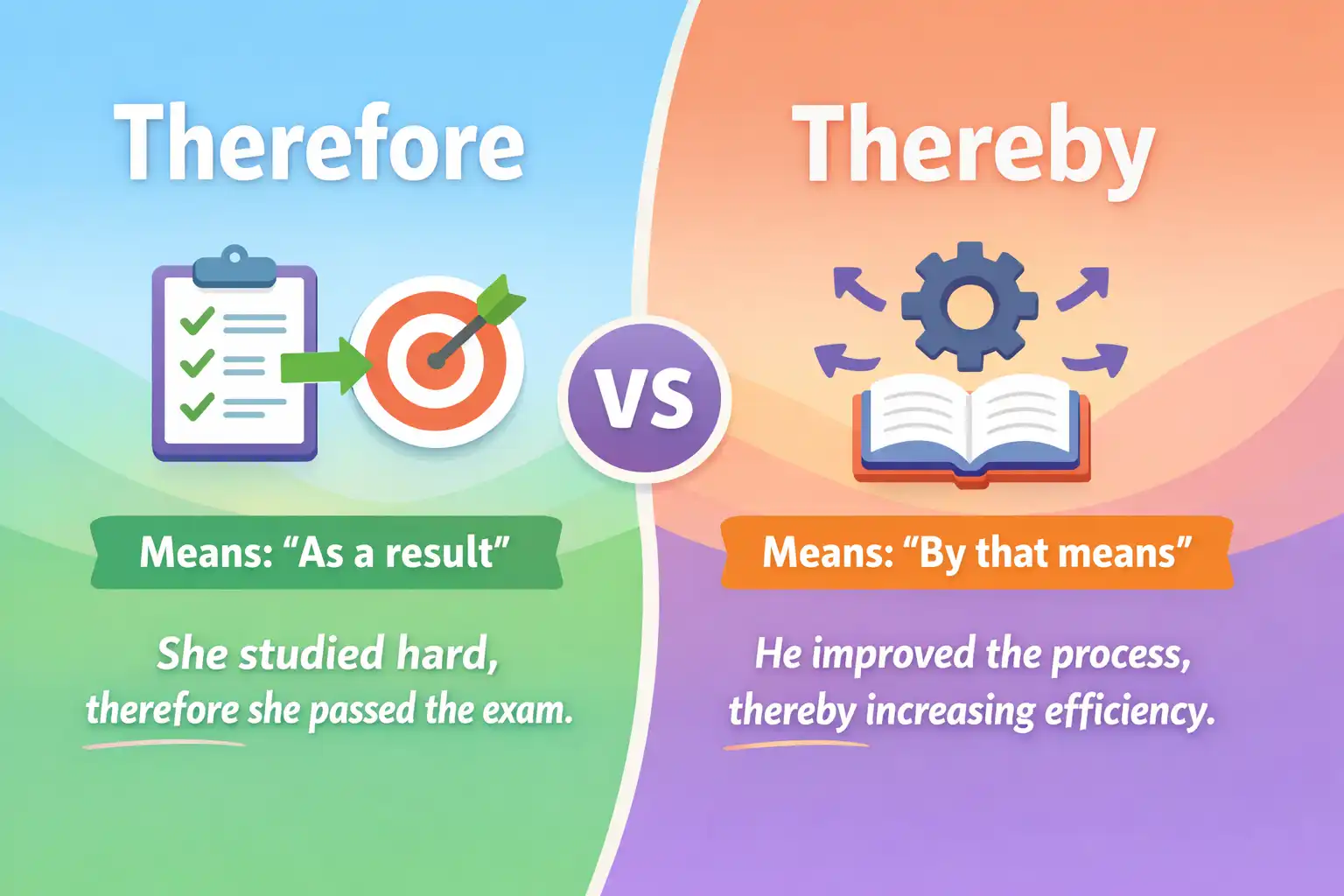
Many writers pause at therefore vs thereby and feel unsure. The words look alike. They sound formal. They often appear in exams, emails, and reports. But they do not mean the same thing. Small mistakes here can change meaning fast.
This confusion happens because both words point to results. But one shows a logical conclusion, and the other shows a method or effect. Mix them up, and your sentence feels wrong or unclear.
In this guide, you will learn the clear difference. You will see simple rules, short examples, and real uses. You will also learn common mistakes to avoid. By the end, you will know when to use each word with confidence. And you will remember one easy rule that works every time.
Therefore vs Thereby – Quick Answer
- Therefore shows a result or conclusion.
- Thereby shows how an action causes a result.
Examples
- It rained all day; therefore, the game stopped.
- She signed the form, thereby approving the plan.
Easy rule
- Ask “Why?” → use therefore
- Ask “How?” → use thereby
The Origin of Therefore vs Thereby (Simple History)
Both words come from Old English. Therefore comes from “there” + “for,” meaning for that reason. It points to logic and conclusions.
Thereby comes from “there” + “by,” meaning by that action. It points to method or cause.
Over time, both words stayed formal. Writers used them in law, study, and reports. Today, they still appear in serious writing, which adds to the confusion.
Reason for confusion today
People often use therefore when they want to sound smart. Others use thereby without checking meaning. Also, both words connect ideas, so they feel similar. But their roles are different.
British English vs American English Spelling
There is no spelling difference in British or American English.
- Therefore is spelled the same everywhere.
- Thereby is spelled the same everywhere.
The real difference is usage, not spelling.
Short examples
- US or UK: He was late; therefore, he missed the train.
- US or UK: She pressed save, thereby keeping her work.
Quick note
Focus on meaning and tone, not region.
How to Choose the Right Word Fast
US
Use therefore for clear logic in essays and reports. Use thereby only when showing cause by action.
UK / Commonwealth
The rule stays the same. British writing may use thereby more in formal documents, but meaning does not change.
Global or professional writing
Both words are formal. If clarity matters, use therefore more often. Use thereby only when it clearly fits.
If spelling does not vary, focus on tone and meaning, not region.
Common Mistakes with therefore vs thereby
Frequent errors
- Using thereby to mean “so”
- Using therefore to explain a method
❌ Incorrect → ✅ Correct
- ❌ He forgot his password, thereby he could not log in.
✅ He forgot his password; therefore, he could not log in. - ❌ She clicked the link, therefore opening the file.
✅ She clicked the link, thereby opening the file.
Why this happens
Writers confuse result with method. Fix this, and the error disappears.
Therefore vs Thereby in Everyday Examples
Emails
- The file is missing; therefore, I cannot send it.
- You approved the draft, thereby moving the project forward.
News
- The vote failed; therefore, the bill ends.
- The law changed, thereby affecting small firms.
Social media
- I forgot my charger, therefore no phone today.
- He shared the post, thereby spreading the news.
Formal or professional writing
- Costs rose; therefore, profits fell.
- The company merged teams, thereby reducing delays.
Therefore vs Thereby– Usage Patterns & Search Interest
Both terms appear often in education and work writing. Therefore is more common. Students, ESL learners, and professionals search it often because it appears in exams and reports.
Thereby appears less. Lawyers, researchers, and formal writers use it more.
Real-world confusion
In contracts, using therefore instead of thereby can change meaning. One shows logic. The other shows action effect. This can cause serious misunderstanding.
Comparison Table
| Feature | Therefore | Thereby |
| Meaning | As a result; for that reason | By that action; in that way |
| Part of speech | Adverb | Adverb |
| Context of use | Logic, conclusions | Method, cause by action |
| Formal vs informal | Formal but common | Very formal |
| Common mistakes | Used for method | Used for conclusion |
| Correct example | It was late; therefore, we left. | He signed, thereby agreeing. |
People Also Ask (FAQs)
What is the difference between thereby and thus?
Thus means “in this way” or “so.” Thereby shows cause by action. They are close but not the same.
Where do we use thereby?
Use thereby when one action directly causes another result.
What is the difference between therefore and thereof?
Therefore means “for that reason.” Thereof means “of that thing.” They serve different roles.
What is the difference between thus and therefore?
Thus can show method or result. Therefore shows only logical result.
When to use therefore vs thereby?
Use therefore for conclusions. Use thereby for cause by action.
When should I use therefore?
Use therefore when you explain why something happened.
Is therefore the same as thereby?
No. One shows reason. The other shows method.
Which one is correct in formal writing?
Both are correct. Choose based on meaning, not formality.
Conclusion
Overall, therefore vs thereby is not about style. It is about meaning. Therefore shows a logical result. Thereby shows how an action creates a result. This small difference matters in clear writing.
The biggest mistake is using thereby as a fancy word for “so.” Avoid that. Always check what your sentence answers.
In short, remember this rule:
Reason = therefore. Action effect = thereby.
Finally, ask one question before you choose. If you ask why, use therefore. If you ask how, use thereby. That rule never fails.

James Holloway writes detailed guides on confusing English words and grammar usage with clear side-by-side comparisons.