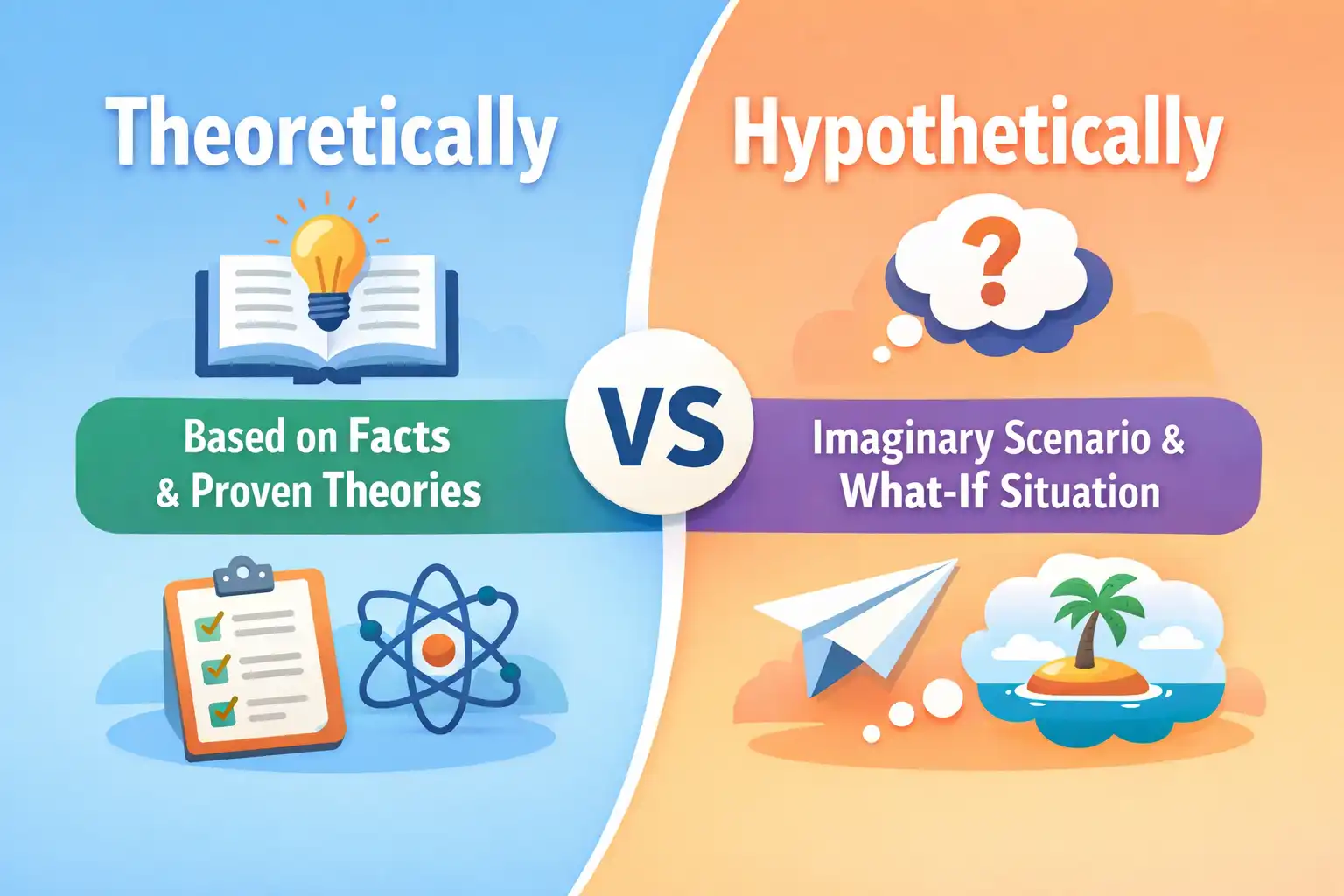
Many learners mix up theoretically and hypothetically. The words look similar, so people often use them in the wrong place. This creates confusion in emails, essays, and even daily talk. For example, some writers use hypothetically when they actually mean a fact based on theory. Others use it theoretically when they are only imagining a situation.
This matters because the two words show different levels of truth. One is about ideas backed by theory. The other is about imagined situations. If you use the wrong one, your meaning can change.
In this guide, you will learn the clear difference, simple rules, and real examples. You will also see common mistakes and how to avoid them. By the end, you will know exactly when to use each word with confidence.
Theoretically vs Hypothetically – Quick Answer
- Theoretically means something is true based on theory or logic
- Hypothetically means something is imagined or assumed, not real
- Use theoretically for facts from ideas
- Use hypothetically for “what if” situations
Meaning of Theoretically
- Based on theory, logic, or known principles
- Often used when something should work in theory
Examples:
- The plan should work theoretically.
- This machine can theoretically save time.
Meaning of Hypothetically
- Based on an imagined situation
- Used when something is not real but possible
Examples:
- Hypothetically, what if we move the office?
- If you had more time, hypothetically, what would you do?
The Origin of Theoretically vs Hypothetically
The word theoretically comes from the word “theory.” A theory is an idea supported by logic or study. So, this word connects to knowledge and reasoning.
On the other hand, hypothetically comes from “hypothesis.” A hypothesis is an assumption made for testing. It is not proven yet. It is just a possible idea.
Because both words come from academic roots, they sound formal. That is why many learners confuse them today. Also, both words relate to ideas, not direct facts, which makes the confusion stronger.
British vs American English Spelling
There is no spelling difference between British and American English for these words. Both use:
- Theoretically
- Hypothetically
So, the confusion is not about spelling. It is about meaning and usage.
Quick examples:
- UK: This could theoretically work.
- US: This could hypothetically happen.
The spelling stays the same, but the meaning changes based on context.
How to Choose the Right Word Fast
Choosing the correct word is simple if you follow one rule.
- Use theoretically when something is based on logic or known ideas
- Use hypothetically when you are imagining a situation
For different audiences:
- US: Same rule applies in both formal and casual writing
- UK / Commonwealth: Also follows the same usage
- Global or professional writing: Use carefully, because these words affect clarity
If there is no real theory behind your statement, do not use it theoretically.
If you are not imagining a situation, do not use it hypothetically.
Common Mistakes with Theoretically vs Hypothetically
Writers often mix these words in daily use. Here are common errors:
❌ Hypothetically, this system works well
✅ Theoretically, this system works well
Explanation: This is based on logic, not imagination
❌ Theoretically, what if we change the plan?
✅ Hypothetically, what if we change the plan?
Explanation: This is an imagined situation
❌ The idea is hypothetically correct
✅ The idea is theoretically correct
Explanation: The idea is based on theory
❌ Theoretically, if I were rich
✅ Hypothetically, if I were rich
Explanation: This is a “what if” case
Theoretically vs Hypothetically in Real Life Examples
Emails:
- The project can theoretically finish in two weeks
- Hypothetically, if we delay, costs may rise
News:
- The policy could theoretically improve growth
- Hypothetically, a crisis may occur if supply drops
Social Media:
- This app should theoretically save time
- Hypothetically, imagine working only 4 days
Professional Writing:
- The model is theoretically sound
- Hypothetically, results may change under pressure
Theoretically vs Hypothetically – Word Usage Patterns and Search Trends
These words are common in academic writing, business communication, and discussions. Students and ESL learners search this topic often because the difference is not obvious.
Theoretically it is more common in science, research, and formal writing.
Hypothetically appears more in discussions, debates, and casual talk.
A common real-world issue happens in meetings. For example, someone says:
“Hypothetically, this plan will work.”
This can confuse others. Are they imagining or explaining a logical idea? This small mistake can lead to unclear communication.
Comparison Table: Theoretically vs Hypothetically
| Feature | Theoretically | Hypothetically |
| Meaning | Based on theory or logic | Based on imagination |
| Part of Speech | Adverb | Adverb |
| Context | Facts, research, systems | “What if” situations |
| Formal Usage | Common in formal writing | Used in both formal and informal |
| Common Mistake | Used for imagined cases | Used for logical facts |
| Example | This should work theoretically | Hypothetically, what if it fails |
FAQs
Is theoretically the same as hypothetically?
No. Theoretically it is based on logic. Hypothetically it is based on imagination.
Which one is correct in formal writing?
Both are correct, but use them carefully based on meaning.
Can they be used interchangeably?
No. They have different purposes and should not replace each other.
Why do people confuse them?
Because both relate to ideas and sound similar.
Can grammar tools catch this mistake?
Sometimes, but not always. You must understand the meaning.
Is there a British vs American difference?
No. Both words are the same in spelling and usage.
Which is more common in daily speech?
Hypothetically is more common in casual talk.
Conclusion
The difference between theoretically and hypothetically is simple once you understand the core idea. One deals with logic and theory, while the other deals with imagination.
Use theoretically when something should be true based on known ideas. Use hypothetically when you are asking or explaining a “what if” situation. This small difference can improve your clarity in writing and speaking.
Writers often confuse these words because they seem similar. However, the meaning changes your message. So, choosing the right one matters.
Overall, remember one easy rule:
If it is based on logic, use it theoretically. If it is imagined, use it hypothetically.